
UBA Grama Sabha Meeting 2026: Powerful Step Towards Rural Development


Report on UBA Grama Sabha Meeting at Kulaiyankarisal Village
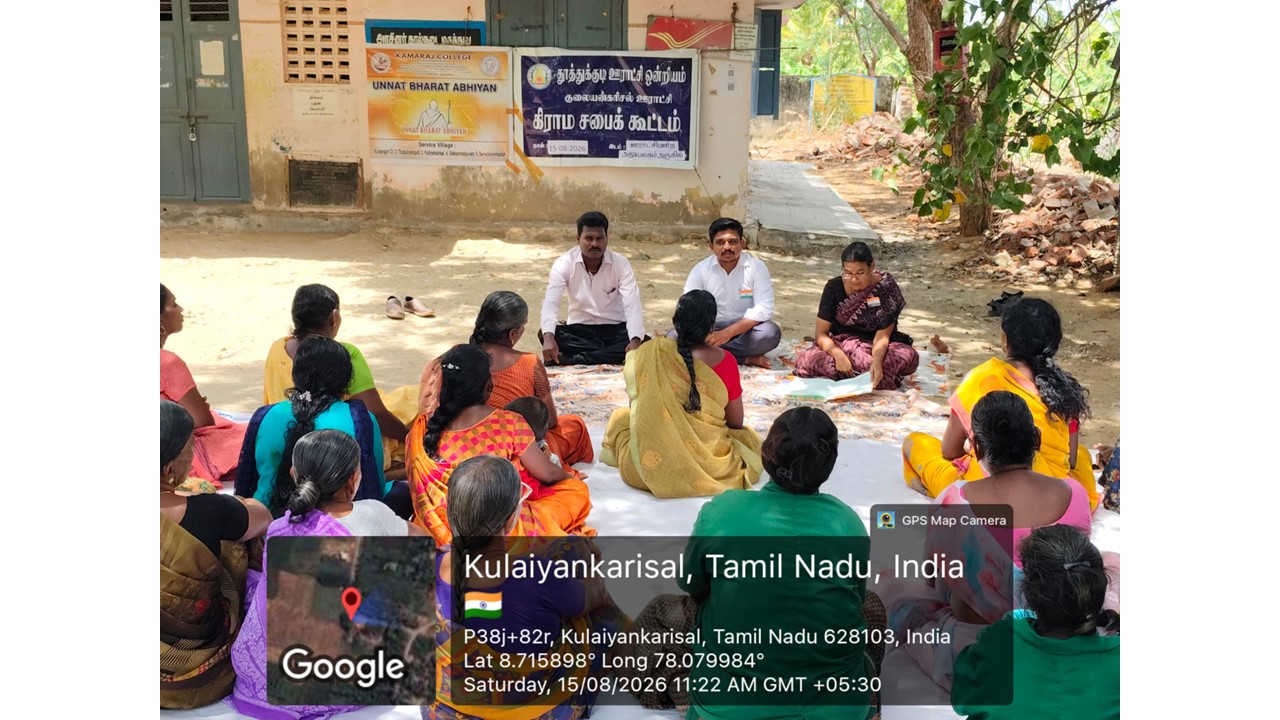
UBA Grama Sabha Meeting participation was undertaken by the Unnat Bharat Abhiyan (UBA) Cell of Kamaraj College (Autonomous), Thoothukudi, at Kulaiyankarisal Village Panchayat on 15 August 2026. Dr. P. Pounraj, UBA Coordinator, along with UBA student volunteers, actively participated in the meeting and interacted with Panchayat representatives and local residents.
The meeting provided an important platform for the UBA team to understand the developmental needs of the village directly from the community. Moreover, it enabled the students to gain practical exposure to rural governance and community participation.
Objectives of the UBA Grama Sabha Meeting
The UBA Grama Sabha Meeting participation aimed to strengthen the relationship between the institution and the village community while identifying areas that require attention.
The key objectives included:
- Understand the developmental needs of the village
- Interact directly with Panchayat representatives and residents
- Identify basic civic and environmental concerns
- Explore opportunities for community-based initiatives
- Provide students with practical exposure to rural development
- Promote active community participation
- Strengthen the institution-village partnership under UBA
Thus, participation in the Grama Sabha created a valuable connection between academic involvement and grassroots development.
Interaction with the Village Community
During the meeting, Dr. P. Pounraj and the UBA student volunteers interacted with Panchayat representatives and residents of Kulaiyankarisal.
The villagers shared their experiences, suggestions and concerns regarding various local issues. Furthermore, the interaction helped the UBA team understand community priorities from the perspective of the people who experience these challenges in their daily lives.
The volunteers carefully listened to the residents and observed the major areas that may require further attention.
Identifying Village Development Needs
The UBA Grama Sabha Meeting covered several important issues related to village development and basic civic amenities.
The community discussed concerns related to:
- Drinking water
- Sanitation and cleanliness
- Drainage facilities
- Road infrastructure
- Streetlights
- Waste management
- Environmental protection
- Health and hygiene
- Other basic civic amenities
These discussions helped the UBA team develop a clearer understanding of the practical challenges faced by the village community.
Exploring Community Development Initiatives
Based on the interaction, the UBA Coordinator and student volunteers discussed possible areas where the institution could support the village through appropriate community-oriented activities.
Potential initiatives discussed included:
- Community awareness programmes
- Village cleanliness drives
- Environmental awareness activities
- Health and hygiene awareness initiatives
- Tree planting and environmental conservation
- Waste management awareness
- Other need-based community development activities
Moreover, the discussion emphasized the importance of designing activities according to the actual needs of the community.
Practical Learning for UBA Student Volunteers
Participation in the UBA Grama Sabha Meeting provided valuable experiential learning for the student volunteers.
Instead of learning about rural development only through academic discussions, students had an opportunity to observe local governance and community participation directly. As a result, they gained a better understanding of how village-level issues are discussed and how local communities participate in decision-making.
The experience also helped students understand that successful rural development requires communication, cooperation and active participation from different stakeholders.
Understanding Local Governance
The Grama Sabha provided students with direct exposure to the functioning of grassroots democracy.
Through their participation, the volunteers gained awareness of how local residents raise concerns, communicate their needs and participate in discussions regarding village development.
Furthermore, the experience strengthened their understanding of the role of Panchayat institutions in addressing local issues and improving civic amenities.
Strengthening the Institution-Village Partnership
The participation of Kamaraj College (Autonomous), Thoothukudi, in the Grama Sabha strengthened its engagement with Kulaiyankarisal Village Panchayat under the Unnat Bharat Abhiyan initiative.
Regular interaction with village communities helps educational institutions understand local challenges before planning suitable interventions. Therefore, such engagement supports a more participatory and need-based approach to rural development.
The meeting also created opportunities for future collaboration between the college, Panchayat representatives and residents.
Programme Outcomes
The UBA Grama Sabha Meeting produced several meaningful outcomes for both the student volunteers and the institution.
Through the meeting, the UBA team was able to:
- Identify important village-level concerns
- Understand community priorities directly from residents
- Gain practical knowledge about Panchayat-level governance
- Explore suitable awareness and development activities
- Improve students’ understanding of rural development
- Promote community engagement among student volunteers
- Strengthen the relationship with Kulaiyankarisal Village Panchayat
Consequently, the meeting served as an effective platform for understanding community needs and planning future engagement.
Commitment to Sustainable Rural Development
The interaction reinforced the importance of community participation in achieving sustainable development.
The UBA team recognized that meaningful change requires cooperation between educational institutions, local authorities and village residents. In addition, students understood the importance of listening to the community before planning development activities.
This approach supports the broader objective of Unnat Bharat Abhiyan by connecting higher educational institutions with rural communities and encouraging participatory development.
Conclusion
Overall, the UBA Grama Sabha Meeting at Kulaiyankarisal Village Panchayat provided a meaningful opportunity for Dr. P. Pounraj and the UBA student volunteers of Kamaraj College to interact directly with the village community.
The discussions helped identify concerns related to water, sanitation, drainage, roads, streetlights, waste management, health and environmental protection. Furthermore, the meeting provided valuable practical exposure to students on rural development, local governance and community participation.
The meeting concluded with a shared commitment to strengthen cooperation and work towards the sustainable development and overall welfare of the Kulaiyankarisal village community.
Internal Links
External Links
- Unnat Bharat Abhiyan – Learn more about the national initiative connecting higher educational institutions with rural communities.
- Ministry of Panchayati Raj – Explore information about Panchayati Raj institutions, local governance and rural development in India.