
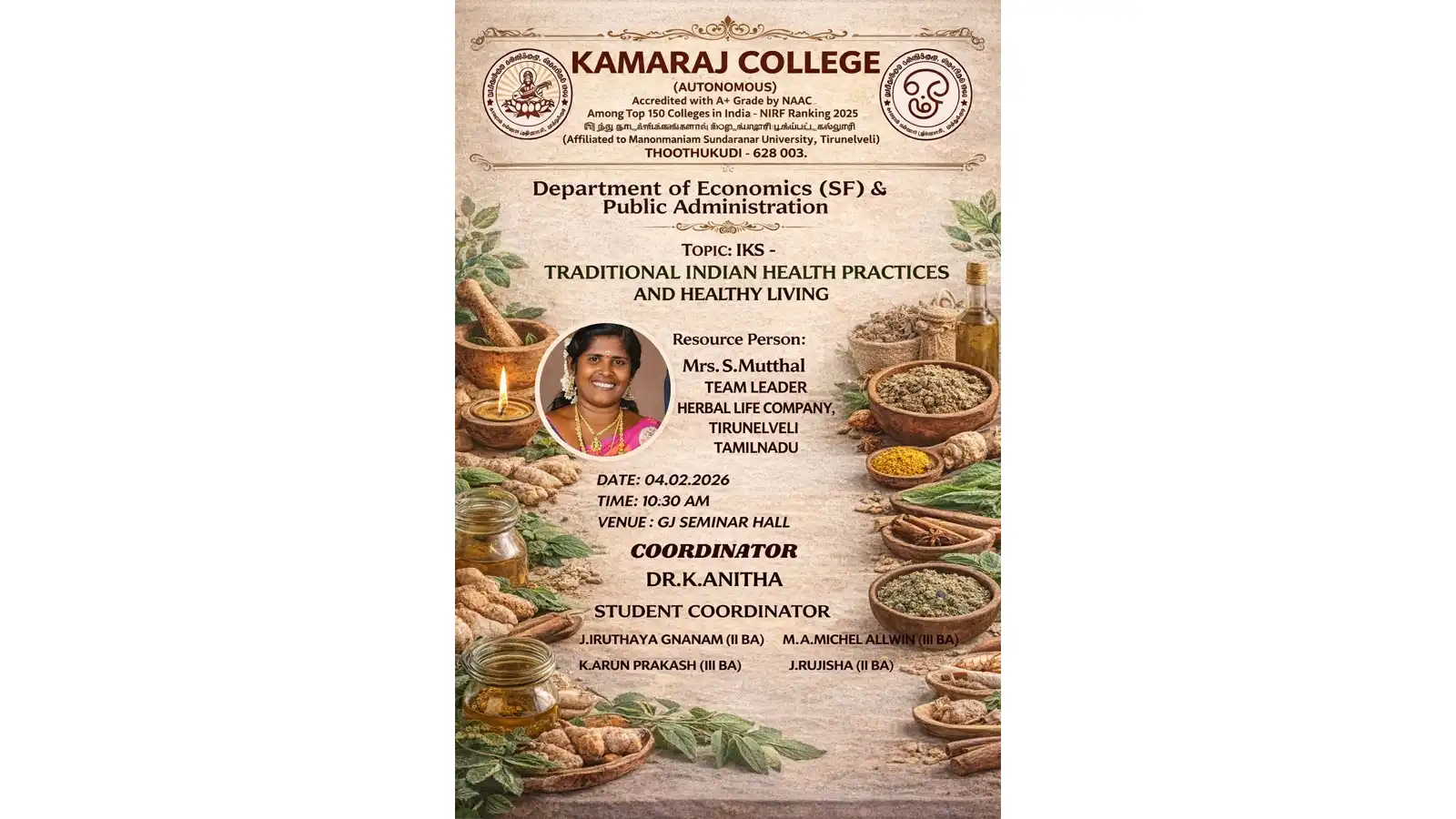
Traditional Health Practices Ignite 6 Powerful Healthy Living Insights


Traditional Health Practices – Programme Overview
The Traditional Health Practices guest lecture was successfully organized by the Department of Economics (SF) and Department of Public Administration, Kamaraj College (Autonomous), Thoothukudi, on 4 February 2026 from 10.00 a.m. to 12.00 p.m. at the Golden Jubilee Block Seminar Hall. The programme was conducted with the objective of creating awareness among students about the relevance of traditional Indian health systems and their role in promoting a balanced and healthy lifestyle.
The lecture focused on the integration of time-tested Indian health practices with modern living, highlighting the importance of preventive healthcare, natural food habits, and disciplined daily routines.
Objectives of the Traditional Health Practices Lecture
The primary aim of the Traditional Health Practices programme was to educate students on holistic well-being rooted in Indian traditions. The programme sought to:
- Create awareness about traditional Indian health systems
- Highlight the role of herbal remedies in daily health care
- Promote healthy lifestyle choices among students
- Encourage preventive health practices
- Reconnect youth with indigenous knowledge systems
By addressing health from a traditional perspective, the session emphasized sustainability, balance, and long-term wellness.
Welcome Address and Programme Inauguration
The programme commenced with a warm welcome address and introduction of the resource person by Dr. K. Karuppaiah, Assistant Professor, Department of Public Administration. He highlighted the importance of understanding traditional health knowledge in an era dominated by fast-paced lifestyles and processed food habits.
The inauguration set a reflective tone for the session, encouraging students to view health as a holistic concept rather than merely the absence of disease.
Resource Person and Expert Insights
The Traditional Health Practices lecture was delivered by Mrs. S. Mutthal, Team Leader, Herbal Life Company, Tirunelveli. Drawing from her professional experience, she shared practical insights into traditional Indian health practices that are relevant to modern life.
Her lecture covered:
- Use of herbal remedies in daily healthcare
- Importance of natural food habits
- Role of routine and discipline in maintaining health
- Preventive health measures from Indian traditions
- Mind–body balance through lifestyle choices
She explained how simple dietary changes and natural practices can significantly improve physical and mental well-being.
Traditional Health Practices and Healthy Living
A major focus of the session was the connection between Traditional Health Practices and sustainable living. Mrs. Mutthal emphasized that Indian traditions advocate moderation, mindfulness, and harmony with nature.
Students were introduced to concepts such as:
- Seasonal eating and natural diets
- Use of medicinal herbs in households
- Importance of sleep and daily routines
- Physical activity as part of daily life
These practices were presented as practical tools that students can adopt easily in their everyday routines.
Student Engagement and Learning Experience
Students actively listened to the lecture and showed keen interest throughout the programme. The Traditional Health Practices session encouraged students to reflect on their current lifestyle choices and explore healthier alternatives.
The interactive nature of the lecture helped students:
- Understand health beyond medical treatment
- Develop awareness of preventive healthcare
- Appreciate indigenous health knowledge
- Adopt healthier daily habits
The programme created a positive impact by motivating students to take responsibility for their own health and well-being.
Institutional Support and Academic Collaboration
The successful organization of the programme reflected strong collaboration between the Department of Economics (SF) and the Department of Public Administration. The event concluded with a vote of thanks by Dr. J. Rajaselvi, Assistant Professor of Tamil, Department of Economics (SF), who expressed gratitude to the resource person, faculty members, and students.
Kamaraj College (Autonomous), Thoothukudi, continues to organize such interdisciplinary programmes that address academic, social, and personal development.
Internal Link:
Kamaraj College (Autonomous), Thoothukudi
Relevance to National Health Awareness
Programmes focusing on Traditional Health Practices align with national efforts to promote preventive healthcare and traditional medicine systems.
External Links:
Ministry of AYUSH, Government of India
World Health Organization – Traditional Medicine
These platforms emphasize the importance of integrating traditional knowledge with modern healthcare.
Overall Impact of the Programme
The Traditional Health Practices guest lecture proved to be informative and impactful. It helped students recognize the value of Indian health traditions and encouraged them to adopt healthier, more balanced lifestyles.
Such programmes contribute significantly to students’ holistic development by combining academic learning with life skills and well-being awareness.
Conclusion
The guest lecture on Traditional Indian Health Practices and Healthy Living marked a meaningful initiative by the Department of Economics (SF) and Public Administration. By addressing health from a traditional and practical perspective, the Traditional Health Practices programme successfully inspired students to embrace natural, preventive, and sustainable approaches to well-being.
The event reaffirmed the institution’s commitment to nurturing informed, responsible, and health-conscious individuals prepared for both academic and personal success.