
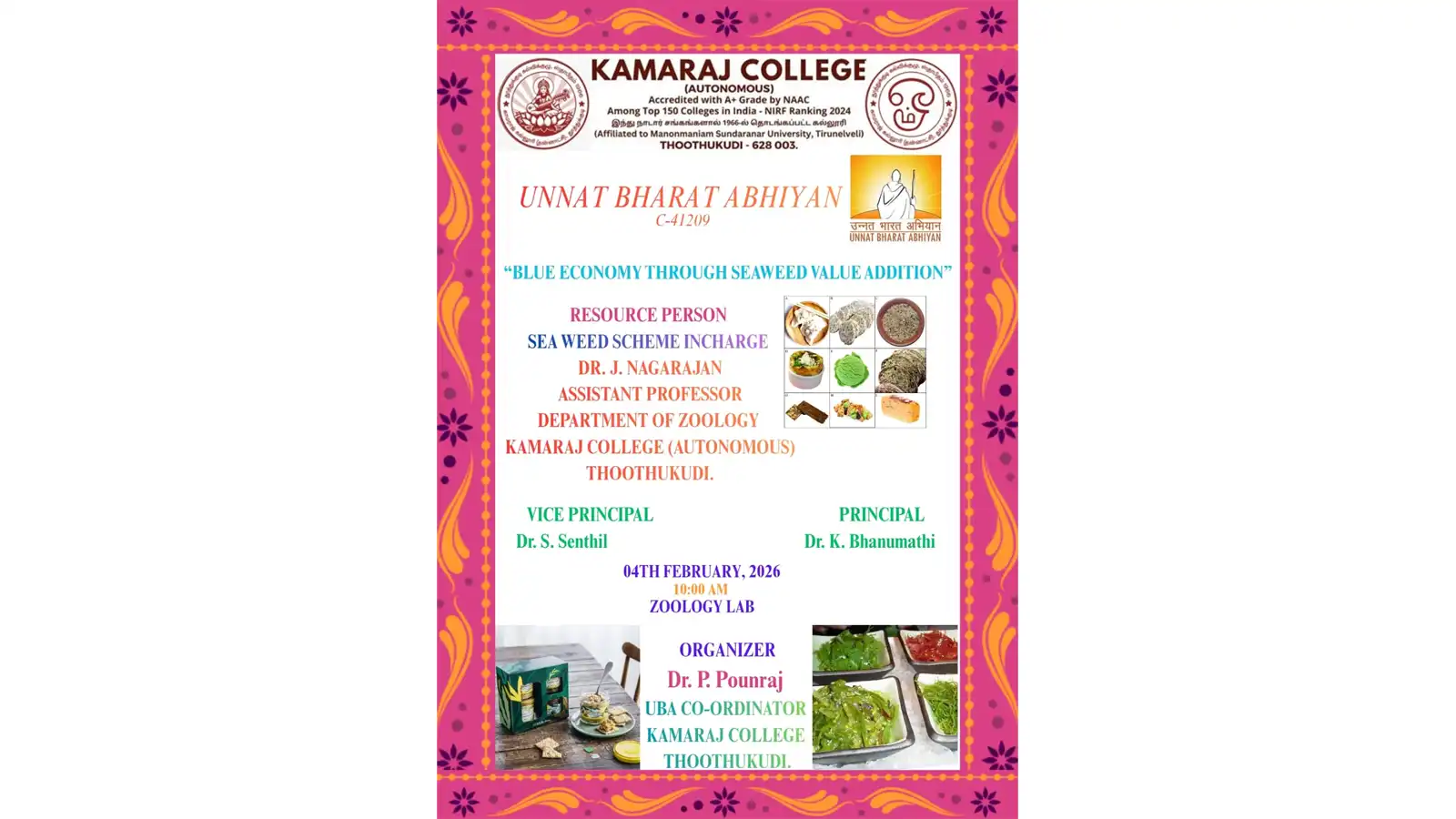
Seaweed Training Delivers 60 Powerful Student Success Stories


Seaweed Training Programme Overview
Seaweed Training was successfully conducted on 04 February 2026 by the Unnat Bharat Abhiyan (UBA) of Kamaraj College (Autonomous), Thoothukudi, at the Swami Vivekananda Block. The programme was organized between 11.00 a.m. and 12.30 p.m. with the primary objective of introducing students to sustainable livelihood opportunities through seaweed-based entrepreneurship.
The initiative focused on equipping students with practical knowledge related to seaweed resources, value-added product development, and rural entrepreneurship. The programme strongly aligned with the national vision of promoting self-employment, skill development, and community engagement among youth.
Objectives of the Seaweed Training Programme
The Seaweed Training programme was designed to encourage innovation and self-reliance among students by introducing them to marine-based entrepreneurial opportunities. The major objectives included:
- Creating awareness about seaweed as a sustainable marine resource
- Training students in seaweed collection and processing methods
- Introducing value-added seaweed products and their market potential
- Promoting student entrepreneurship and self-employment
- Encouraging knowledge transfer to rural women Self-Help Groups
Through this programme, students were motivated to explore alternative income-generation models that contribute to both economic growth and environmental sustainability.
Resource Person and Technical Expertise
The Seaweed Training session was handled by Dr. J. Nagarajan, Seaweed Project In-Charge and Assistant Professor, Department of Zoology, Kamaraj College (Autonomous), Thoothukudi. With extensive experience in marine biology and seaweed research, he delivered a detailed and practical lecture on the significance of seaweeds in coastal economies.
Dr. Nagarajan explained the biological importance of seaweeds, their role in marine ecosystems, and their increasing demand in food, pharmaceutical, cosmetic, and agricultural industries. His session provided students with a strong scientific foundation and real-world insights into seaweed-based enterprises.
Training on Seaweed Value-Added Products
A major highlight of the Seaweed Training programme was the introduction to various value-added products derived from seaweeds. Students were educated on how raw seaweed can be transformed into commercially viable products such as:
- Seaweed-based food supplements
- Organic fertilizers and bio-manure
- Cosmetic and skincare ingredients
- Pharmaceutical and nutraceutical products
- Animal feed additives
The resource person emphasized the importance of quality control, hygiene, and sustainable harvesting practices while producing seaweed-based products. Students gained clarity on how value addition significantly increases the economic worth of marine resources.
Skill Development and Extension Activities
As part of the Seaweed Training programme, students were trained in basic seaweed collection techniques and informed about responsible harvesting methods. They were also briefed on post-training extension activities planned under the Unnat Bharat Abhiyan framework.
Students were encouraged to act as trainers and resource persons for women Self-Help Groups in UBA-adopted village panchayats. This approach aimed to ensure knowledge transfer, women empowerment, and community-based entrepreneurship development.
Such extension activities strengthen the bond between academic institutions and rural communities while fostering inclusive growth.
Student Participation and Learning Outcomes
Students actively participated in the Seaweed Training programme, showing keen interest in entrepreneurship and marine-based livelihoods. Interactive discussions, question-and-answer sessions, and real-life examples enhanced their understanding of seaweed industries.
Key learning outcomes for students included:
- Awareness of sustainable marine resources
- Understanding of seaweed value chains
- Knowledge of entrepreneurship opportunities in coastal regions
- Skill development for rural training and outreach
- Confidence to explore self-employment ventures
The programme played a crucial role in shaping students’ entrepreneurial mindset and social responsibility.
Role of Unnat Bharat Abhiyan
The Seaweed Training programme was successfully organized under the Unnat Bharat Abhiyan, a flagship initiative that promotes rural development through higher education institutions. The programme was coordinated by Dr. P. Pounraj, UBA Co-ordinator, with the active support of UBA student representatives.
The coordinated efforts ensured smooth planning, execution, and student engagement throughout the training session. The programme reflected UBA’s mission of linking academic knowledge with grassroots development.
Institutional Support and Commitment
Kamaraj College (Autonomous), Thoothukudi, continues to demonstrate strong commitment toward skill-based education, entrepreneurship development, and community engagement. The institution actively supports initiatives that promote sustainability, innovation, and inclusive growth.
More about the institution can be found at:
https://kamarajcollege.ac.in/
External Learning Resources
Students were encouraged to explore additional information on seaweed industries and marine entrepreneurship through authoritative external resources:
Food and Agriculture Organization – Fisheries and Aquaculture
ICAR – Central Inland Fisheries Research Institute
These resources provide valuable insights into sustainable marine practices and global trends in seaweed utilization.
Conclusion
The Seaweed Training programme organized on 04 February 2026 proved to be an impactful initiative that empowered students with practical knowledge, entrepreneurial skills, and social responsibility. By combining scientific expertise, hands-on learning, and community outreach, the programme strengthened the institution’s mission of holistic education.
The training not only introduced students to emerging opportunities in seaweed-based industries but also prepared them to contribute meaningfully to rural development and sustainable livelihoods. Such initiatives continue to inspire students to become responsible entrepreneurs and change-makers in society.