
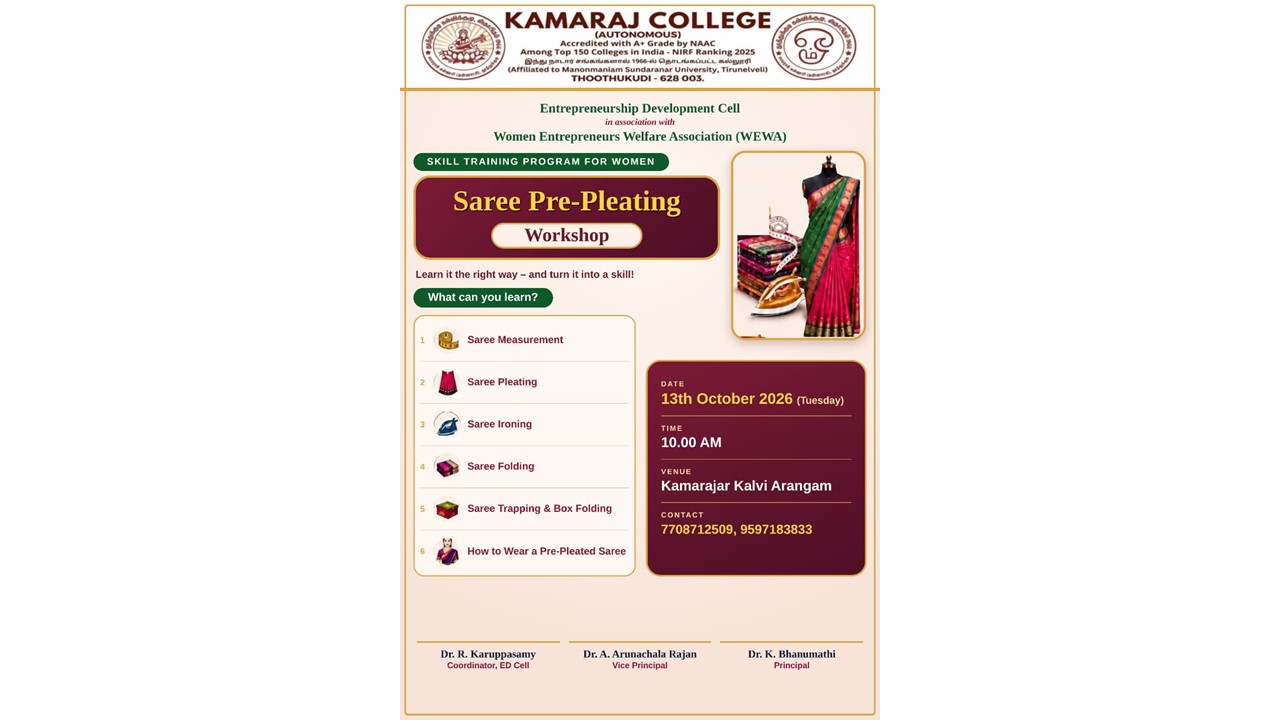
Saree Pre-Pleating Workshop 2026: 6 Powerful Skills for Women Entrepreneurs
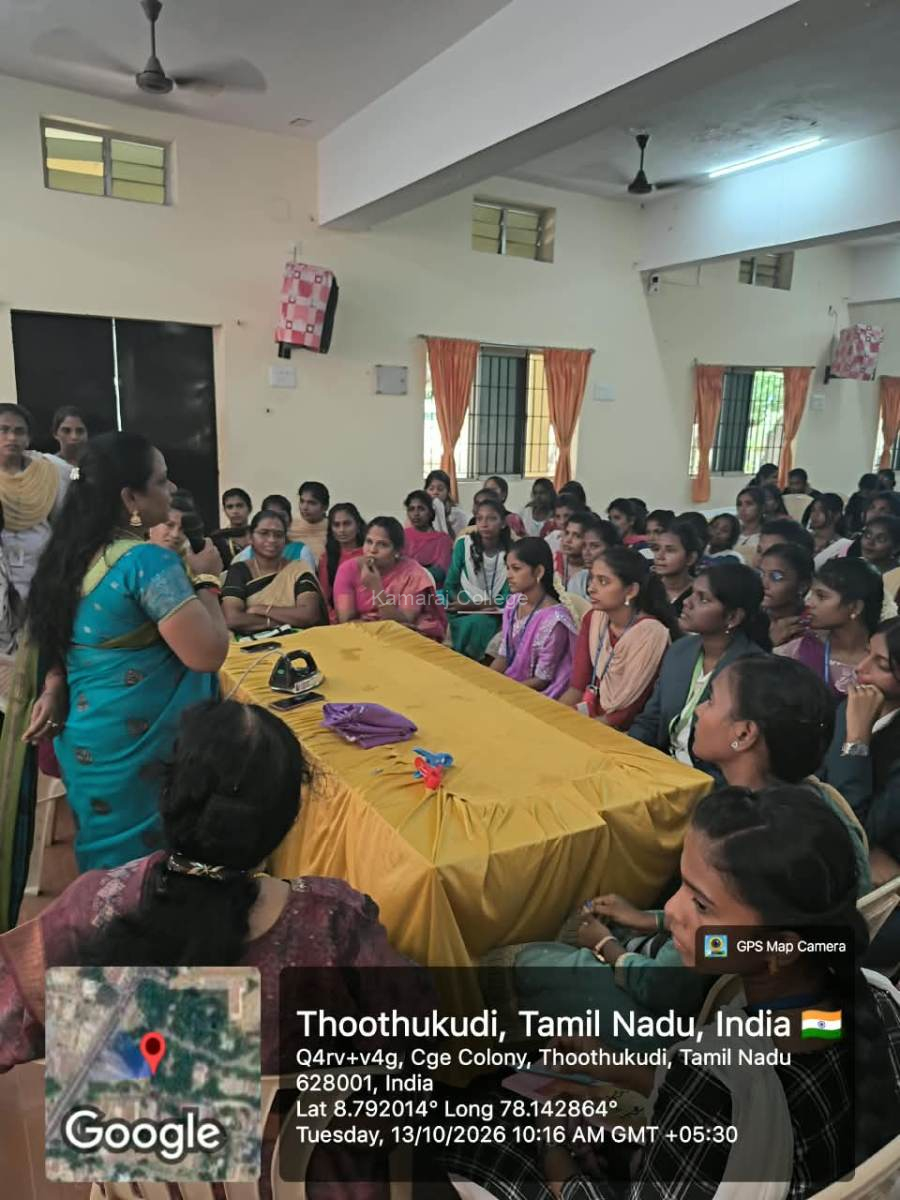
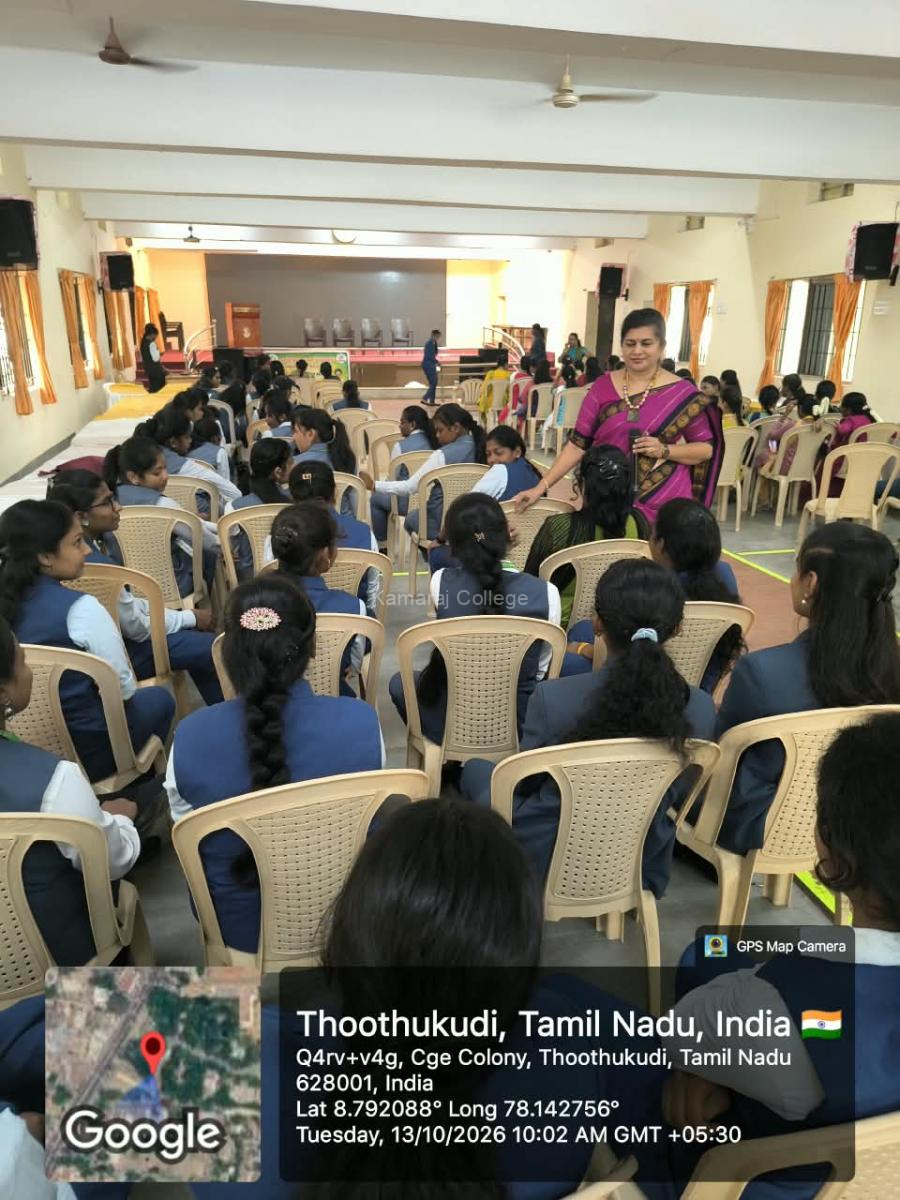
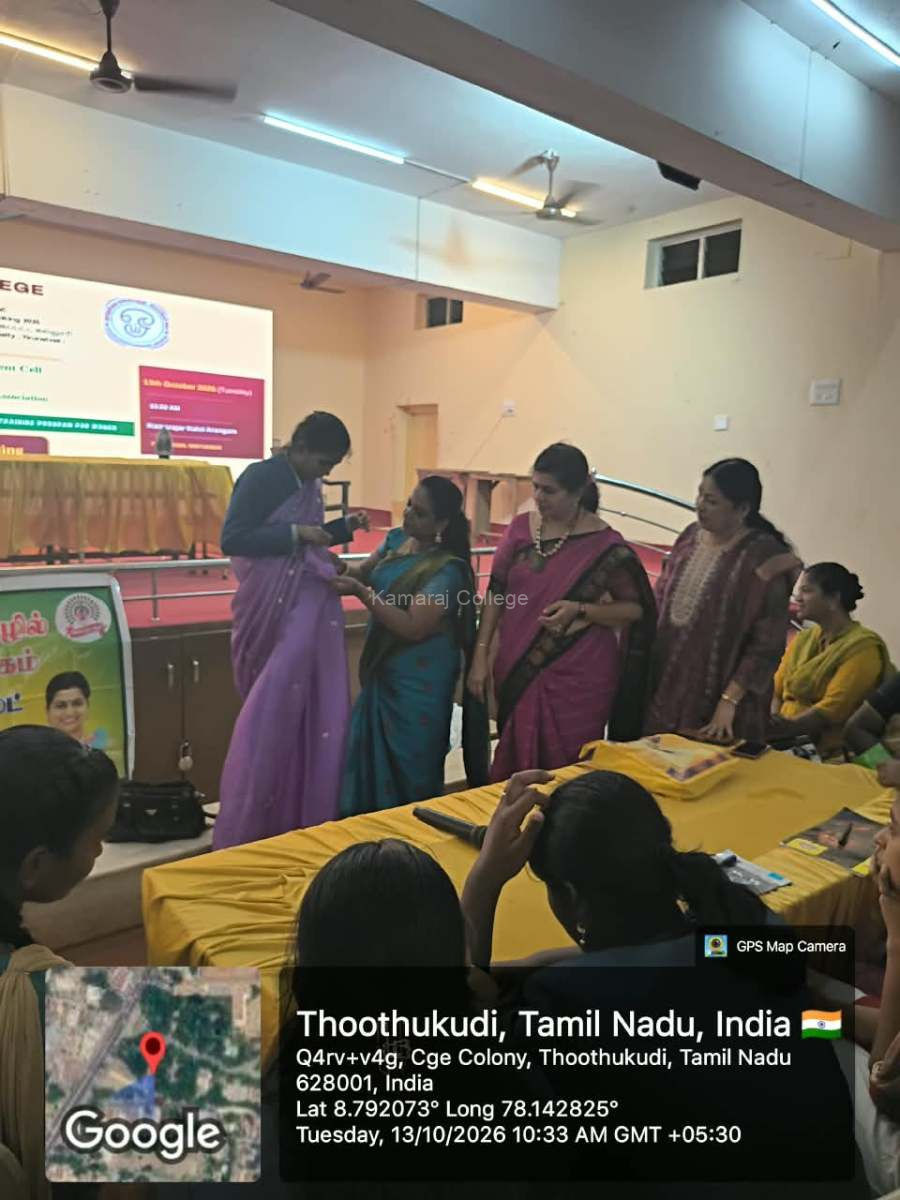
The workshop was designed as a practical skill development programme for women, focusing on professional saree pre-pleating techniques and their potential as an entrepreneurial activity. The initiative aimed to empower participants with specialised skills that could be developed into income-generating opportunities and small business ventures.
The hands-on training covered six key modules: saree measurement, pleating, ironing, folding, trapping and box folding, and wearing a pre-pleated saree. The programme introduced participants to the importance of precision, presentation, time management and professional finishing in saree pre-pleating services.
The event was coordinated by Dr. R. Karuppasamy, Coordinator of the Entrepreneurship Development Cell, under the guidance of Dr. A. Arunachala Rajan, Vice Principal, and Dr. K. Bhanumathi, Principal.
Saree Pre-Pleating Workshop 2026
The Saree Pre-Pleating Workshop was organised to promote women’s skill development and encourage entrepreneurship through practical vocational training.
Saree pre-pleating has emerged as a specialised service that helps individuals prepare sarees for convenient and elegant draping. Professional pre-pleating involves careful measurement, accurate pleat formation, appropriate ironing and systematic folding to achieve a neat appearance.
The workshop introduced participants to the practical aspects of these techniques while highlighting their relevance to self-employment and service-based entrepreneurship.
By combining traditional attire with professional skill development, the programme demonstrated how an everyday activity could be transformed into a potential business opportunity.
Collaboration with Women Entrepreneurs Welfare Association
The programme was conducted in association with the Women Entrepreneurs Welfare Association (WEWA), reflecting the importance of collaboration in promoting women’s economic empowerment.
The association supported the broader objective of encouraging women to acquire practical skills and explore entrepreneurial opportunities.
The collaboration between the Kamaraj Startup Centre, Entrepreneurship Development Cell and WEWA highlighted the value of connecting educational institutions with organisations focused on women’s development.
Such partnerships can help create opportunities for vocational learning, entrepreneurship awareness and community engagement.
Promoting Women Entrepreneurship through Skill Development
A major objective of the Saree Pre-Pleating Workshop was to encourage women to recognise the entrepreneurial potential of practical skills.
Professional saree pre-pleating can be offered as a specialised service for weddings, celebrations, cultural events and other occasions.
The workshop highlighted how technical proficiency, consistency and customer-oriented service can contribute to developing a small business.
Participants were encouraged to view saree pre-pleating not merely as a household activity but as a skill with potential commercial value.
The initiative reinforced the importance of skill-based entrepreneurship in supporting women’s confidence, independence and economic participation.
Practical Training in Saree Measurement
The first module focused on saree measurement, an essential step in preparing a saree for professional pre-pleating.
Accurate measurement helps ensure that the saree is prepared according to the intended draping requirements.
Participants were introduced to the importance of understanding fabric length, pleat placement and the relationship between measurement and final presentation.
The module highlighted the need for precision and careful preparation when offering saree pre-pleating as a professional service.
Professional Saree Pleating Techniques
The second module covered saree pleating, one of the most important skills in the pre-pleating process.
Pleating requires attention to alignment, consistency and fabric handling to achieve a neat and balanced appearance.
The practical training helped participants understand the importance of forming uniform pleats and maintaining an organised arrangement.
The session highlighted how proper pleating techniques can improve the appearance of the saree and make the draping process more convenient.
Developing proficiency in pleating is particularly important for those interested in offering professional saree preparation services.
Ironing and Fabric Preparation
The third module focused on ironing as an important part of professional saree preparation.
Appropriate ironing techniques help maintain the shape of pleats and contribute to a neat and polished finish.
The workshop highlighted the importance of careful fabric handling and suitable preparation methods.
Participants gained practical awareness of the role of ironing in maintaining pleat alignment and improving the overall presentation of pre-pleated sarees.
The module reinforced the importance of attention to detail and professional finishing.
Systematic Saree Folding Techniques
The fourth module introduced participants to saree folding techniques.
Proper folding helps maintain the arrangement of prepared pleats and supports convenient handling.
The session highlighted the importance of organising the fabric carefully to preserve its appearance after preparation.
Participants gained an understanding of how systematic folding contributes to the quality and presentation of a pre-pleated saree.
The training also demonstrated the importance of consistency and precision in professional service delivery.
Trapping and Box Folding Techniques
The fifth module covered trapping and box folding, specialised techniques included in the workshop’s practical training.
These techniques formed part of the process of preparing and arranging sarees for convenient handling and presentation.
Participants were introduced to the importance of maintaining the prepared pleats and organising the saree systematically.
The module highlighted how careful finishing and presentation can contribute to the perceived quality of a professional pre-pleating service.
The training encouraged participants to recognise the value of mastering each stage of saree preparation.
How to Wear a Pre-Pleated Saree
The sixth module focused on how to wear a pre-pleated saree.
This component connected the preparation process with the practical requirements of the person wearing the saree.
Participants gained awareness of how professionally prepared pleats can simplify draping and support a neat appearance.
The module highlighted the importance of understanding customer convenience and ensuring that the prepared saree is suitable for its intended use.
This knowledge is particularly valuable for individuals interested in providing customer-oriented saree pre-pleating services.
Six Essential Skills Covered in the Workshop
The Saree Pre-Pleating Workshop provided practical training in the following six modules:
- Saree Measurement: Understanding accurate measurement and preparation requirements for professional pre-pleating.
- Pleating: Learning techniques for forming neat, consistent and properly aligned saree pleats.
- Ironing: Understanding the importance of fabric preparation and maintaining a polished finish.
- Folding: Developing systematic methods for arranging and handling prepared sarees.
- Trapping and Box Folding: Learning specialised techniques for organising and presenting pre-pleated sarees.
- Wearing a Pre-Pleated Saree: Understanding practical draping methods and customer convenience.
Together, these modules provided a structured introduction to the professional saree pre-pleating process.
Hands-On Learning and Practical Skill Development
An important feature of the Saree Pre-Pleating Workshop was its emphasis on hands-on training.
Practical learning allows participants to understand techniques through direct experience and develop confidence in performing specialised tasks.
The workshop provided opportunities to become familiar with the different stages of saree preparation, from initial measurement to final draping.
The training highlighted the importance of accuracy, patience, coordination and attention to detail.
These qualities are essential for maintaining service quality and developing professional competence.
Transforming Traditional Skills into Business Opportunities
The workshop demonstrated how a familiar traditional practice can be developed into a specialised commercial service.
Saree pre-pleating can offer opportunities for individuals interested in home-based services, independent work or small-scale entrepreneurship.
The programme encouraged participants to recognise the business potential of developing professional expertise in saree handling.
It also highlighted the importance of combining practical skill with service quality and customer satisfaction.
By introducing the entrepreneurial possibilities associated with saree pre-pleating, the initiative helped bridge the gap between domestic skills and commercial enterprise.
Encouraging Self-Employment Opportunities
The Saree Pre-Pleating Workshop promoted awareness of self-employment opportunities for women.
Skill-based services can provide a pathway for individuals seeking to develop independent sources of income.
Professional saree preparation may be offered as a standalone service or combined with related activities in fashion, tailoring, beauty and event preparation.
The workshop encouraged participants to consider how acquired skills could be developed further through practice and entrepreneurial planning.
The initiative reinforced the importance of practical training in creating opportunities for economic participation.
Importance of Professional Quality and Customer Satisfaction
Professional service delivery requires consistency, accuracy and attention to customer expectations.
The workshop highlighted the importance of producing neatly arranged pleats, maintaining fabric quality and ensuring convenient draping.
These aspects can influence customer satisfaction and contribute to the reputation of a saree pre-pleating service.
Participants were encouraged to appreciate the importance of reliable workmanship and professional presentation.
The programme demonstrated that technical skills and customer-oriented practices are complementary components of entrepreneurship.
Business Awareness and Entrepreneurial Thinking
Beyond practical training, the Saree Pre-Pleating Workshop introduced participants to the entrepreneurial potential of the skill.
Developing a service-based business involves understanding customer requirements, maintaining quality and delivering work consistently.
The workshop encouraged participants to recognise that specialised skills can create value when offered professionally.
The training provided a foundation for thinking about how saree pre-pleating could be developed into a sustainable service activity.
This approach reflected the Entrepreneurship Development Cell’s objective of promoting innovation, self-reliance and entrepreneurial awareness.
Role of Kamaraj Startup Centre
The Kamaraj Startup Centre played an important role in organising the skill development initiative.
The programme reflected the Centre’s focus on encouraging entrepreneurship and promoting practical business-oriented learning.
By supporting training in a specialised service skill, the Centre contributed to creating awareness of entrepreneurship beyond conventional business activities.
The initiative demonstrated the relevance of startup-oriented thinking to small-scale and skill-based enterprises.
It also reinforced the importance of identifying business opportunities within everyday activities and traditional practices.
Contribution of the Entrepreneurship Development Cell
The Entrepreneurship Development Cell (EDC) organised the workshop in collaboration with the Kamaraj Startup Centre and WEWA.
The programme reflected the Cell’s commitment to promoting entrepreneurial skills, practical knowledge and economic empowerment.
Entrepreneurship development initiatives help participants recognise business opportunities and understand the importance of professional competence.
The workshop supported these objectives by combining vocational training with awareness of potential income-generating activities.
Programme Coordination by Dr. R. Karuppasamy
The programme was coordinated by Dr. R. Karuppasamy, Coordinator of the Entrepreneurship Development Cell.
His coordination contributed to the organisation and successful conduct of the training programme.
The workshop reflected the ED Cell’s efforts to create opportunities for practical skill development and entrepreneurship awareness.
The initiative also highlighted the importance of collaborative programmes in strengthening community-oriented entrepreneurial activities.
Guidance of the College Administration
The Saree Pre-Pleating Workshop was conducted under the guidance of Dr. A. Arunachala Rajan, Vice Principal, and Dr. K. Bhanumathi, Principal.
Their guidance supported the organisation of the programme and the institution’s efforts to promote skill development and entrepreneurship.
The initiative reflected the commitment of Kamaraj College to encouraging practical learning, women’s empowerment and community engagement.
Women’s Empowerment through Vocational Training
Vocational training plays an important role in helping women develop practical skills and explore economic opportunities.
The Saree Pre-Pleating Workshop encouraged participants to build confidence through specialised training.
The programme demonstrated how skill development can support independent work and entrepreneurial aspirations.
By focusing on a service with potential market demand, the initiative highlighted the value of practical knowledge in promoting women’s economic participation.
The workshop also encouraged participants to recognise the importance of continuous practice and professional improvement.
Promoting Skill-Based Entrepreneurship
Skill-based entrepreneurship enables individuals to create value through specialised knowledge and practical abilities.
The workshop introduced participants to the possibility of developing saree pre-pleating into a professional service.
Such activities can be particularly relevant for individuals exploring flexible or home-based entrepreneurial opportunities.
The programme encouraged participants to understand the importance of technical proficiency, service quality and customer satisfaction.
It also reinforced the role of entrepreneurship education in identifying and developing small business opportunities.
Objectives of the Workshop
The major objectives of the Saree Pre-Pleating Workshop were:
- Provide practical training in professional saree pre-pleating techniques
- Develop skills in saree measurement, pleating and ironing
- Introduce systematic folding, trapping and box folding techniques
- Demonstrate how to wear a pre-pleated saree
- Encourage women to explore skill-based entrepreneurial opportunities
- Promote awareness of self-employment and income-generating activities
- Highlight the importance of professional finishing and customer satisfaction
- Connect traditional skills with modern service-based entrepreneurship
- Strengthen collaboration between educational institutions and women’s organisations
- Promote confidence, independence and practical business awareness
Programme Highlights
- Programme: Saree Pre-Pleating Workshop
- Date: 13 October 2026
- Time: 10:00 AM
- Venue: Kamarajar Kalvi Arangam
- Organised by: Kamaraj Startup Centre and Entrepreneurship Development Cell
- Institution: Kamaraj College (Autonomous), Thoothukudi
- Collaborating Organisation: Women Entrepreneurs Welfare Association (WEWA)
- Programme Type: Skill Development and Entrepreneurship Training
- Target Group: Women
- Training Modules: Six
- Skills Covered: Saree Measurement, Pleating, Ironing, Folding, Trapping and Box Folding, and Wearing a Pre-Pleated Saree
- Programme Coordinator: Dr. R. Karuppasamy, Coordinator, Entrepreneurship Development Cell
- Vice Principal: Dr. A. Arunachala Rajan
- Principal: Dr. K. Bhanumathi
- Key Focus: Women’s Skill Development, Self-Employment and Entrepreneurship
- Major Outcome: Practical Skill Training and Awareness of Potential Business Opportunities
Learning Outcomes
The Saree Pre-Pleating Workshop provided participants with opportunities to:
- Understand the professional process of saree pre-pleating
- Gain practical knowledge of accurate saree measurement
- Develop awareness of techniques for forming uniform pleats
- Understand the importance of ironing and fabric preparation
- Learn systematic saree folding methods
- Become familiar with trapping and box folding techniques
- Understand how to wear a pre-pleated saree
- Recognise the importance of professional finishing and presentation
- Identify the entrepreneurial potential of saree pre-pleating services
- Develop awareness of self-employment opportunities
- Appreciate the importance of customer satisfaction and service quality
- Gain confidence in exploring skill-based business activities
Contribution to Sustainable Development Goals
The Saree Pre-Pleating Workshop supported the broader principles of the United Nations Sustainable Development Goals (SDGs) through its focus on women’s empowerment, skill development and entrepreneurship.
The initiative was particularly relevant to the following goals:
- SDG 4 – Quality Education: Promoting practical learning and vocational skill development.
- SDG 5 – Gender Equality: Encouraging women’s empowerment and participation in economic activities.
- SDG 8 – Decent Work and Economic Growth: Supporting awareness of self-employment and small business opportunities.
- SDG 17 – Partnerships for the Goals: Strengthening collaboration between educational institutions and community organisations.
The programme demonstrated how skill-oriented educational initiatives can contribute to broader social and economic development objectives.
Importance of Community-Oriented Entrepreneurship Programmes
Community-oriented entrepreneurship programmes help connect educational institutions with the practical needs and aspirations of society.
The collaboration with WEWA enabled the Kamaraj Startup Centre and Entrepreneurship Development Cell to focus on a skill with potential relevance to women’s self-employment.
The workshop highlighted the value of accessible vocational training and the importance of encouraging participants to recognise opportunities within familiar activities.
Such initiatives can contribute to building confidence, strengthening practical abilities and promoting an entrepreneurial mindset.
Conclusion
The Saree Pre-Pleating Workshop, organised by the Kamaraj Startup Centre and Entrepreneurship Development Cell of Kamaraj College (Autonomous), Thoothukudi, in association with the Women Entrepreneurs Welfare Association (WEWA), on 13 October 2026, was a meaningful skill development and entrepreneurship initiative.
Conducted at the Kamarajar Kalvi Arangam, the programme provided hands-on training in six essential saree pre-pleating techniques, including measurement, pleating, ironing, folding, trapping and box folding, and wearing a pre-pleated saree.
The workshop helped participants understand the professional requirements of saree preparation while introducing the possibility of developing these skills into entrepreneurial ventures.
The event was coordinated by Dr. R. Karuppasamy, Coordinator of the Entrepreneurship Development Cell, under the guidance of Dr. A. Arunachala Rajan, Vice Principal, and Dr. K. Bhanumathi, Principal.
Overall, the Saree Pre-Pleating Workshop successfully promoted women’s empowerment, practical skill development, entrepreneurial awareness and self-employment opportunities, demonstrating how traditional skills can be transformed into potential commercial enterprises.
Internal Link
- Kamaraj College (Autonomous), Thoothukudi – Explore more Entrepreneurship Development Cell activities, startup initiatives and skill development programmes.
External Links
- Startup India – Government of India initiative supporting entrepreneurship, innovation and startup development.
- Ministry of Micro, Small and Medium Enterprises – Information on entrepreneurship development, small business support and enterprise promotion.
- Skill India Digital – Information on skill development, vocational learning and employment-oriented training opportunities.
- United Nations Sustainable Development Goals – Information on gender equality, quality education, economic development and partnerships.