
Professional Communication 2026: Powerful Skills for Student Success
Report on Capacity Development and Skill Enhancement Activity
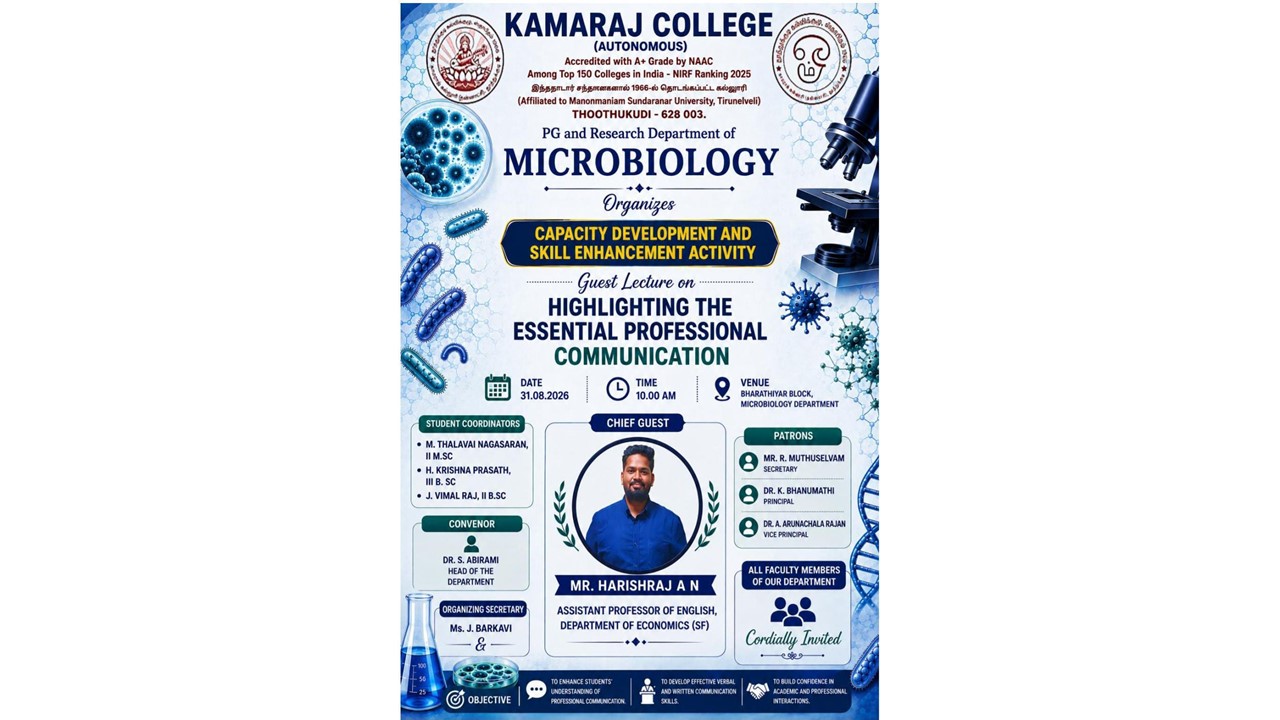
Professional Communication plays an important role in preparing students for academic success and future careers. With this objective, the PG and Research Department of Microbiology, Kamaraj College (Autonomous), Thoothukudi, organized a Capacity Development and Skill Enhancement Activity for First Year students on the topic “Highlighting the Essential Professional Communication.”
The programme focused on helping students understand the importance of effective communication in both academic and professional settings.
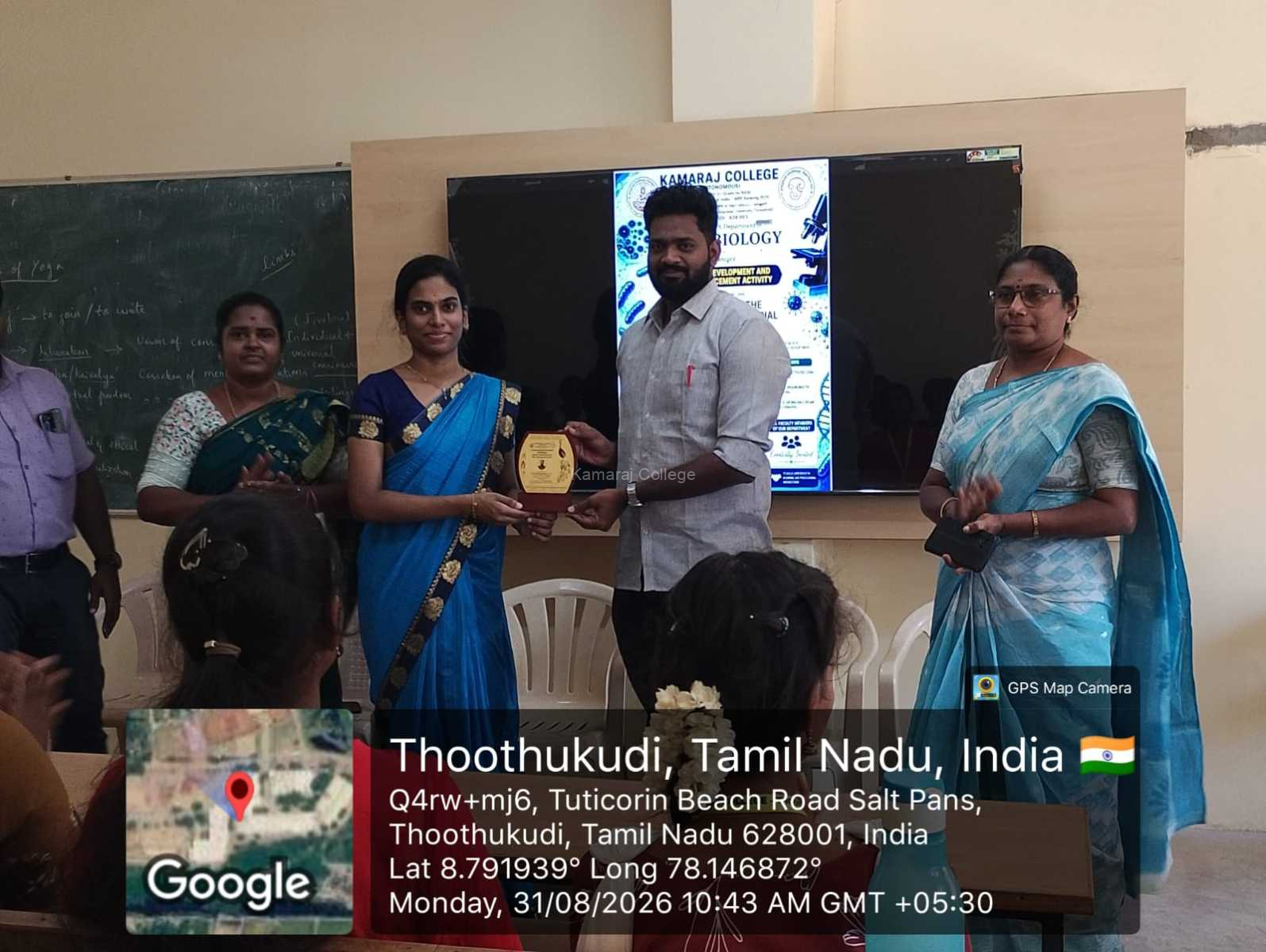
Mr. Harishraj A. N., Assistant Professor of English, Department of Economics (SF), served as the resource person for the programme.
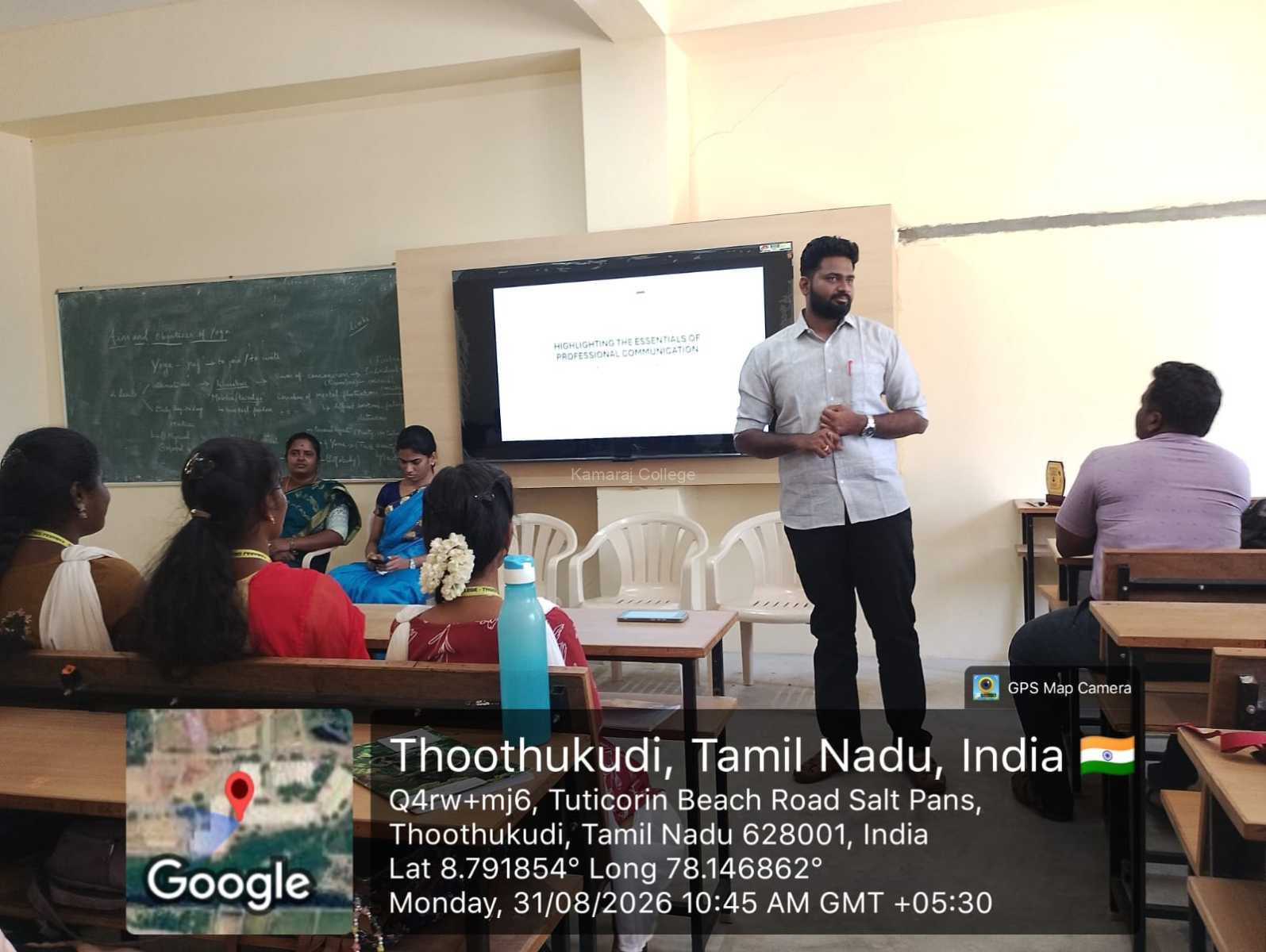
He conducted an informative and interactive session that focused on verbal communication, written communication, professional etiquette, confidence and clear expression.
Objectives of the Programme
The programme aimed to create awareness among First Year students about the importance of developing effective Professional Communication skills from the beginning of their college education.
The major objectives were:
- Improve verbal communication skills
- Strengthen written communication abilities
- Create awareness about professional etiquette
- Develop confidence among students
- Encourage clear expression of ideas
- Improve communication in academic situations
- Prepare students for future professional environments
- Support overall personality and skill development
Thus, the activity aimed to equip students with essential abilities that would support them throughout their academic and professional journey.
Importance of Professional Communication
The session highlighted that communication is one of the most important skills required in today’s academic and professional environments.
Students may possess strong subject knowledge. However, they also need the ability to communicate that knowledge clearly and confidently.
Effective communication helps students during classroom interactions, seminars, presentations, group discussions, interviews and professional meetings.
Therefore, the programme encouraged students to view communication as an essential skill that should be developed continuously.
Resource Person
Mr. Harishraj A. N., Assistant Professor of English, Department of Economics (SF), served as the resource person.
He shared useful insights and practical guidance with the students on various aspects of communication.
His interactive approach encouraged students to understand how communication skills can influence their academic performance, confidence and future professional growth.
Moreover, the session helped participants relate communication concepts to situations they may encounter in college and later in the workplace.
Developing Verbal Communication
A major part of the session focused on verbal communication.
Students were encouraged to express their thoughts clearly and confidently while speaking.
Effective verbal communication requires clarity, suitable language and the ability to organize thoughts before expressing them.
Furthermore, students need strong speaking skills while participating in presentations, seminars, interviews and group discussions.
The programme therefore encouraged participants to practice speaking regularly and gradually improve their confidence.
Improving Written Communication
The resource person also emphasized the importance of written communication.
Students regularly use written communication for assignments, reports, examinations and academic correspondence.
Later, they may also need to prepare professional emails, reports, applications and other workplace documents.
Therefore, the ability to write clearly and appropriately is essential.
Students were encouraged to focus on clarity, correct expression and proper organization while communicating in writing.
Professional Etiquette
The session introduced students to the importance of professional etiquette.
Professional etiquette includes appropriate behaviour, respectful communication and responsible interaction with others.
Students were encouraged to understand that their behaviour and communication style can influence how others perceive them.
Moreover, professional etiquette contributes to positive relationships in academic institutions and workplaces.
Developing such habits during college can help students adapt more easily to future professional environments.
Building Confidence
Confidence was another important focus of the programme.
Students sometimes hesitate to express their ideas even when they understand a topic well.
The resource person encouraged them to overcome fear and hesitation through regular practice and participation.
Students were reminded that confidence improves gradually when they actively engage in communication-based activities.
As a result, they were motivated to participate more confidently in classroom discussions and other academic activities.
Clear Expression of Ideas
The programme emphasized the importance of expressing ideas in a clear and understandable manner.
Clear expression helps avoid confusion and improves the effectiveness of communication.
Students were encouraged to organize their thoughts before speaking or writing.
They also learned that good communication involves selecting appropriate words and presenting information in a logical order.
Thus, the programme helped students understand that clarity is a fundamental element of effective Professional Communication.
Communication in Academic Settings
Effective communication can significantly support students’ academic development.
Students need to interact with faculty members, classmates and academic groups throughout their college education.
They may also be required to participate in seminars, presentations, projects and discussions.
Therefore, communication skills can help them express their knowledge more effectively and participate actively in learning.
The programme encouraged First Year students to begin strengthening these skills early in their academic journey.
Preparing for Professional Life
The programme also connected communication skills with future career development.
Professional environments require individuals to communicate with colleagues, supervisors, clients and other stakeholders.
Strong communication skills can support students during:
- Job interviews
- Group discussions
- Professional presentations
- Workplace meetings
- Email communication
- Report writing
- Team interactions
- Customer and client communication
Therefore, developing these abilities during college can improve students’ readiness for employment.
Interactive Learning Experience
The session was both informative and interactive.
Students were encouraged to engage with the resource person and understand communication through practical discussion.
The interactive format made the programme more engaging and helped students relate the concepts to their own experiences.
Furthermore, interaction encouraged students to think about their current communication habits and identify areas that required improvement.
Supporting First Year Students
Organizing the programme for First Year students was particularly valuable.
Students entering college experience a new academic environment and may need to develop greater confidence in communicating with teachers and classmates.
Early exposure to professional communication skills can help them adapt more effectively.
Moreover, it can encourage them to participate actively in academic and co-curricular activities throughout their degree programme.
Developing Career-Ready Skills
The activity helped students understand that employers value both academic knowledge and practical abilities.
Communication, confidence and professional behaviour can significantly influence career opportunities.
Therefore, students were encouraged to strengthen these skills continuously.
The programme also reinforced the idea that communication is not a one-time learning activity but a skill that develops through regular practice.
Key Areas Covered
The session focused on several important aspects of Professional Communication:
- Verbal Communication
- Written Communication
- Professional Etiquette
- Confidence Building
- Clear Expression
- Academic Communication
- Professional Behaviour
- Interpersonal Interaction
- Presentation Skills
- Career Readiness
Together, these areas provided students with a strong introduction to effective communication in academic and professional contexts.
Programme Highlights
- Programme: Capacity Development and Skill Enhancement Activity
- Topic: Highlighting the Essential Professional Communication
- Organized by: PG and Research Department of Microbiology
- Institution: Kamaraj College (Autonomous), Thoothukudi
- Participants: First Year Students
- Resource Person: Mr. Harishraj A. N.
- Designation: Assistant Professor of English
- Department: Department of Economics (SF)
- Major Focus: Verbal and written communication, professional etiquette, confidence and clear expression
Programme Outcomes
The Professional Communication programme resulted in several useful learning outcomes.
Through the session, students:
- Understood the importance of effective communication
- Gained awareness of verbal communication skills
- Recognised the importance of written communication
- Learned the value of professional etiquette
- Were encouraged to communicate with greater confidence
- Understood the importance of clear expression
- Recognised the role of communication in academic development
- Gained awareness of professional communication expectations
- Identified areas for improving their communication abilities
- Became more aware of the skills required for future careers
Overall, the programme helped students understand how communication skills can contribute to both academic performance and professional success.
Vote of Thanks
The programme concluded with a vote of thanks.
Gratitude was expressed to the resource person, management, faculty members and students for their valuable support, cooperation and active participation.
The contribution of all those involved helped ensure the successful conduct of the programme.
Conclusion
The Capacity Development and Skill Enhancement Activity on “Highlighting the Essential Professional Communication”, organized by the PG and Research Department of Microbiology, Kamaraj College (Autonomous), Thoothukudi, was informative, interactive and beneficial to the First Year students.
Mr. Harishraj A. N., Assistant Professor of English, Department of Economics (SF), shared valuable insights on verbal communication, written communication, professional etiquette, confidence and clear expression.
The session helped students understand the practical importance of Professional Communication in academic and workplace environments.
Furthermore, the programme encouraged students to communicate with greater clarity and confidence and to develop professional habits from the beginning of their college education.
Overall, the activity successfully supported the academic growth, skill development, confidence and future career readiness of the students.
Internal Link
External Links
- Skill India Digital – Explore skill-development opportunities and resources supporting professional growth.
- National Career Service – Explore career guidance, employment resources and professional development opportunities.