
Library Day 2026: Inspiring Reading Habits for Lifelong Learning


Report on Library Day Celebration – Best Practice II
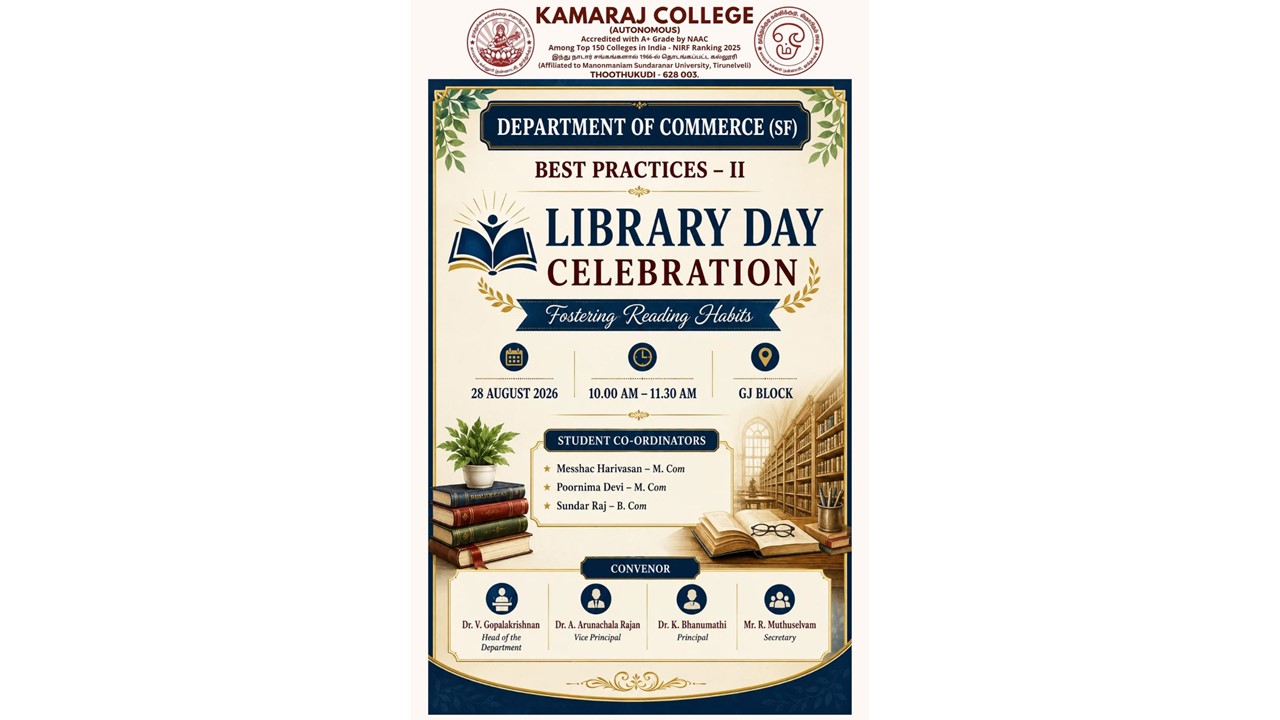
Library Day was celebrated by the Department of Commerce (SF), Kamaraj College (Autonomous), Thoothukudi, on 28 August 2026 at the GJ Block from 10.00 a.m. to 11.30 a.m.
The programme was conducted as Best Practice II of the Department with the objective of fostering reading habits among students and encouraging them to make effective and regular use of library resources.
The celebration focused on creating awareness about the importance of reading in academic development. It also encouraged students to develop greater interest in books and cultivate a sustained reading culture.
Furthermore, the programme highlighted the library as an important centre for knowledge acquisition, self-learning, intellectual development and lifelong learning.
Objectives of the Programme
The Library Day celebration was organized with several important academic and developmental objectives.
The major objectives were:
- Promote regular reading habits among students
- Encourage effective use of library resources
- Create greater interest in books and reading
- Develop a sustained reading culture
- Promote self-directed learning
- Encourage continuous knowledge development
- Strengthen students’ academic abilities
- Promote intellectual development
- Highlight the importance of lifelong learning
- Encourage students to use the library regularly
Thus, the programme aimed to make reading an integral part of students’ academic and personal development.
Best Practice II of the Department
The Library Day Celebration was conducted as Best Practice II of the Department of Commerce (SF).
The initiative reflects the Department’s commitment to encouraging students to develop habits that support learning beyond regular classroom instruction.
Reading provides students with opportunities to explore new ideas, improve subject knowledge and develop independent thinking.
Therefore, promoting regular reading and effective library utilization can contribute significantly to the overall quality of students’ academic experience.
As a departmental best practice, the initiative also encourages students to continue these habits throughout their college education.
Promoting a Reading Culture
One of the primary aims of the Library Day celebration was to cultivate a strong reading culture among students.
Reading regularly can help students expand their knowledge and develop a deeper understanding of different subjects.
It also introduces them to new ideas and perspectives.
Furthermore, a sustained reading habit can improve concentration, vocabulary, comprehension and analytical thinking.
The programme therefore encouraged students to view reading not merely as an academic requirement but as a valuable habit for continuous personal development.
Importance of Library Resources
The programme emphasized the importance of making effective use of library resources.
A college library provides students with access to a wide range of academic materials and learning resources.
These resources can complement classroom teaching and help students explore subjects in greater depth.
Students were encouraged to use the library regularly and identify materials relevant to their academic interests.
As a result, the initiative helped reinforce the idea that the library is an essential part of the learning process.
Library as a Centre of Knowledge
The celebration highlighted the role of the library as a valuable centre for knowledge acquisition.
Libraries create an environment where students can read, explore and learn independently.
They also provide opportunities to move beyond prescribed textbooks and discover wider areas of knowledge.
Moreover, regular library use can encourage curiosity and help students develop the habit of seeking reliable information.
Therefore, the programme encouraged students to recognise the library as an important academic resource throughout their college education.
Encouraging Self-Learning
Self-learning was another important focus of the programme.
Students cannot depend entirely on classroom instruction for all their learning needs.
Independent reading allows them to explore subjects according to their interests and academic requirements.
It also encourages them to take responsibility for their own learning.
Therefore, the Library Day initiative motivated students to use books and other library resources to supplement classroom learning.
This approach can help them become more independent and confident learners.
Developing Intellectual Curiosity
Reading plays an important role in developing intellectual curiosity.
Students who read regularly are exposed to different ideas, experiences and perspectives.
Such exposure can encourage them to ask questions, analyse information and develop independent opinions.
Furthermore, reading can help students connect knowledge across different subjects.
The programme therefore encouraged students to explore books beyond their immediate syllabus and develop a broader interest in learning.
Supporting Academic Development
Regular reading can contribute significantly to academic development.
Students who use library resources effectively can strengthen their understanding of classroom topics and prepare more confidently for academic activities.
Reading can also improve their ability to understand complex information and communicate their ideas clearly.
Moreover, exposure to different sources can help students develop better research and information-gathering habits.
Thus, the Library Day Celebration connected reading directly with improved academic performance and knowledge development.
Reading and Communication Skills
The programme also highlighted the wider benefits of regular reading.
Reading can help students improve vocabulary and develop greater confidence in using language.
It can support both written and verbal communication by exposing students to different styles of expression.
For Commerce students, effective communication is particularly important in academic presentations, interviews and professional environments.
Therefore, developing a strong reading habit can contribute to both academic and career readiness.
Developing Critical Thinking
Reading encourages students to think critically about information.
Instead of simply accepting ideas, students can compare different viewpoints and form their own understanding.
This ability is valuable in higher education as well as professional life.
Furthermore, critical thinking supports problem-solving and informed decision-making.
The programme therefore encouraged students to use reading as a tool for developing deeper and more analytical thinking.
Reading for Professional Growth
The Library Day celebration also connected reading with future professional development.
The business and employment environment changes continuously. Therefore, students need to remain informed about new ideas, developments and professional practices.
Regular reading can help them develop this habit of continuous learning.
Students were encouraged to explore materials related to commerce, business, finance, management, entrepreneurship, economics and emerging workplace trends.
Such reading can strengthen both subject knowledge and professional awareness.
Encouraging Lifelong Learning
One of the most important messages of the programme was the value of lifelong learning.
Education does not end with the completion of a degree.
Individuals need to continue learning throughout their personal and professional lives.
Reading is one of the most accessible ways to maintain this habit.
Therefore, students were encouraged to develop a relationship with books and learning resources that continues beyond their college years.
Creating a Positive Academic Environment
The programme contributed to creating a positive academic environment within the Department.
When students actively read, discuss ideas and explore knowledge independently, the overall learning culture becomes stronger.
Such an environment encourages curiosity and academic engagement.
Moreover, collective participation in initiatives such as Library Day can motivate students who may not already have a regular reading habit.
The programme therefore helped reinforce a culture of learning within the Department of Commerce (SF).
Role of Student Coordinators
The event was coordinated by the student coordinators:
- Messhac Harivasan, M.Com
- Poornima Devi, M.Com
- Sundar Raj, B.Com
Their involvement contributed to the smooth and successful conduct of the programme.
Student participation in coordinating departmental activities also provides practical experience in planning, communication, teamwork and responsibility.
Furthermore, student-led involvement strengthens participation and creates a greater sense of ownership in academic initiatives.
Participation of Students and Faculty
The active participation of students and faculty members contributed significantly to the success of the programme.
Their involvement helped create an encouraging environment focused on reading and knowledge development.
The response from students demonstrated the relevance of initiatives that promote learning beyond the classroom.
Moreover, faculty support reinforced the importance of developing consistent academic habits throughout the students’ college education.
Guidance and Institutional Support
The programme was conducted under the guidance of Dr. V. Gopalakrishnan, Head of the Department.
The event received valuable support from:
- Dr. A. Arunachala Rajan, Vice Principal
- Dr. K. Bhanumathi, Principal
- Mr. R. Muthuselvam, Secretary
Their encouragement and support contributed to the successful conduct of the Library Day celebration and strengthened the Department’s efforts to promote academic development among students.
Benefits of Regular Reading
The programme highlighted several important benefits of developing regular reading habits:
- Improved subject knowledge
- Better vocabulary and communication
- Greater concentration
- Improved comprehension
- Stronger analytical thinking
- Enhanced creativity
- Independent learning
- Better academic preparation
- Professional awareness
- Continuous knowledge development
These benefits demonstrated why reading should become a regular part of students’ daily lives.
Programme Highlights
- Programme: Library Day Celebration
- Best Practice: Best Practice II
- Date: 28 August 2026
- Time: 10.00 a.m. to 11.30 a.m.
- Venue: GJ Block
- Organized by: Department of Commerce (SF)
- Institution: Kamaraj College (Autonomous), Thoothukudi
- Student Coordinators: Messhac Harivasan and Poornima Devi, M.Com; Sundar Raj, B.Com
- Head of the Department: Dr. V. Gopalakrishnan
- Vice Principal: Dr. A. Arunachala Rajan
- Principal: Dr. K. Bhanumathi
- Secretary: Mr. R. Muthuselvam
- Major Focus: Reading habits, library utilization, self-learning and knowledge development
Programme Outcomes
The Library Day Celebration produced several meaningful learning outcomes.
Through the programme, students:
- Understood the importance of developing regular reading habits
- Recognised the value of effective library utilization
- Developed greater awareness of available learning resources
- Understood the importance of self-directed learning
- Recognised reading as a tool for academic development
- Understood the role of reading in intellectual growth
- Gained motivation to explore books beyond their syllabus
- Recognised the relationship between reading and communication skills
- Understood the importance of continuous knowledge development
- Developed greater awareness of lifelong learning
Overall, the programme encouraged students to use library resources more effectively and develop reading as a sustained academic habit.
Conclusion
The Library Day Celebration organized by the Department of Commerce (SF), Kamaraj College (Autonomous), Thoothukudi, on 28 August 2026 was a meaningful initiative aimed at strengthening students’ reading habits and encouraging regular library utilization.
Conducted as Best Practice II of the Department, the programme highlighted the importance of reading, self-learning, intellectual development and continuous knowledge acquisition.
The involvement of student coordinators Messhac Harivasan, Poornima Devi and Sundar Raj, along with the participation of students and faculty members, contributed to the successful conduct of the programme.
Under the guidance of Dr. V. Gopalakrishnan, Head of the Department, and with the support of Dr. A. Arunachala Rajan, Vice Principal; Dr. K. Bhanumathi, Principal; and Mr. R. Muthuselvam, Secretary, the programme concluded successfully with an encouraging response from the students.
Overall, the Library Day Celebration reinforced the idea that reading is not limited to academic success but is a lifelong habit that supports personal, intellectual and professional growth.
Internal Link
External Links
- National Digital Library of India – Explore digital learning resources, books and academic materials across different disciplines.
- University Grants Commission – Explore higher education initiatives and resources supporting academic development in India.