
Indian Inscriptions Exhibition 2026: Remarkable ASI Cultural Awareness Programme
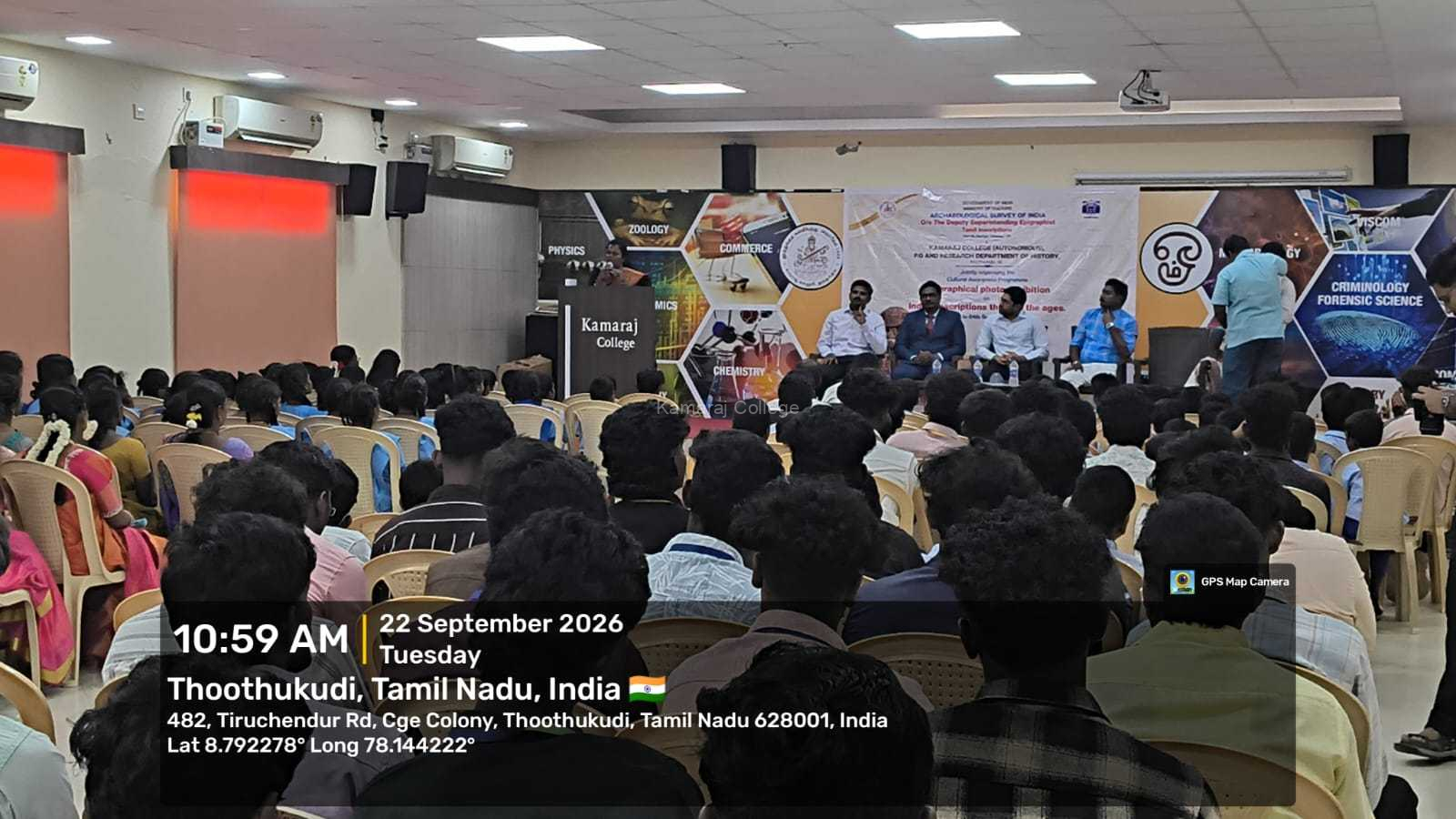

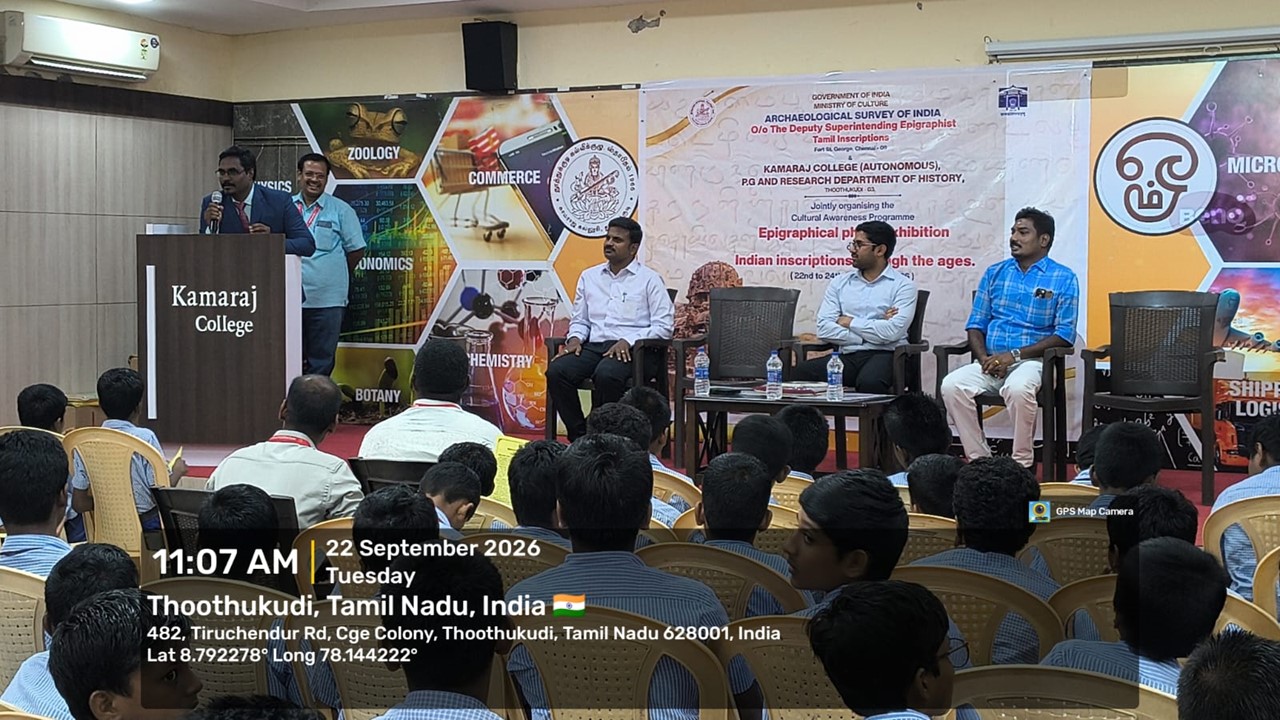
Indian Inscriptions Exhibition titled “Indian Inscriptions Through the Ages” was the central highlight of a One-Day Cultural Awareness Programme organised by the P.G. and Research Department of History, Kamaraj College (Autonomous), Thoothukudi, in collaboration with the Office of the Deputy Superintending Epigraphist, Tamil Inscriptions, Archaeological Survey of India (ASI), Chennai. The programme was held on 22 September 2026 at 10.30 a.m. in the GN Seminar Hall, Kamaraj College.
The programme brought together academic expertise, heritage awareness and visual documentation to introduce participants to the significance of inscriptions as valuable sources for understanding India’s history and cultural heritage.
Indian Inscriptions Exhibition – Cultural Awareness Programme
The One-Day Cultural Awareness Programme was organised to strengthen awareness about India’s rich historical and epigraphic heritage.
The photo exhibition, “Indian Inscriptions Through the Ages”, formed the central feature of the programme and provided an opportunity to explore the importance of inscriptions in understanding different periods of Indian history.
The collaboration with the Archaeological Survey of India added significant academic value to the programme and connected students with the specialised field of epigraphy.
Traditional Inauguration of the Programme
The programme commenced with the traditional Tamil Thai Vazhthu.
This was followed by the ceremonial lighting of the lamp by the dignitaries, marking the formal beginning of the Cultural Awareness Programme.
The inaugural proceedings created an appropriate setting for a programme devoted to history, inscriptions and cultural heritage.
Welcome Address by Dr. A. Devaraj
Dr. A. Devaraj, Head and Assistant Professor, P.G. and Research Department of History, Kamaraj College, delivered the Welcome Address.
He warmly welcomed the Chief Guest, officials from the Archaeological Survey of India, dignitaries, faculty members, students and other participants to the programme.
The Welcome Address introduced the significance of the event and the academic relevance of creating awareness about India’s historical heritage.
Inaugural Address by Principal Dr. K. Bhanumathi
Dr. K. Bhanumathi, Principal, Kamaraj College (Autonomous), Thoothukudi, delivered the Inaugural Address.
She highlighted the institution’s emphasis on promoting historical and cultural education among students.
The address reinforced the importance of programmes that enable students to connect classroom learning with historical evidence and India’s wider cultural heritage.
Inauguration by Shri Patil Krushna Babruwan, IAS
The programme was officially inaugurated by the Chief Guest, Shri Patil Krushna Babruwan, IAS, Assistant Collector (Training), Thoothukudi District.
He delivered the Presidential Address and highlighted the importance of historical records and the role of public administration in supporting the preservation of national heritage.
His address encouraged participants to recognise historical records not merely as materials from the past but as valuable sources that contribute to an understanding of society, governance and cultural development.
Keynote Address by ASI Epigraphist Dr. M. Yesubabu
Dr. M. Yesubabu, Deputy Superintending Epigraphist I/c, Archaeological Survey of India, Chennai, delivered the Keynote Address.
His participation provided the programme with an important scholarly perspective from the field of epigraphy.
The keynote established the academic framework for understanding inscriptions and their significance in reconstructing and interpreting India’s historical past.
Indian Inscriptions Through the Ages
The major attraction of the Cultural Awareness Programme was the photo exhibition titled “Indian Inscriptions Through the Ages.”
The Indian Inscriptions Exhibition brought attention to inscriptions as important historical records that help scholars understand different aspects of the past.
The exhibition format provided a visual dimension to historical learning and complemented the academic addresses delivered during the programme.
Understanding the Importance of Epigraphy
Epigraphy, the study of inscriptions, is an important source for historical research.
Inscriptions can provide evidence relating to rulers, institutions, society, language, religion, administration and other dimensions of historical development.
The programme helped participants appreciate the importance of carefully recording, preserving and studying inscriptions as part of the country’s historical heritage.
Connecting Students with Primary Historical Sources
One of the major academic values of the Indian Inscriptions Exhibition was its focus on primary historical evidence.
For History students, understanding how evidence is used to reconstruct the past is an essential part of academic learning.
The programme encouraged participants to appreciate inscriptions as direct historical sources and strengthened their understanding of evidence-based historical study.
Collaboration with the Archaeological Survey of India
The collaboration between the P.G. and Research Department of History and the Office of the Deputy Superintending Epigraphist, Tamil Inscriptions, Archaeological Survey of India, Chennai, was a significant feature of the programme.
It provided students with exposure to the work of a national institution engaged in the study and preservation of India’s archaeological and historical heritage.
Such academic collaborations help bridge the gap between classroom education and specialised professional work in fields such as history, archaeology and epigraphy.
Promoting Cultural and Heritage Awareness
The programme encouraged participants to understand the importance of preserving India’s cultural heritage for future generations.
Historical monuments, archaeological remains, inscriptions and other records provide valuable evidence about the development of society over time.
Creating awareness among young people about these resources is therefore important for developing a responsible attitude towards heritage conservation.
Objectives of the Cultural Awareness Programme
The major objectives of the programme were:
- Create awareness about India’s epigraphic heritage
- Introduce students to inscriptions as primary historical sources
- Highlight the importance of epigraphy in historical research
- Promote awareness about cultural heritage preservation
- Provide students with exposure to the work of the Archaeological Survey of India
- Connect classroom learning with historical evidence
- Encourage interest in history, archaeology and epigraphy
- Strengthen institutional collaboration for heritage education
- Develop appreciation for India’s diverse historical legacy
Programme Highlights
- Programme: One-Day Cultural Awareness Programme
- Exhibition: Indian Inscriptions Through the Ages
- Date: 22 September 2026
- Time: 10.30 a.m.
- Venue: GN Seminar Hall, Kamaraj College
- Organised by: P.G. and Research Department of History
- In Collaboration with: Office of the Deputy Superintending Epigraphist, Tamil Inscriptions, Archaeological Survey of India, Chennai
- Chief Guest: Shri Patil Krushna Babruwan, IAS, Assistant Collector (Training), Thoothukudi District
- Keynote Speaker: Dr. M. Yesubabu, Deputy Superintending Epigraphist I/c, ASI, Chennai
- Inaugural Address: Dr. K. Bhanumathi, Principal
- Welcome Address: Dr. A. Devaraj, Head and Assistant Professor, Department of History
- Vote of Thanks: Dr. S. Subramaniyan, Assistant Professor, Department of History
Learning Outcomes
The Indian Inscriptions Exhibition and Cultural Awareness Programme enabled participants to:
- Understand the historical importance of inscriptions
- Recognise inscriptions as valuable primary sources
- Develop awareness about the field of epigraphy
- Appreciate India’s historical and cultural heritage
- Understand the importance of preserving historical records
- Gain exposure to the work of the Archaeological Survey of India
- Connect academic study with historical evidence
- Develop greater interest in heritage conservation
Vote of Thanks
The formal session concluded with the Vote of Thanks proposed by Dr. S. Subramaniyan, Assistant Professor, P.G. and Research Department of History.
He expressed gratitude to the organisers, dignitaries, officials, faculty members and student participants whose involvement contributed to the successful conduct of the programme.
Conclusion
The Indian Inscriptions Exhibition titled “Indian Inscriptions Through the Ages”, organised as part of the One-Day Cultural Awareness Programme at Kamaraj College (Autonomous), Thoothukudi, on 22 September 2026, provided a valuable platform for promoting historical and cultural awareness.
The collaboration between the P.G. and Research Department of History and the Archaeological Survey of India, Chennai, enabled participants to gain meaningful exposure to India’s epigraphic heritage and the importance of inscriptions in historical research.
The addresses by Shri Patil Krushna Babruwan, IAS, Dr. M. Yesubabu, Dr. K. Bhanumathi and the faculty members highlighted the importance of historical records, heritage education and preservation.
Overall, the programme successfully combined academic learning, visual historical documentation and cultural awareness, encouraging students to appreciate and preserve India’s rich historical heritage for future generations.
Internal Link
- Kamaraj College (Autonomous), Thoothukudi – Explore more academic, research and cultural programmes conducted by the College.
External Links
- Archaeological Survey of India – Official information on archaeology, monuments, epigraphy and heritage conservation in India.
- Ministry of Culture, Government of India – Official information on India’s cultural heritage, preservation and related initiatives.