
IKS in Microbiology: 10 Powerful Insights on Traditional Science


Introduction
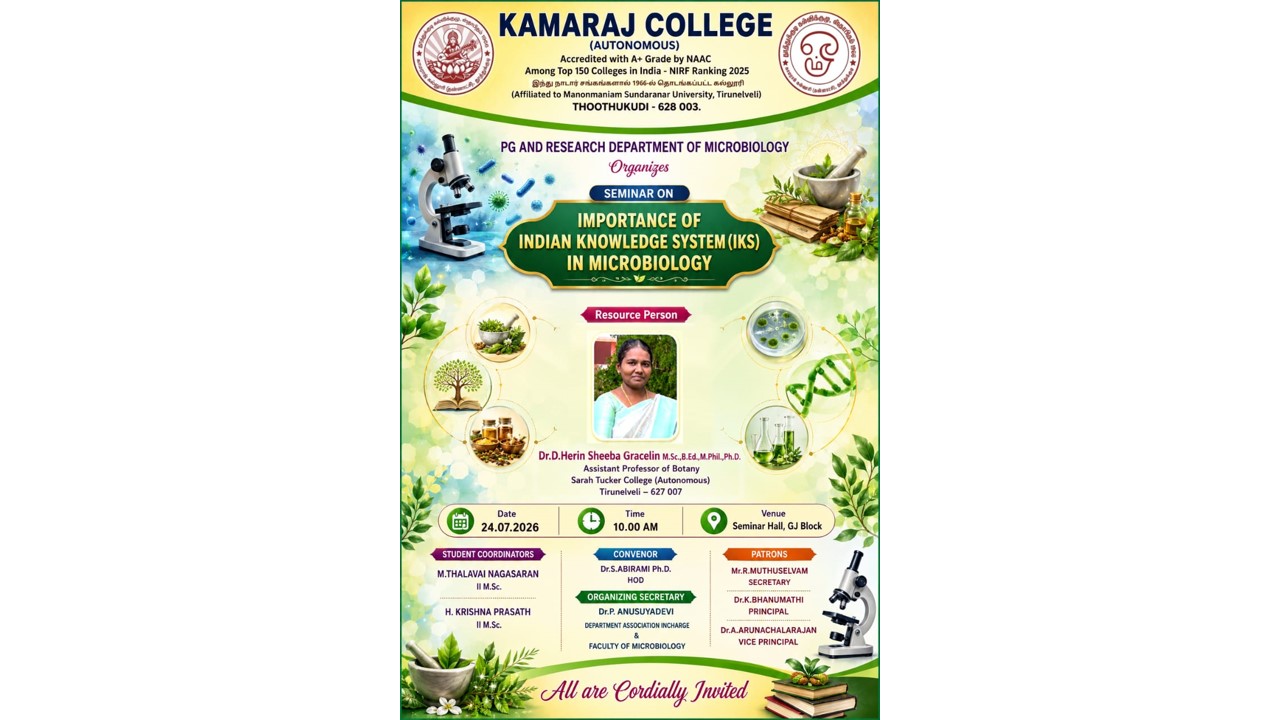
The IKS in Microbiology seminar on the topic “Importance of Indian Knowledge System in Microbiology” was successfully organized by the PG and Research Department of Microbiology of Kamaraj College (Autonomous), Thoothukudi on 24 July 2026 at 10.00 a.m. in the Seminar Hall, Golden Jubilee Block.
The programme was conducted to create awareness among students about the relevance of Indian Knowledge System in microbiology, healthcare, traditional medicine, fermentation technologies and modern biological research.
Objectives of the Seminar
The IKS in Microbiology seminar was organized to help students understand the scientific value of traditional Indian knowledge.
The major objectives of the seminar were:
- To create awareness about Indian Knowledge System in Microbiology
- To highlight the scientific basis of traditional Indian knowledge
- To explain the importance of indigenous medicinal practices
- To create awareness about herbal remedies and healthcare practices
- To introduce the relevance of fermentation technologies
- To connect traditional wisdom with modern microbiological research
- To encourage students to preserve and promote India’s scientific heritage
The seminar helped students understand that traditional knowledge and modern science can work together to support research, healthcare and biological studies.
Welcome Address
The programme commenced with a warm Welcome Address delivered by Ms. J. Sujitha Vadivoo of III B.Sc Microbiology.
She welcomed the dignitaries, faculty members, resource person and students. Her welcome address created a pleasant beginning to the IKS in Microbiology seminar and encouraged students to actively participate in the session.
Guest Introduction
The Guest Introduction was delivered by Mrs. B. Snowlin Josphin Mary of II M.Sc Microbiology.
She introduced the resource person, Dr. D. Herin Sheeba Gracelin, Assistant Professor, Department of Botany, Sarah Tucker College (Autonomous), Tirunelveli, and highlighted her academic background and expertise.
The introduction helped the participants understand the relevance of the resource person to the seminar topic.
Guidance and Organization
The seminar was convened under the guidance of Dr. S. Abirami, Head, PG and Research Department of Microbiology.
The programme was organized by Dr. P. Anusuyadevi, Department Association In-charge and Faculty of Microbiology. Their guidance and coordination ensured the smooth and successful conduct of the seminar.
The efforts of the department reflected its commitment to academic enrichment and research-oriented learning.
Resource Person of the Programme
The resource person for the seminar was Dr. D. Herin Sheeba Gracelin, M.Sc., B.Ed., M.Phil., Ph.D., Assistant Professor, Department of Botany, Sarah Tucker College (Autonomous), Tirunelveli.
She delivered an enlightening lecture on the significance of Indian Knowledge System in the field of Microbiology. Her presentation was clear, informative and academically valuable.
Her session helped students understand how traditional Indian knowledge can contribute to modern scientific research and healthcare practices.
Lecture on Indian Knowledge System
The resource person delivered a meaningful lecture on the importance of Indian Knowledge System in Microbiology. She explained that India has a rich tradition of scientific knowledge connected with medicine, food, health, environment and biological practices.
She highlighted that many traditional practices have scientific relevance and can be studied through modern microbiological methods. The lecture encouraged students to look at Indian knowledge traditions with curiosity, respect and scientific understanding.
The session helped students appreciate the value of India’s scientific heritage.
Traditional Indian Knowledge and Microbiology
The seminar explained the connection between traditional Indian knowledge and microbiology. The resource person highlighted that many traditional practices involve microorganisms, fermentation, natural healing and environmental balance.
Students learned that microbiology can help study and validate traditional practices through scientific methods. This connection helped students understand how ancient knowledge can support modern biological sciences.
The IKS in Microbiology seminar created interest in exploring traditional wisdom through research.
Indigenous Medicinal Practices
A major focus of the seminar was indigenous medicinal practices. The resource person explained how traditional Indian systems have used natural resources for health and healing.
She discussed the importance of studying medicinal practices from a scientific perspective. Students were encouraged to understand how such knowledge can contribute to healthcare research and preventive medicine.
This part of the seminar helped students recognize the importance of traditional health knowledge in modern research.
Herbal Remedies and Healthcare
The seminar also focused on herbal remedies and their relevance to healthcare. The resource person explained that many plants used in traditional practices may have medicinal value.
Students learned that microbiological research can help study the antimicrobial properties, health benefits and safety of herbal preparations. This encouraged students to explore the connection between botany, microbiology and healthcare.
The session helped students understand the research potential of herbal knowledge.
Fermentation Technologies
The resource person highlighted the importance of fermentation technologies in Indian Knowledge System. She explained that traditional food practices often involve fermentation and microbial activity.
Students were made aware of the role of microorganisms in food preparation, preservation and nutrition. The discussion helped them understand that fermentation is an important area where traditional knowledge and microbiology are closely connected.
This topic was highly relevant and useful for Microbiology students.
Integration of Traditional Wisdom and Modern Science
The session emphasized the need to integrate traditional wisdom with contemporary scientific advancements. The resource person explained that traditional knowledge becomes more meaningful when it is studied, tested and applied through scientific methods.
Students were encouraged to approach Indian Knowledge System with a research mindset. The seminar showed how modern microbiology can support the preservation, validation and development of traditional practices.
The session motivated students to think beyond textbooks and explore interdisciplinary research.
Interactive Discussion with Students
The seminar was highly interactive. Students actively participated in the discussion and clarified their queries during the question-and-answer session.
The resource person answered the questions with clarity and practical explanations. The interaction helped students understand the topic better and encouraged them to think deeply about the role of Indian Knowledge System in modern biological sciences.
The active participation of students made the seminar lively and meaningful.
Preserving India’s Scientific Heritage
The programme provided valuable insights into the importance of preserving and promoting India’s rich scientific heritage. Students were encouraged to respect traditional knowledge and study it with scientific curiosity.
The seminar highlighted that Indian Knowledge System can contribute to modern education, research, healthcare and sustainable development. It also encouraged students to become responsible learners who value both tradition and science.
This message created a strong academic and cultural impact among the participants.
Role of the Department of Microbiology
The PG and Research Department of Microbiology played an important role in organizing the seminar. The department created a platform for students to understand the connection between microbiology and Indian Knowledge System.
Through this programme, students were introduced to new areas of research and interdisciplinary learning. The seminar strengthened their academic interest and encouraged them to explore traditional knowledge through modern scientific methods.
Benefits for Students
The seminar provided several valuable benefits to the student participants.
- Students gained awareness about IKS in Microbiology
- They understood the scientific value of traditional Indian knowledge
- They learned about indigenous medicinal practices
- They gained awareness about herbal remedies and healthcare
- They understood the role of fermentation technologies
- They learned the importance of integrating tradition with modern science
- They were encouraged to preserve and promote India’s scientific heritage
These benefits helped students develop academic interest, research thinking and respect for traditional knowledge systems.
Outcome of the Seminar
The IKS in Microbiology seminar was successfully conducted and proved to be an enriching academic experience for the students.
The major outcomes of the seminar were:
- Improved awareness about Indian Knowledge System in biological sciences
- Better understanding of traditional knowledge and microbiological relevance
- Awareness about indigenous medicine, herbal remedies and fermentation
- Motivation to study traditional practices through scientific methods
- Encouragement for interdisciplinary research and academic curiosity
- Active student participation in the interactive discussion
- Promotion of India’s rich scientific and cultural heritage
The seminar was informative, interactive and highly beneficial for all student participants.
Vote of Thanks
The programme concluded with the Vote of Thanks proposed by Ms. Benita A. of III B.Sc Microbiology.
She expressed heartfelt gratitude to the resource person for her informative lecture. She also thanked the college management, Principal, Vice Principal, Head of the Department, faculty members, student coordinators and all the participants for making the event a grand success.
The Vote of Thanks brought the seminar to a graceful conclusion.
Conclusion
The seminar on IKS in Microbiology, organized by the PG and Research Department of Microbiology on 24 July 2026 at the Seminar Hall, Golden Jubilee Block, concluded successfully.
The enlightening lecture by Dr. D. Herin Sheeba Gracelin helped students understand the importance of Indian Knowledge System in microbiology, indigenous medicinal practices, herbal remedies, fermentation technologies, healthcare and modern research.
The programme successfully inspired students to appreciate the integration of traditional wisdom with contemporary scientific advancements. Overall, the seminar reflected the commitment of Kamaraj College to quality education, research awareness, Indian Knowledge System, scientific heritage and holistic academic development.
Internal Link
Kamaraj College (Autonomous), Thoothukudi