
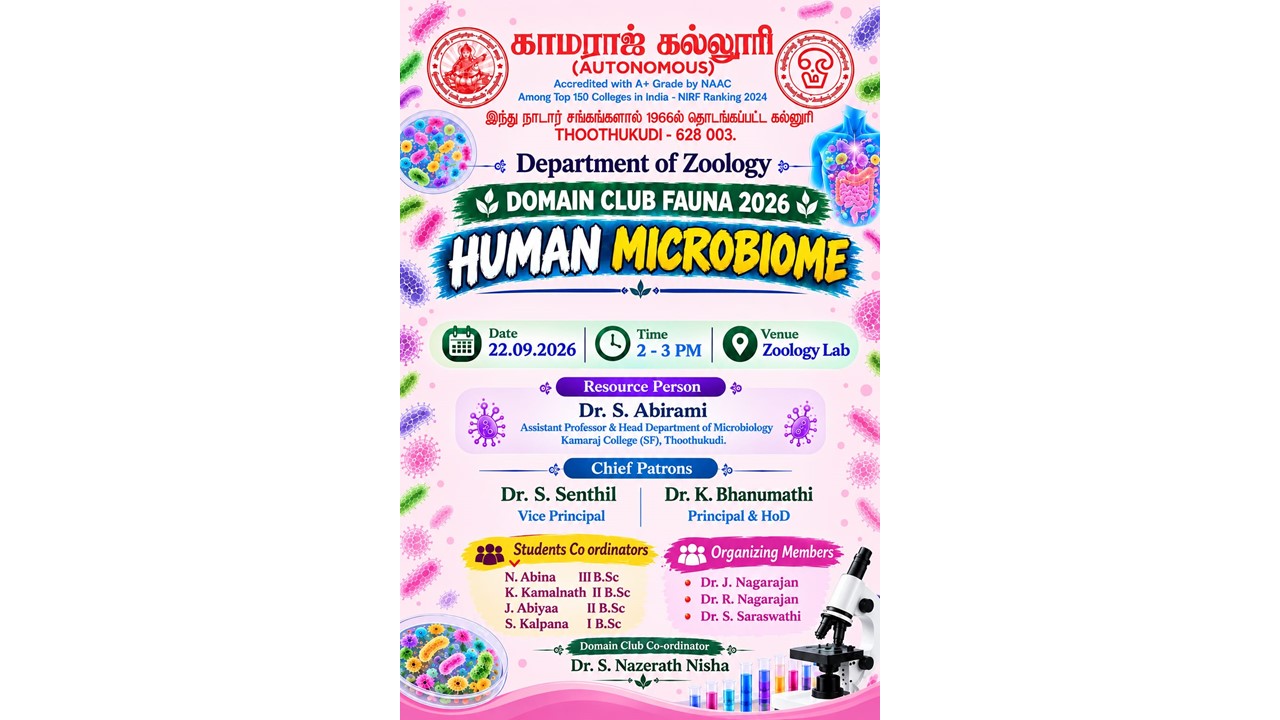
Human Microbiome Awareness 2026: Inspiring FAUNA Session on Probiotics
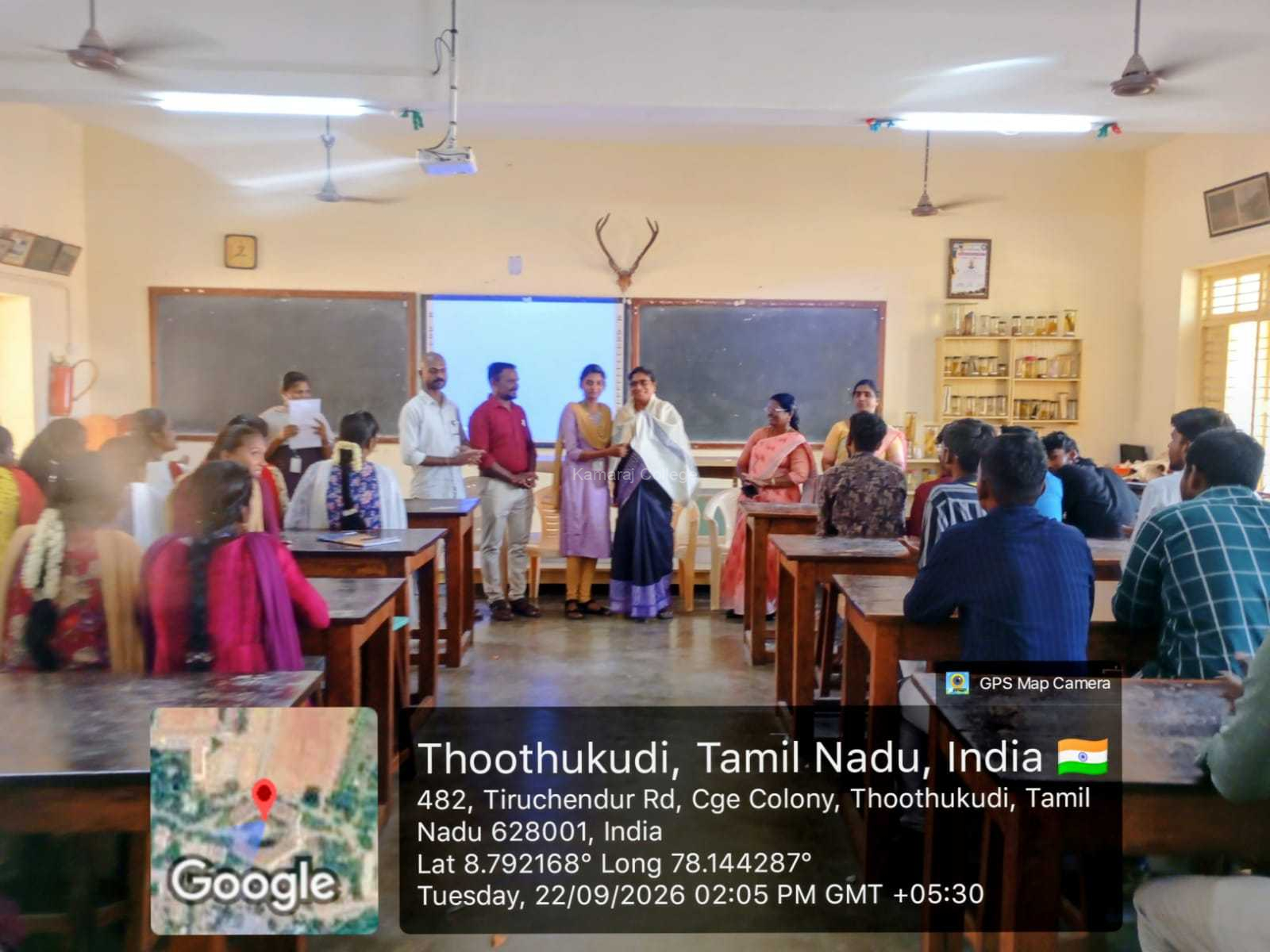
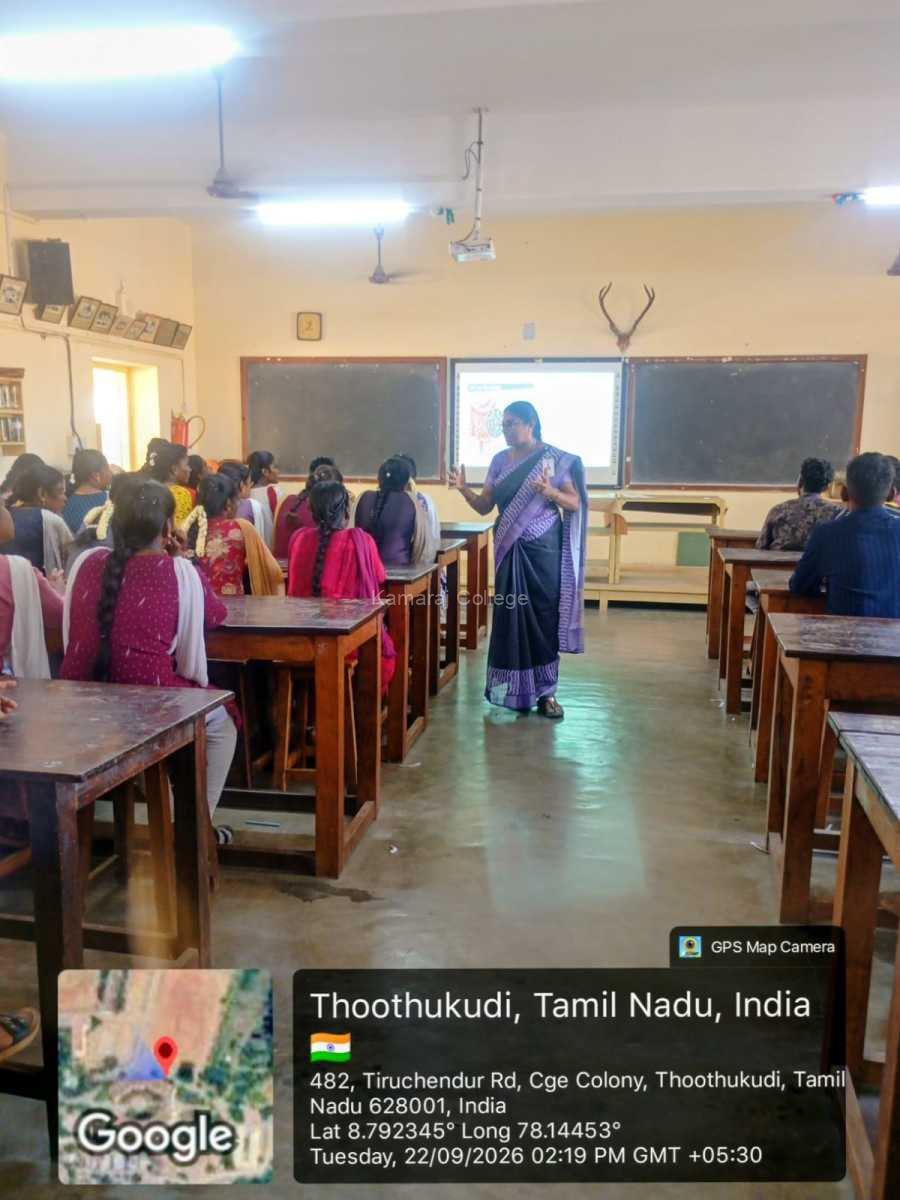
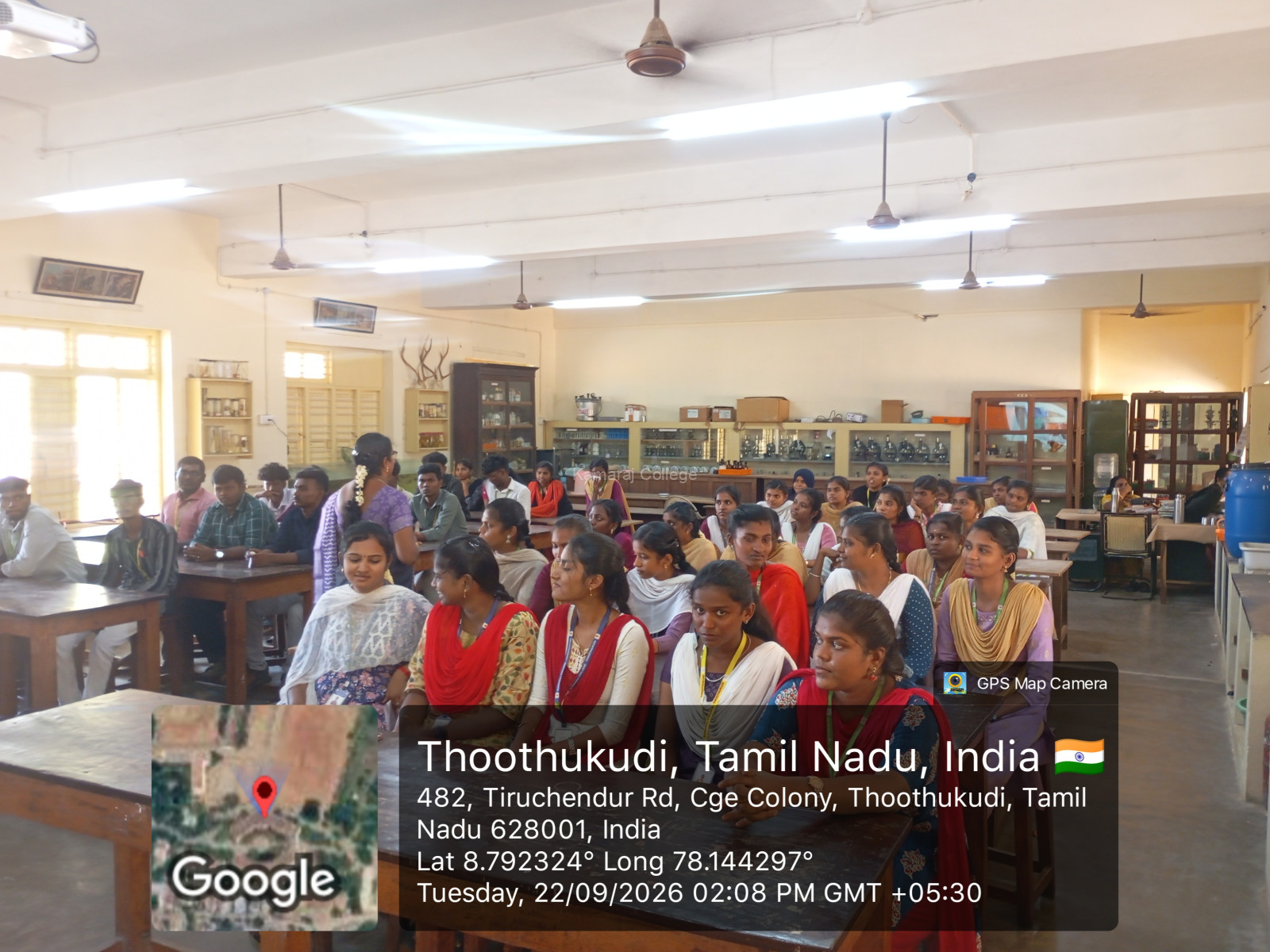
Human Microbiome Awareness was the focus of the FAUNA 2026 Domain Club Programme organised by the Department of Zoology, Kamaraj College (Autonomous), Thoothukudi, on 22 September 2026. The programme featured an informative session on “Human Microbiome, Probiotics and Prebiotics” delivered by Dr. S. Abirami, Head and Assistant Professor, Department of Microbiology, Kamaraj College.
The programme was coordinated by Dr. S. Nazerath Nisha, Domain Club Coordinator, along with the staff members of the Department of Zoology. The session enabled students to understand the significance of microorganisms associated with the human body and the beneficial roles of probiotics and prebiotics.
FAUNA 2026 Domain Club Programme
The Department of Zoology organised the programme as part of its FAUNA 2026 Domain Club activities to provide students with academic exposure beyond the regular curriculum.
The session connected concepts from Zoology, Microbiology, nutrition and human health, enabling students to understand the relevance of microorganisms in everyday biological processes.
The interdisciplinary nature of the topic made the programme particularly useful for students interested in understanding the relationship between microorganisms and human well-being.
Welcome Address
The programme commenced with the Welcome Address delivered by Muthuvigneshwari, III B.Sc. Zoology.
She warmly welcomed the Resource Person, faculty members and students to the programme.
The welcome marked the formal commencement of the FAUNA 2026 academic session and set the stage for the resource person’s presentation.
Expert Session by Dr. S. Abirami
Dr. S. Abirami, Head and Assistant Professor, Department of Microbiology, Kamaraj College, served as the Resource Person.
She delivered an informative talk on:
“Human Microbiome, Probiotics and Prebiotics”
The session introduced students to the human microbiome and explained the importance of beneficial microorganisms associated with the human body.
Understanding the Human Microbiome
The Human Microbiome Awareness session helped students understand the significance of the microbial communities associated with the human body.
The Resource Person highlighted the importance of maintaining an appropriate balance of microorganisms and explained their relevance to human health.
The discussion provided students with a broader understanding of how microorganisms can have beneficial roles rather than being viewed only in relation to disease.
Learning About Probiotics
An important component of the session focused on probiotics.
Students were introduced to the beneficial roles of probiotics and their relationship with microorganisms in the human body.
The discussion helped students connect their biological knowledge with practical concepts related to microorganisms, nutrition and health.
Understanding Prebiotics
The Resource Person also explained the concept and importance of prebiotics.
The session helped students understand the relationship between prebiotics and beneficial microorganisms and how these concepts are connected to maintaining microbial balance.
Discussing probiotics and prebiotics together provided students with a clearer understanding of their distinct but related roles.
Microorganisms, Nutrition and Human Health
One of the key aspects of the programme was the connection established between beneficial microorganisms, nutrition and human health.
The session encouraged students to understand biological concepts from an interdisciplinary perspective.
By connecting microbiology with nutrition and human biology, the programme broadened students’ academic understanding and demonstrated the practical relevance of the subject.
Interdisciplinary Learning Experience
The programme created an opportunity for Zoology students to learn directly from a faculty expert in Microbiology.
Such interdisciplinary interaction enables students to understand how different branches of life sciences complement one another.
The Human Microbiome Awareness programme therefore extended learning beyond a single discipline and encouraged students to appreciate the interconnected nature of biological sciences.
Role of FAUNA 2026
The FAUNA 2026 Domain Club programme provided students with an academic platform to explore contemporary and relevant topics in life sciences.
Domain Club activities complement classroom education by exposing students to specialised topics, expert perspectives and interdisciplinary concepts.
The session on the human microbiome, probiotics and prebiotics effectively supported this objective.
Programme Coordination
The programme was coordinated by Dr. S. Nazerath Nisha, Domain Club Coordinator, along with the staff members of the Department of Zoology.
Their coordination contributed to the smooth conduct of the programme and provided students with a meaningful academic learning opportunity.
Objectives of the Programme
The major objectives of the programme were:
- Create awareness about the human microbiome
- Introduce students to beneficial microorganisms in the human body
- Develop an understanding of probiotics and their roles
- Explain the concept and significance of prebiotics
- Highlight the importance of microbial balance
- Connect microorganisms with nutrition and human health
- Promote interdisciplinary learning between Zoology and Microbiology
- Provide students with academic exposure beyond classroom learning
Programme Highlights
- Programme: FAUNA 2026 – Domain Club Programme
- Date: 22 September 2026
- Organised by: Department of Zoology
- Institution: Kamaraj College (Autonomous), Thoothukudi
- Topic: Human Microbiome, Probiotics and Prebiotics
- Resource Person: Dr. S. Abirami
- Designation: Head and Assistant Professor, Department of Microbiology, Kamaraj College
- Domain Club Coordinator: Dr. S. Nazerath Nisha
- Welcome Address: Muthuvigneshwari, III B.Sc. Zoology
- Vote of Thanks: Vidhya, III B.Sc. Zoology
- Key Focus: Human Microbiome, Beneficial Microorganisms, Probiotics, Prebiotics, Nutrition and Health
Learning Outcomes
The Human Microbiome Awareness programme enabled students to:
- Understand the basic concept of the human microbiome
- Recognise the beneficial roles of microorganisms
- Understand the significance of microbial balance
- Gain knowledge about probiotics
- Understand the concept of prebiotics
- Recognise the relationship between microorganisms and nutrition
- Understand the relevance of microbiology to human health
- Develop an interdisciplinary perspective on life sciences
Vote of Thanks
The programme concluded with the Vote of Thanks proposed by Vidhya, III B.Sc. Zoology.
The session provided students with useful academic insights and strengthened their understanding of the relationship between the human body and its associated microorganisms.
Conclusion
The Human Microbiome Awareness session organised as part of the FAUNA 2026 Domain Club Programme by the Department of Zoology, Kamaraj College (Autonomous), Thoothukudi, on 22 September 2026 was an informative and beneficial academic initiative.
The expert talk by Dr. S. Abirami, Head and Assistant Professor, Department of Microbiology, helped students understand the human microbiome, probiotics, prebiotics and the beneficial roles of microorganisms.
The session also provided valuable insights into the relationship between microorganisms, nutrition and human health, while encouraging interdisciplinary learning among Zoology students.
Coordinated by Dr. S. Nazerath Nisha along with the staff members of the Department of Zoology, the programme successfully provided students with meaningful academic exposure and a better understanding of an important area of modern life sciences.
Internal Link
- Kamaraj College (Autonomous), Thoothukudi – Explore more Domain Club programmes, academic activities and student-development initiatives of the College.
External Links
- University Grants Commission – Official information on higher education and academic initiatives in India.
- Indian Council of Medical Research – Official resources and information related to biomedical and health research in India.