
Communication Skills 2026: Powerful Training to Speak with Confidence
Report on Soft Skills Training – Speak with Confidence
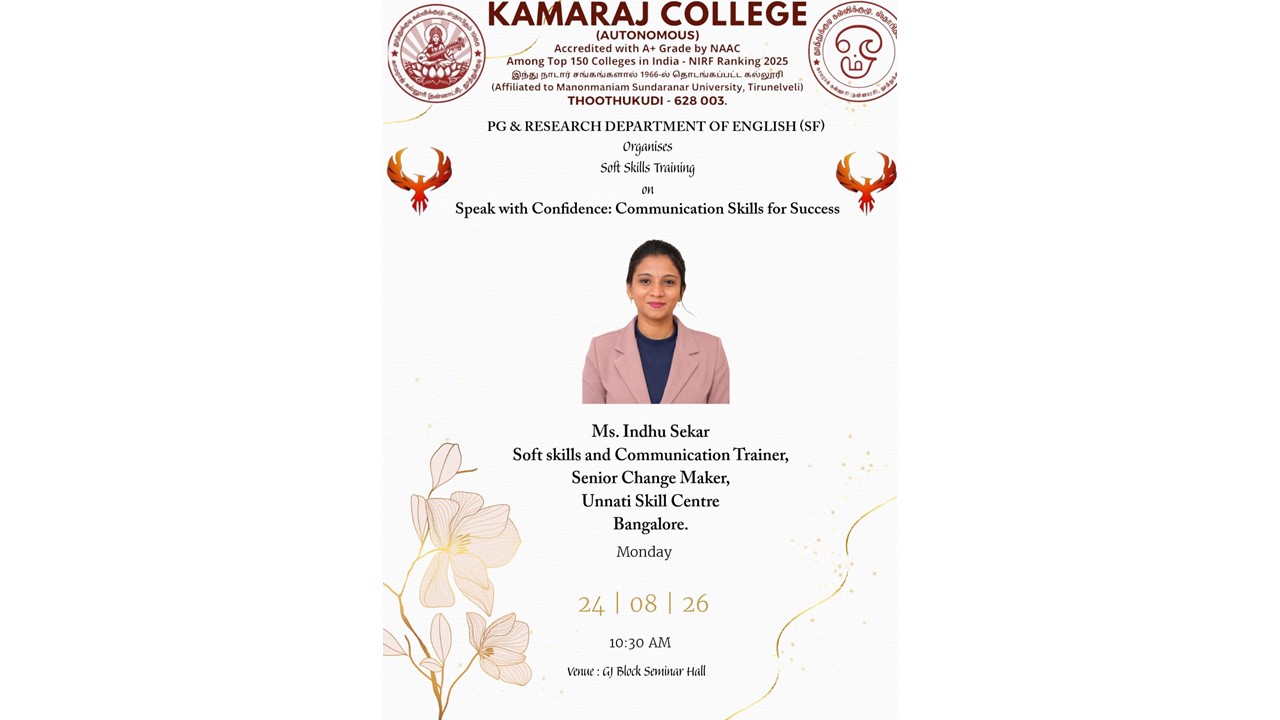
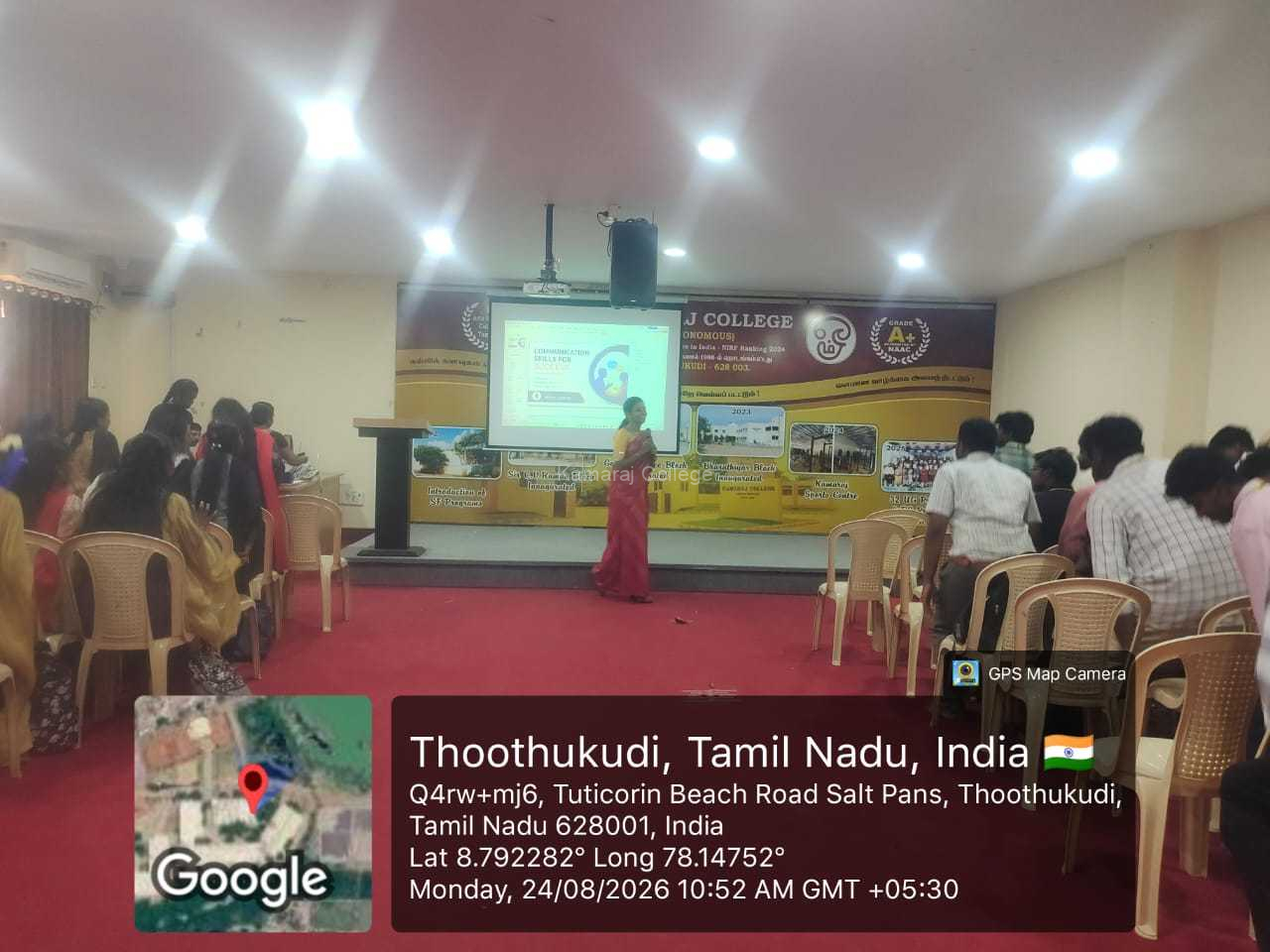
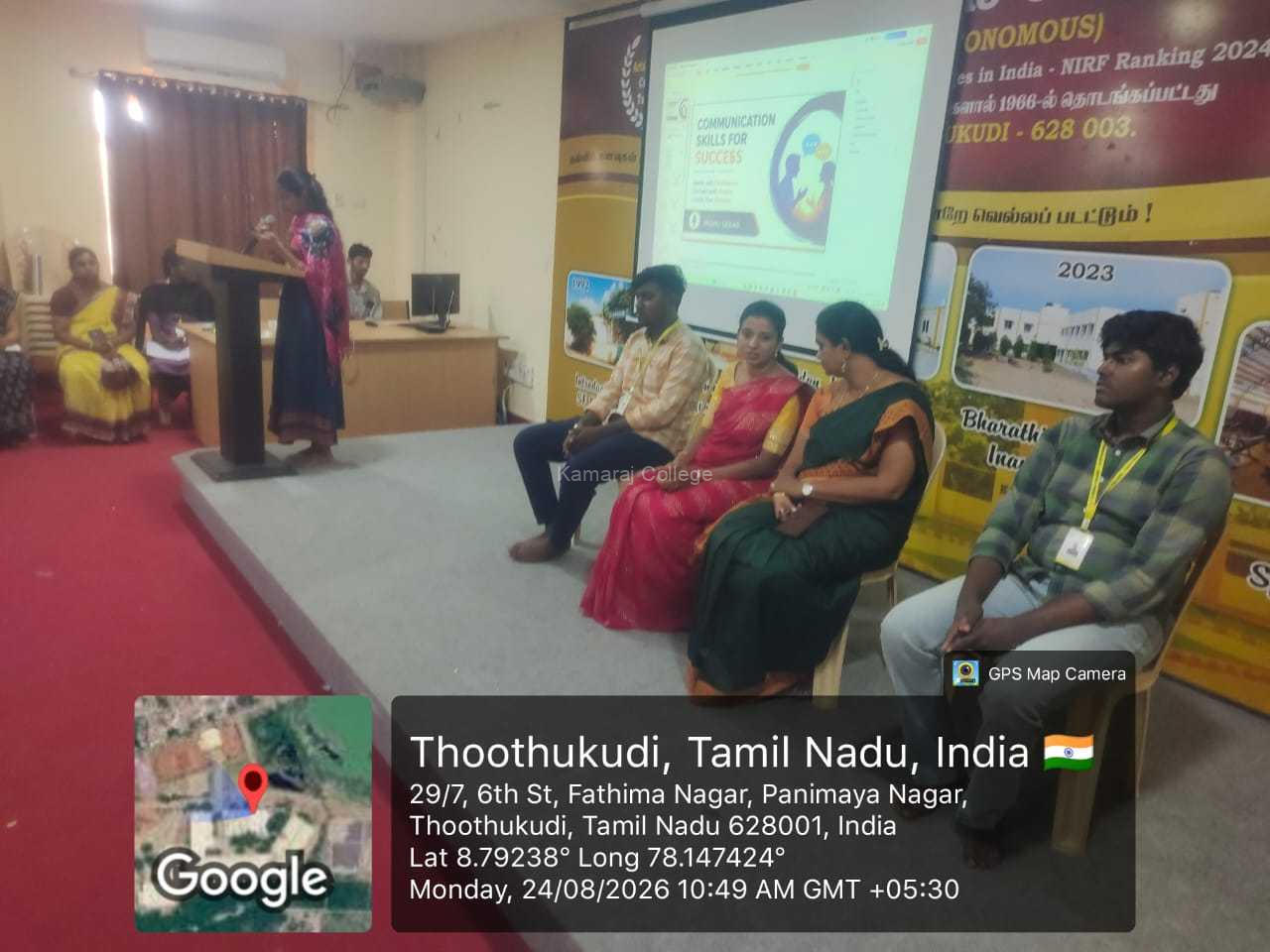
Communication Skills were the focus of a Soft Skills Training session organised by the PG & Research Department of English (SF), Kamaraj College (Autonomous), Thoothukudi, on 24 August 2026 at 10.30 a.m. in the GJ Block Seminar Hall.
The programme was conducted on the topic “Speak with Confidence: Communication Skills for Success.”
Ms. Indhu Sekar, Soft Skills and Communication Trainer and Senior Change Maker, Unnati Skill Centre, Bangalore, served as the resource person.
The session was informative, practical and highly interactive. The resource person shared her knowledge and experience with the students and guided them on the importance of effective communication, confidence, active listening and clear expression.
Furthermore, practical activities encouraged students to express their ideas clearly, overcome hesitation and communicate with greater confidence.
Objectives of the Soft Skills Training
The programme aimed to strengthen the communication abilities of students and prepare them for academic, personal and professional situations.
The major objectives were:
- Improve effective communication skills
- Develop confidence in speaking
- Strengthen active listening skills
- Help students express ideas clearly
- Reduce hesitation while communicating
- Encourage active participation in conversations
- Improve interpersonal communication
- Develop professional communication abilities
- Prepare students for interviews and workplace interactions
- Promote overall personality and career development
Thus, the programme provided students with practical opportunities to improve their communication abilities.
Resource Person
The session was handled by Ms. Indhu Sekar, Soft Skills and Communication Trainer and Senior Change Maker, Unnati Skill Centre, Bangalore.
Her experience in soft skills and communication training added practical value to the programme.
She interacted closely with the students and encouraged them to participate actively throughout the session.
Moreover, she shared valuable insights that helped students understand how communication skills can influence their academic performance, confidence and future professional success.
Speak with Confidence
The central theme of the programme was “Speak with Confidence: Communication Skills for Success.”
Confidence plays an important role in effective communication.
Students may have good ideas and knowledge. However, hesitation can prevent them from expressing themselves effectively.
Therefore, the session encouraged students to overcome fear and communicate their thoughts with greater confidence.
The resource person motivated students to practise speaking regularly and become comfortable expressing their ideas before others.
Importance of Effective Communication
The programme highlighted the importance of Communication Skills in different areas of life.
Effective communication helps individuals express ideas, exchange information and build better relationships.
For students, strong communication abilities can improve classroom participation, presentations, group discussions and interactions with faculty members.
Furthermore, communication becomes particularly important when students enter the workplace.
The session therefore encouraged students to view communication as an essential skill for both academic and professional success.
Developing Speaking Skills
Speaking clearly and confidently was one of the major areas addressed during the training.
Students were encouraged to organise their thoughts before speaking and communicate their ideas in an understandable manner.
Regular speaking practice can help students become more comfortable with different communication situations.
Moreover, students who develop confidence in speaking can participate more actively in discussions, presentations and interviews.
The programme therefore provided a useful platform for strengthening oral communication.
Importance of Listening Skills
Effective communication involves both speaking and listening.
The resource person explained the importance of listening skills in successful communication.
Students were encouraged to listen carefully before responding.
Good listening helps individuals understand information correctly and respond appropriately.
Furthermore, active listening can improve interpersonal relationships and reduce misunderstandings.
The session helped students understand that becoming an effective communicator also requires becoming an attentive listener.
Expressing Ideas Clearly
An important outcome of the programme was encouraging students to express their ideas clearly.
During the practical session, students received opportunities to communicate their thoughts and participate in activities.
These exercises helped them understand how clarity can improve communication.
Furthermore, students learned that clear expression requires both confidence and organised thinking.
The practical approach made the learning experience more meaningful and engaging.
Overcoming Hesitation
Hesitation is a common challenge for students while speaking in front of others.
The activities conducted during the session helped participants gradually overcome this hesitation.
Students were encouraged to participate without worrying excessively about making mistakes.
Such an approach can help learners become more comfortable with communication.
Moreover, continuous practice can gradually strengthen confidence and improve fluency.
The training therefore created a supportive environment where students could practise communication without fear.
Interactive Learning
The interactive nature of the session was one of its major strengths.
Instead of relying only on theoretical explanations, the programme involved students directly in the learning process.
Students actively participated in practical activities and expressed their ideas.
This approach allowed them to apply what they learned immediately.
Furthermore, interactive learning encouraged participation and helped students identify their own communication strengths and areas requiring improvement.
Practical Communication Activities
The practical activities conducted during the session provided students with an opportunity to develop their skills through participation.
Students were encouraged to speak, listen and express their thoughts clearly.
The activities also helped participants become more comfortable communicating with others.
As a result, the programme moved beyond theoretical knowledge and provided an experiential learning opportunity.
Such practical training can make soft skills development more effective and memorable.
Building Self-Confidence
The session highlighted the close relationship between communication and self-confidence.
Students who develop confidence are more willing to participate in academic and professional activities.
They can also communicate their knowledge and abilities more effectively.
The resource person encouraged students to believe in their abilities and improve through regular practice.
Furthermore, students were reminded that confidence develops gradually through experience and continuous effort.
Interpersonal Communication
Interpersonal communication is important in academic life as well as in the workplace.
Students regularly interact with classmates, teachers and other individuals.
Therefore, the ability to communicate respectfully and clearly can strengthen relationships and improve teamwork.
The training helped students understand the importance of listening, responding appropriately and communicating with confidence.
These abilities can contribute significantly to their future professional development.
Communication for Academic Success
Strong communication skills can support students in many academic activities.
They can help students participate effectively in:
- Classroom Discussions
- Seminars
- Presentations
- Group Activities
- Academic Interactions
- Project Discussions
- Public Speaking
Therefore, developing communication abilities can contribute directly to students’ academic confidence and participation.
Communication for Career Success
The programme also connected Communication Skills with future career development.
Employers expect graduates to communicate effectively with colleagues, customers and other professionals.
Good communication is also important during interviews, group discussions and workplace presentations.
Therefore, students who strengthen their communication abilities during college can prepare themselves more effectively for employment.
The training encouraged participants to view soft skills development as an important part of career preparation.
Preparing for Interviews and Group Discussions
Confidence and communication are particularly important during recruitment.
Candidates need to express their knowledge and abilities clearly during interviews.
Similarly, group discussions require participants to listen to others, organise their thoughts and communicate appropriately.
The skills developed through communication training can therefore help students approach recruitment activities with greater confidence.
Furthermore, overcoming hesitation can enable them to participate more actively in selection processes.
Professional Communication
Professional environments require individuals to communicate with clarity and respect.
Students need to understand how communication may vary depending on the situation and audience.
The programme encouraged students to develop a professional approach to communication.
This includes listening carefully, expressing ideas clearly and responding appropriately.
Developing these habits during college can make the transition to professional life smoother.
Importance for English Students
The programme was particularly relevant for students of the PG & Research Department of English (SF).
English students develop strong foundations in language, literature and communication through their academic studies.
Soft skills training provides an opportunity to apply these abilities in practical situations.
Furthermore, strong communication can support careers in teaching, media, content development, corporate communication, administration and many other professional fields.
The programme therefore complemented classroom learning with practical skill development.
Developing Employability Skills
Communication is a major component of employability.
Employers often look for graduates who can work with others, communicate clearly and adapt to different situations.
Students were therefore encouraged to develop communication alongside their academic knowledge.
The session also highlighted the importance of confidence and listening as part of professional readiness.
Consequently, the training supported the overall employability development of the participants.
Learning Through Participation
Students actively participated in the practical session and expressed their ideas clearly.
Their involvement made the programme lively and interactive.
Participation also allowed them to practise the skills discussed by the resource person.
Moreover, the activities encouraged students who may normally hesitate to speak before others.
This practical involvement strengthened the overall learning outcome of the programme.
Key Skills Developed
The Soft Skills Training focused on several important competencies:
- Communication Skills
- Speaking Confidence
- Active Listening
- Clear Expression
- Interpersonal Communication
- Presentation Skills
- Self-Confidence
- Professional Communication
- Active Participation
- Career Readiness
Together, these skills can contribute to students’ academic, personal and professional development.
Programme Highlights
- Programme: Soft Skills Training
- Topic: Speak with Confidence: Communication Skills for Success
- Date: 24 August 2026
- Time: 10.30 a.m.
- Venue: GJ Block Seminar Hall
- Organised by: PG & Research Department of English (SF)
- Institution: Kamaraj College (Autonomous), Thoothukudi
- Resource Person: Ms. Indhu Sekar
- Designation: Soft Skills and Communication Trainer and Senior Change Maker
- Organisation: Unnati Skill Centre, Bangalore
- Major Focus: Communication, confidence, listening and clear expression
- Key Feature: Interactive and practical communication activities
Programme Outcomes
The Communication Skills training produced several valuable learning outcomes.
Through the programme, students:
- Understood the importance of effective communication
- Developed greater confidence in speaking
- Recognised the importance of active listening
- Practised expressing their ideas clearly
- Learned ways to overcome hesitation
- Improved their participation in communication activities
- Developed awareness of professional communication
- Understood the role of communication in career success
- Recognised the value of continuous practice
- Gained motivation to improve their overall soft skills
Overall, the programme provided students with a practical and supportive platform to strengthen their communication abilities.
Conclusion
The Soft Skills Training session on “Speak with Confidence: Communication Skills for Success”, organised by the PG & Research Department of English (SF), Kamaraj College (Autonomous), Thoothukudi, on 24 August 2026, was an informative, interactive and valuable learning experience.
Ms. Indhu Sekar, Soft Skills and Communication Trainer and Senior Change Maker, Unnati Skill Centre, Bangalore, shared her knowledge and experience with the students and provided practical guidance on effective communication.
The programme highlighted the importance of speaking with confidence, active listening, clear expression and overcoming hesitation.
Furthermore, the practical activities provided students with opportunities to express their ideas and develop confidence through active participation.
The session successfully demonstrated that strong Communication Skills can contribute significantly to academic performance, interpersonal relationships, employability and future professional success.
Overall, the programme motivated students to practise communication continuously and develop the confidence, listening abilities and professional communication skills required to succeed in their academic and professional lives.
Internal Link
External Links
- Skill India Digital – Explore skill development and career-readiness opportunities for students and young professionals.
- National Career Service – Explore career guidance, employability resources and professional development opportunities.