
Commerce MOU 2026: Powerful Academic Partnership for Student Growth
Report on Memorandum of Understanding Signing Ceremony
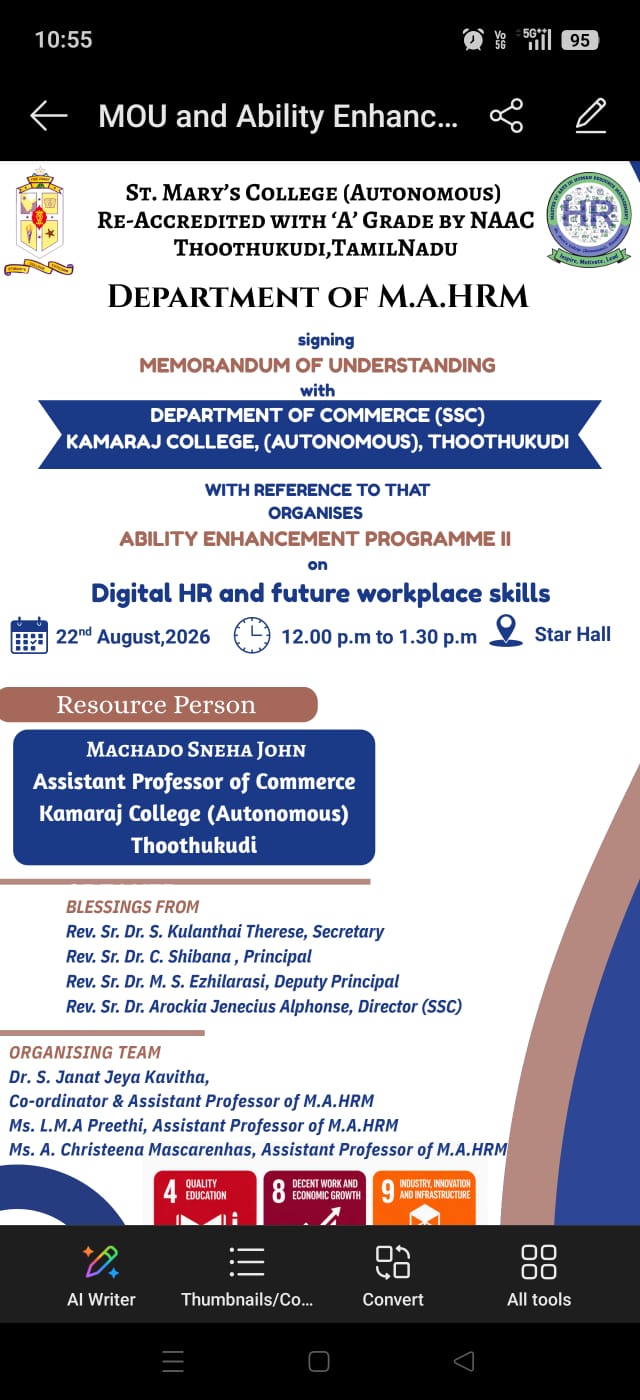
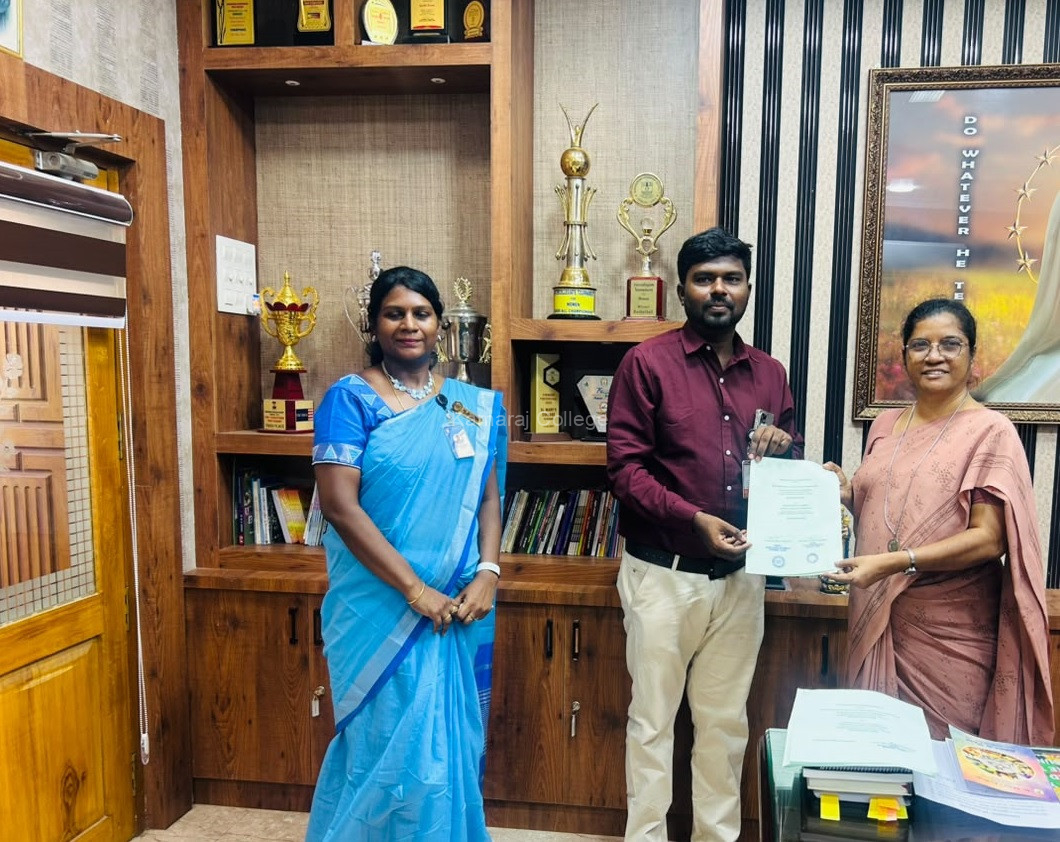
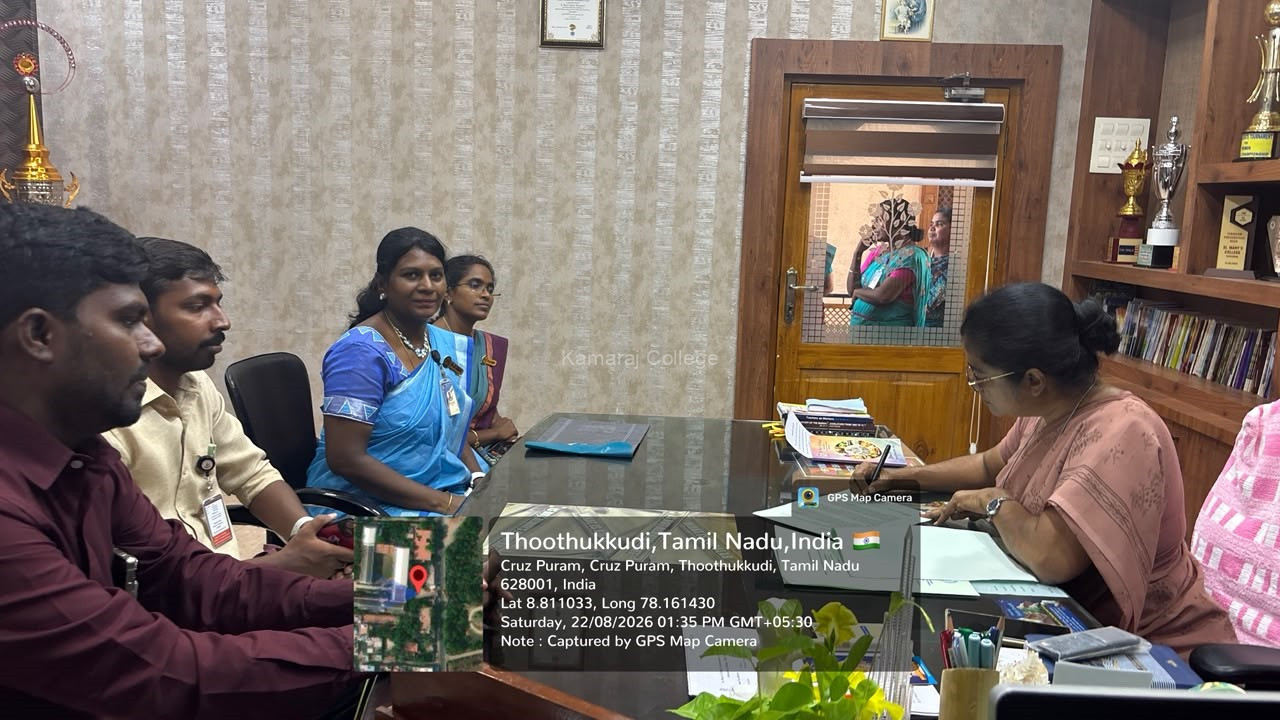
Commerce MOU was signed between the Department of Commerce (SSC), Kamaraj College (Autonomous), Thoothukudi, and the Department of M.A. HRM, St. Mary’s College (Autonomous), Thoothukudi, on 22 August 2026.
The Memorandum of Understanding was established with the objective of strengthening academic collaboration and building a meaningful relationship between the two departments.
The partnership aims to create opportunities for knowledge sharing, skill development, professional exposure, academic interaction and participation in co-curricular activities.
Furthermore, the MOU provides a structured platform through which students and faculty members of both institutions can participate in joint academic initiatives and share knowledge and expertise.
Objectives of the MOU
The Commerce MOU was signed with several academic and developmental objectives.
The major objectives are:
- Strengthen academic collaboration between the two departments
- Promote knowledge sharing among students and faculty members
- Provide opportunities for skill development
- Enhance professional exposure among students
- Encourage joint academic and co-curricular activities
- Promote faculty and student interaction
- Develop industry-relevant competencies
- Improve employability and career readiness
- Encourage the sharing of academic expertise and resources
- Build a sustainable academic partnership between the institutions
Thus, the MOU aims to support both academic enrichment and professional development.
Academic Collaboration
Academic collaboration forms the foundation of the MOU.
Both departments intend to work together in areas that can provide students with wider exposure beyond regular classroom learning.
The partnership encourages the exchange of ideas, knowledge and academic experiences.
Moreover, collaboration between Commerce and Human Resource Management can provide students with an interdisciplinary understanding of business, management, workplace practices and professional development.
Such academic cooperation can help students connect theoretical knowledge with contemporary professional requirements.
Joint Academic Initiatives
Through the Commerce MOU, both departments plan to organise a variety of joint academic initiatives.
These may include:
- Seminars
- Workshops
- Guest Lectures
- Ability Enhancement Programmes
- Training Sessions
- Knowledge-Sharing Activities
- Student Interaction Programmes
- Faculty Interaction Programmes
- Academic Competitions
- Co-curricular Activities
These activities can help students gain fresh perspectives and learn from experts, faculty members and students from both institutions.
Focus on Commerce and Human Resource Management
The collaboration creates an opportunity to connect the fields of Commerce and Human Resource Management.
Commerce students benefit from understanding areas such as business operations, finance, marketing and entrepreneurship.
At the same time, Human Resource Management provides valuable insights into recruitment, employee relations, organisational behaviour, leadership and workplace development.
Therefore, the partnership can support interdisciplinary learning and help students understand how different areas of business function together.
Digital Technologies and Emerging Workplace Trends
The MOU also includes academic initiatives related to digital technologies and emerging workplace trends.
Modern workplaces are changing rapidly due to automation, digital communication, data-based decision-making and new business models.
Students need to understand these developments and prepare themselves accordingly.
Therefore, joint programmes can expose participants to current trends and encourage them to strengthen their digital awareness.
Furthermore, such activities can help students remain adaptable in a changing employment environment.
Skill Development
Skill development is an important objective of the Commerce MOU.
Academic knowledge alone may not be sufficient for professional success. Students also need practical and interpersonal skills.
The collaboration aims to strengthen abilities such as:
- Communication Skills
- Digital Competencies
- Teamwork
- Leadership
- Problem-Solving
- Adaptability
- Professional Awareness
- Presentation Skills
- Workplace Readiness
Developing these competencies can help students prepare for higher education, employment and entrepreneurship.
Enhancing Employability
The partnership also aims to improve students’ employability.
Employers increasingly expect graduates to combine academic knowledge with practical abilities and professional behaviour.
Therefore, students need opportunities to develop communication, teamwork, digital literacy and adaptability.
Joint academic activities under the MOU can provide such exposure.
As a result, students can become better prepared to respond to the expectations of modern workplaces.
Professional Exposure
Professional exposure plays an important role in helping students understand real-world expectations.
The MOU creates opportunities for students to participate in activities that connect academic learning with professional practice.
Guest lectures, workshops and training sessions can introduce students to current workplace requirements.
Moreover, interaction with faculty members and experts from another institution can broaden their academic and professional outlook.
Student Interaction and Knowledge Sharing
The collaboration encourages interaction between students of both departments.
Such interaction can provide opportunities to exchange ideas, discuss academic topics and participate in collaborative activities.
Students can learn from different perspectives and strengthen their communication and teamwork skills.
Furthermore, participation in joint programmes can help them build confidence and improve their ability to work with diverse groups.
Faculty Interaction and Academic Expertise
The MOU also promotes interaction between faculty members of both institutions.
Faculty collaboration can support the sharing of academic expertise, teaching approaches and educational resources.
It can also lead to the development of meaningful academic initiatives for students.
Moreover, collaboration between faculty members can create opportunities for further programmes and institutional partnerships in the future.
Sharing of Academic Resources
Another important aspect of the MOU is the sharing of academic resources and expertise.
Institutions can benefit when departments collaborate and make effective use of available knowledge and educational resources.
This approach can improve the quality of programmes organised for students.
Furthermore, sharing resources can support innovation and encourage both departments to explore new academic activities.
Developing Communication Skills
Effective communication remains a key requirement in academic and professional settings.
Therefore, the partnership aims to provide students with opportunities to develop their speaking, presentation and interpersonal skills.
Participation in seminars, workshops and collaborative activities can help students express their ideas more clearly.
Moreover, such exposure can improve confidence and prepare them for interviews, presentations and professional interactions.
Strengthening Digital Competencies
Digital competence has become increasingly important in business and employment.
Students need to be comfortable with digital platforms, communication tools and emerging technologies.
The MOU therefore provides scope for programmes that can strengthen students’ digital knowledge.
Such initiatives can help them adapt more effectively to technology-driven workplaces.
Promoting Adaptability
The modern employment environment continues to change due to technological and organisational developments.
Therefore, students need the ability to adapt to new roles, tools and expectations.
The Commerce MOU aims to create learning opportunities that encourage flexibility and continuous development.
Students can benefit from exposure to different academic environments and professional perspectives.
This can help them become more confident in responding to change.
Holistic Development of Students
The collaboration is expected to support the holistic development of students.
Academic achievement remains important. However, students also need practical skills, professional awareness and interpersonal abilities.
By participating in joint initiatives, students can develop across multiple areas.
Therefore, the MOU supports a broader approach to student development that includes knowledge, skills, confidence and career readiness.
Benefits for Faculty Members
The partnership is also expected to benefit faculty members.
Academic interaction between departments can lead to the exchange of ideas and good practices.
Faculty members can collaborate in planning seminars, workshops and training programmes.
Furthermore, such interactions can strengthen institutional networking and create new opportunities for academic development.
Building Institutional Networking
The MOU strengthens institutional networking between Kamaraj College (Autonomous) and St. Mary’s College (Autonomous), Thoothukudi.
Strong institutional relationships can support knowledge exchange and create wider opportunities for students and faculty members.
Moreover, collaborative partnerships can encourage institutions to work together on shared academic objectives.
The signing of the MOU therefore marks an important step towards continued cooperation between the two departments.
A Sustainable Academic Partnership
The MOU is intended to create a meaningful and sustainable academic partnership.
Rather than limiting collaboration to a single activity, both departments can continue organising programmes over time.
This long-term approach can create regular opportunities for students and faculty members.
Furthermore, sustained collaboration can strengthen academic relationships and contribute to mutual institutional development.
Areas of Collaboration
The partnership is expected to cover several areas:
- Commerce Education
- Human Resource Management
- Digital Technologies
- Emerging Workplace Trends
- Skill Development
- Professional Communication
- Career Readiness
- Employability Development
- Faculty Interaction
- Student Exchange of Ideas
These areas provide a broad framework for future joint initiatives.
MOU Highlights
- Event: Memorandum of Understanding Signing Ceremony
- Date: 22 August 2026
- First Institution: Kamaraj College (Autonomous), Thoothukudi
- Department: Department of Commerce (SSC)
- Partner Institution: St. Mary’s College (Autonomous), Thoothukudi
- Partner Department: Department of M.A. HRM
- Major Focus: Academic collaboration and skill development
- Key Areas: Commerce, HRM, digital technologies and workplace trends
- Beneficiaries: Students and faculty members of both institutions
- Long-Term Goal: Sustainable academic cooperation and mutual development
Expected Outcomes
The Commerce MOU is expected to generate several positive outcomes.
Through the partnership:
- Students can gain wider academic exposure
- Joint seminars and workshops can be organised
- Professional knowledge can be shared across departments
- Students can strengthen communication skills
- Digital competencies can be improved
- Employability skills can be enhanced
- Faculty members can share academic expertise
- Students can gain interdisciplinary learning experiences
- Institutional networking can be strengthened
- Long-term academic cooperation can be developed
Overall, the partnership creates valuable opportunities for academic enrichment and professional preparation.
Conclusion
The Commerce MOU signed between the Department of Commerce (SSC), Kamaraj College (Autonomous), Thoothukudi, and the Department of M.A. HRM, St. Mary’s College (Autonomous), Thoothukudi, on 22 August 2026 marked an important step towards stronger academic collaboration.
The agreement provides a platform for jointly organising seminars, workshops, guest lectures, ability enhancement programmes, training sessions and knowledge-sharing activities.
It also creates opportunities for students to strengthen their communication skills, digital competencies, adaptability, employability and professional awareness.
Furthermore, the collaboration encourages interaction among students and faculty members while promoting the sharing of knowledge, academic expertise and resources.
The partnership is expected to support interdisciplinary learning in Commerce, Human Resource Management, digital technologies and emerging workplace trends.
Overall, the MOU signing strengthened institutional networking and created a strong foundation for continued academic cooperation, skill development and mutual growth between the two departments.
Internal Link
External Links
- University Grants Commission – Explore higher education initiatives and academic development resources in India.
- Skill India Digital – Explore skill development and career readiness resources supporting students and young professionals.