
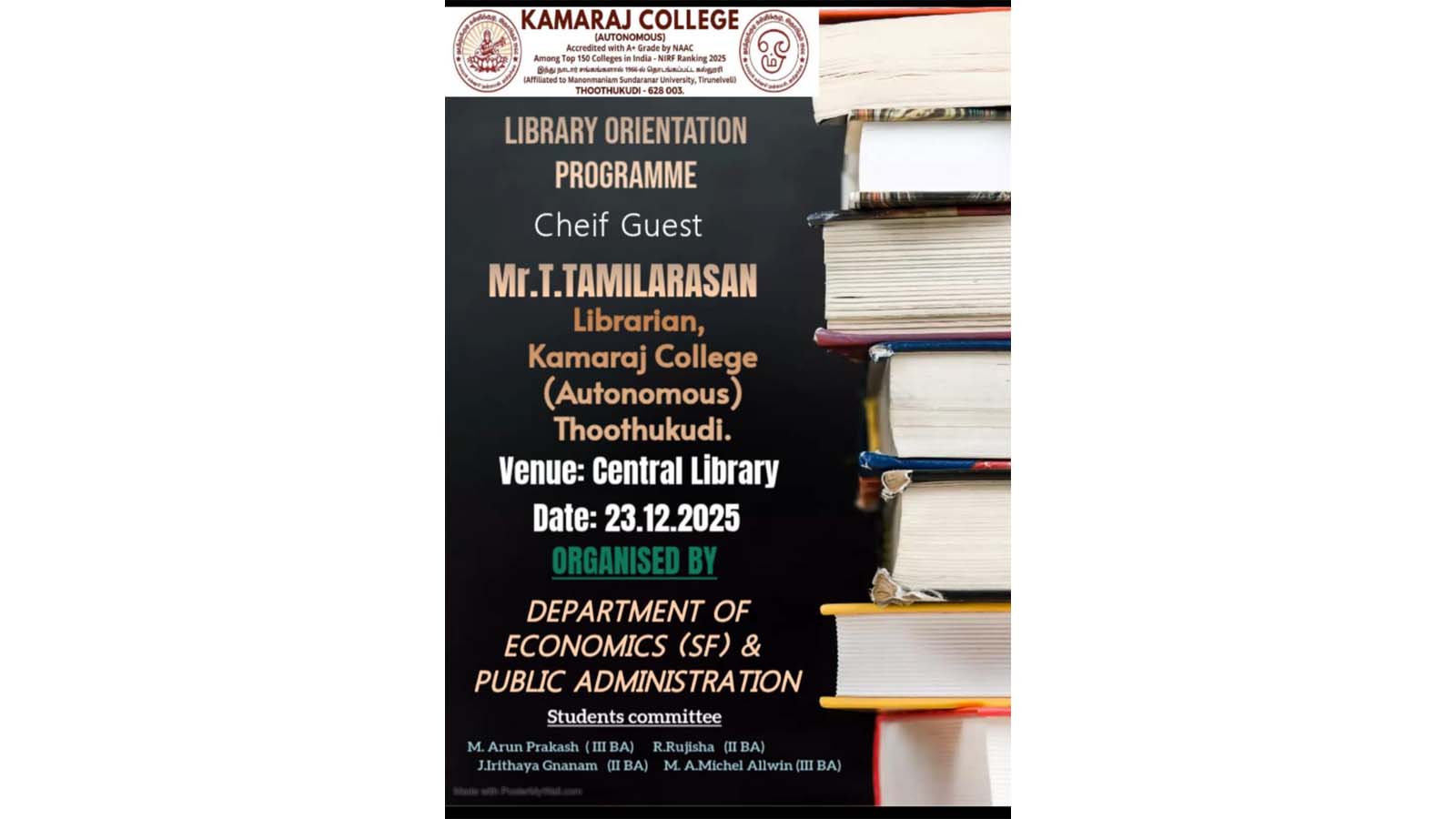
6 Powerful Benefits of Library Orientation Programme at Kamaraj College


Library Orientation Programme
On 23 December 2025, the Department of Economics (Self-Finance) and the Department of Public Administration of Kamaraj College (Autonomous), Thoothukudi, jointly organized a Library Orientation Programme at the Central Library of the college. The programme was conducted from 11.30 a.m. to 01.00 p.m. on the college campus with the objective of familiarizing students with library resources and promoting effective academic learning.
The Library Orientation Programme was designed to help students understand the importance of the library as a vital academic support system and to encourage regular and independent learning habits.
Objectives of the Library Orientation Programme
The primary objective of the Library Orientation Programme was to introduce students, especially first-year learners, to the wide range of academic resources available in the college library. The programme aimed to cultivate information literacy skills and to guide students on how to efficiently access and utilize library facilities.
Key objectives included:
- Creating awareness about library services
- Encouraging regular library usage
- Supporting academic and research activities
- Promoting independent and self-directed learning
Chief Guest and Resource Person
The Library Orientation Programme featured Mr. T. Tamilarasan, Librarian, Kamaraj College (Autonomous), Thoothukudi, as the chief guest and resource person. With his extensive experience in academic librarianship, he delivered a comprehensive and engaging session on the role of libraries in higher education.
His interaction with students added significant value to the Library Orientation Programme, making it informative and practical.
Importance of Library in Academic Learning
During the Library Orientation Programme, the resource person emphasized the crucial role of the library in enhancing academic performance. He explained how libraries support classroom learning by providing access to textbooks, reference materials, competitive examination guides, journals, and research publications.
He highlighted that effective use of library resources helps students improve subject understanding, critical thinking, and research skills, which are essential for academic success.
Introduction to Library Sections and Resources
A major component of the Library Orientation Programme was the detailed introduction to various sections of the Central Library. Students were guided through:
- Book circulation and reference sections
- Journals and periodicals section
- Competitive examination resources
- Digital library and e-resources
The librarian explained the procedure for accessing books, journals, and digital databases, enabling students to confidently navigate the library system.
Rules, Regulations, and Library Ethics
As part of the Library Orientation Programme, students were briefed on library rules and regulations. The resource person explained borrowing procedures, return deadlines, and the importance of maintaining discipline and silence within the library premises.
He also emphasized ethical practices such as respecting library materials, avoiding plagiarism, and using academic resources responsibly.
Use of Digital and Online Resources
The Library Orientation Programme also introduced students to digital resources available through the library. The resource person explained how students could access online journals, e-books, and academic databases to support their coursework and research.
Students were encouraged to explore national digital initiatives such as:
National Digital Library of India
This exposure helped students understand the importance of combining traditional library use with digital learning tools.
Student Participation and Engagement
Students from the Departments of Economics and Public Administration actively participated in the Library Orientation Programme. They listened attentively and showed keen interest in learning how to maximize the benefits of library facilities.
The interactive nature of the session allowed students to clarify doubts related to book access, journal usage, and digital resources, making the programme highly engaging.
Academic Benefits of the Library Orientation Programme
The Library Orientation Programme proved particularly beneficial for first-year students, as it helped them transition smoothly into higher education learning practices. The programme encouraged regular library visits, improved study habits, and enhanced academic confidence.
Students gained clarity on how to use the library not only for examinations but also for long-term academic growth and research.
Institutional Support and Learning Environment
Kamaraj College (Autonomous) continues to support student-centered learning through initiatives like the Library Orientation Programme. The Central Library serves as a knowledge hub that complements teaching and research activities across departments.
More details about academic facilities can be accessed at:
Kamaraj College Official Website
Conclusion
The Library Orientation Programme organized by the Department of Economics (SF) and Public Administration was informative, practical, and academically enriching. It successfully familiarized students with library resources and encouraged independent learning.
The guidance provided by the librarian empowered students to make effective use of books, journals, and digital resources, thereby enhancing their academic journey. The programme reaffirmed the importance of libraries in higher education and contributed meaningfully to student development.