
Nanomaterials 2026: Inspiring QUARKS HUB Launch for Physics Students
Report on QUARKS HUB 2026 Inauguration and Resource Lecture
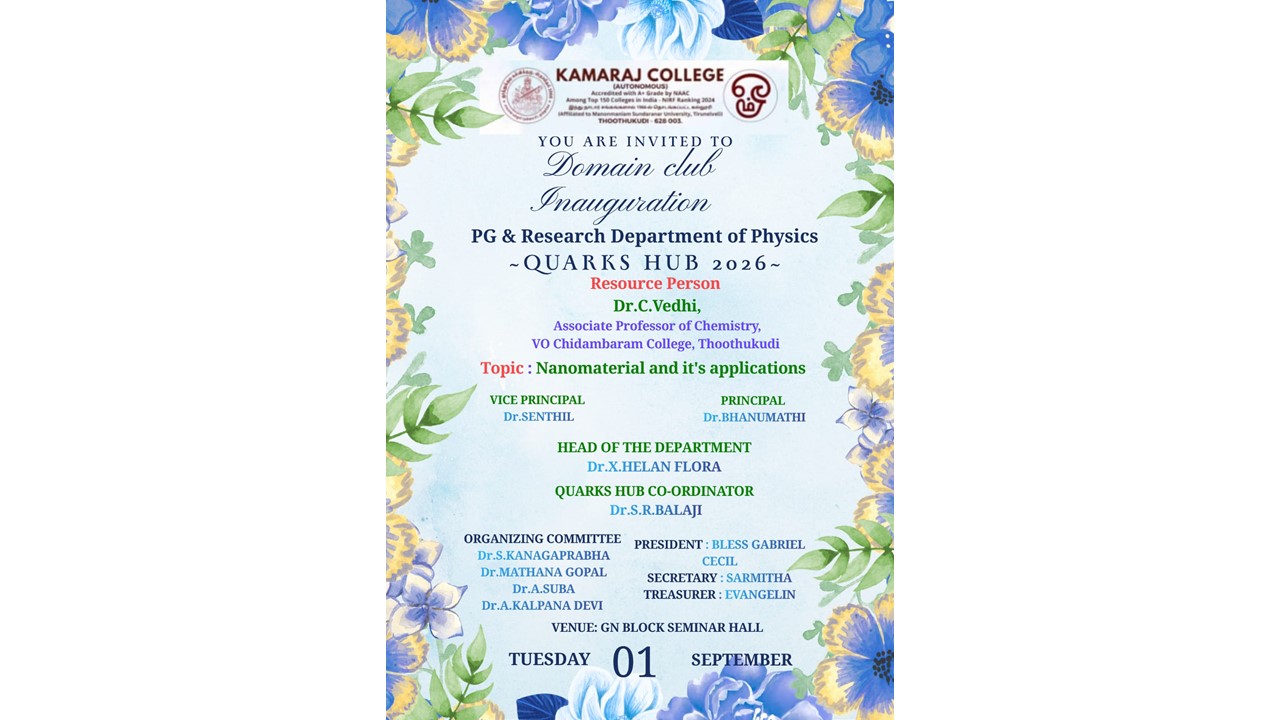
Nanomaterials and their growing importance in science and technology formed the central theme of the inauguration of “QUARKS HUB 2026”, the Domain Club of the PG & Research Department of Physics, Kamaraj College (Autonomous), Thoothukudi, on 1 September 2026.
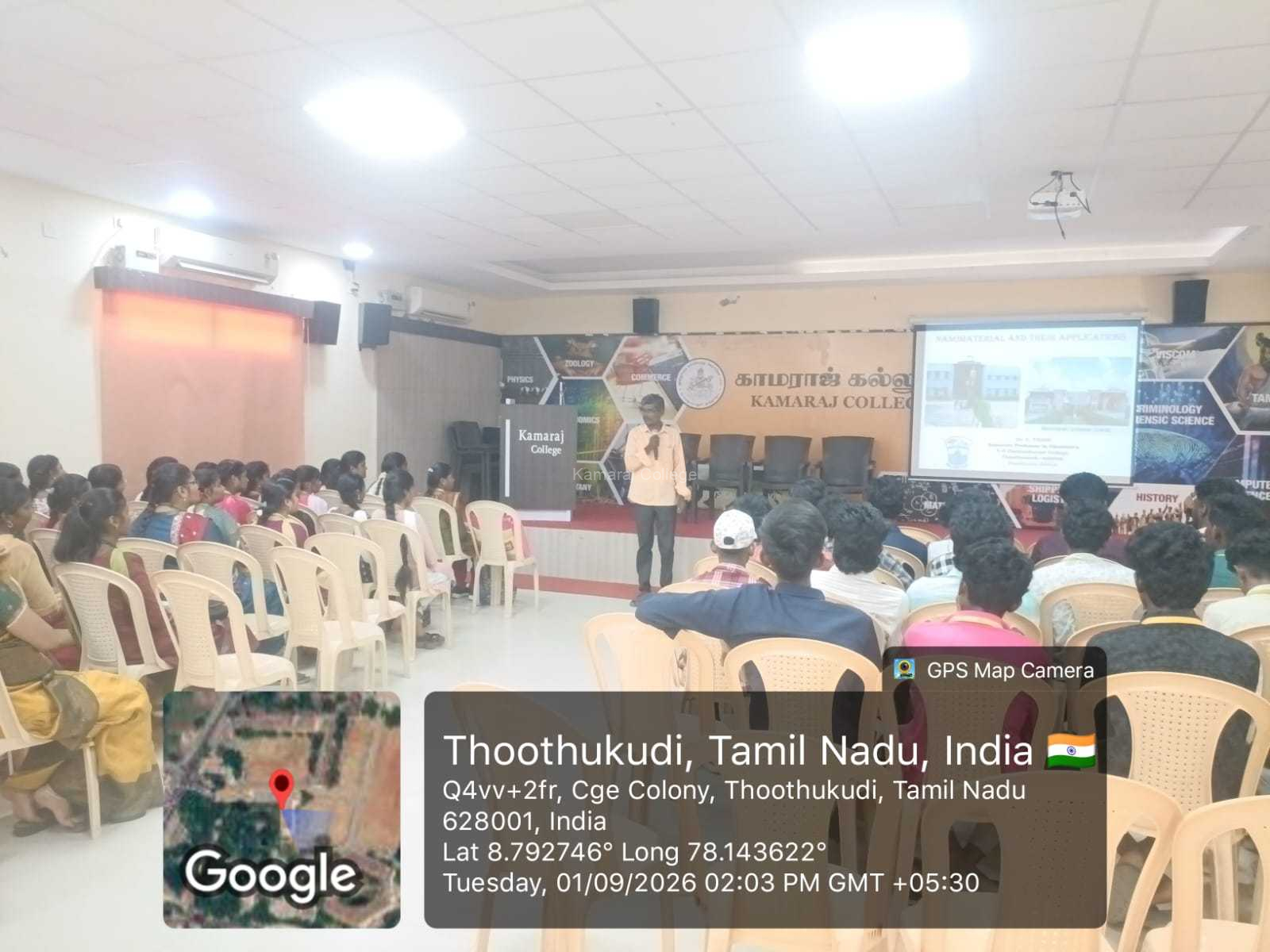
The programme featured an insightful resource lecture on “Nanomaterial and Its Applications” delivered by Dr. C. Vedhi, Associate Professor of Chemistry, V.O. Chidambaram College, Thoothukudi.
The session introduced students to nanomaterials, their distinctive properties and their applications across different areas of science and technology.
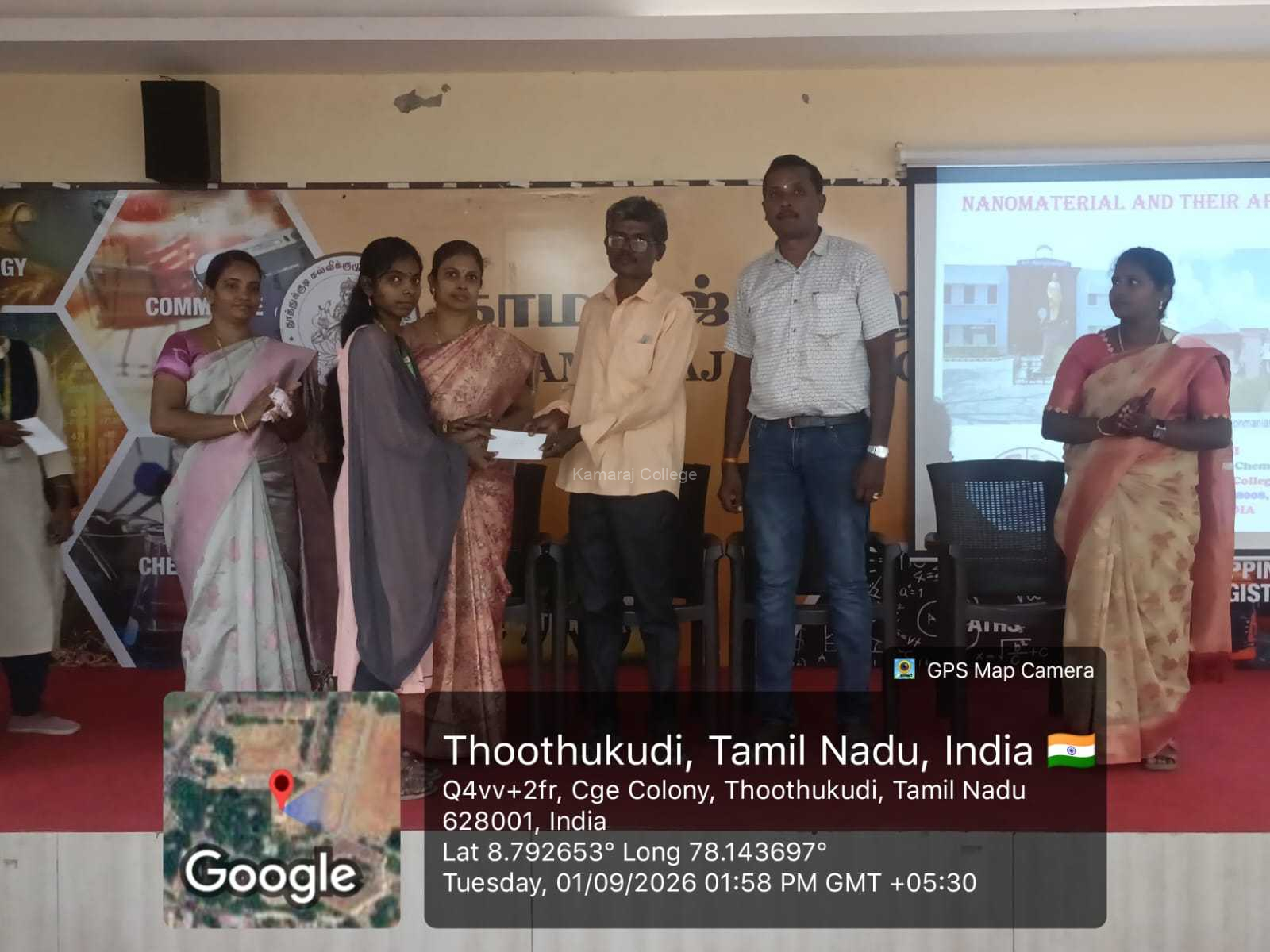
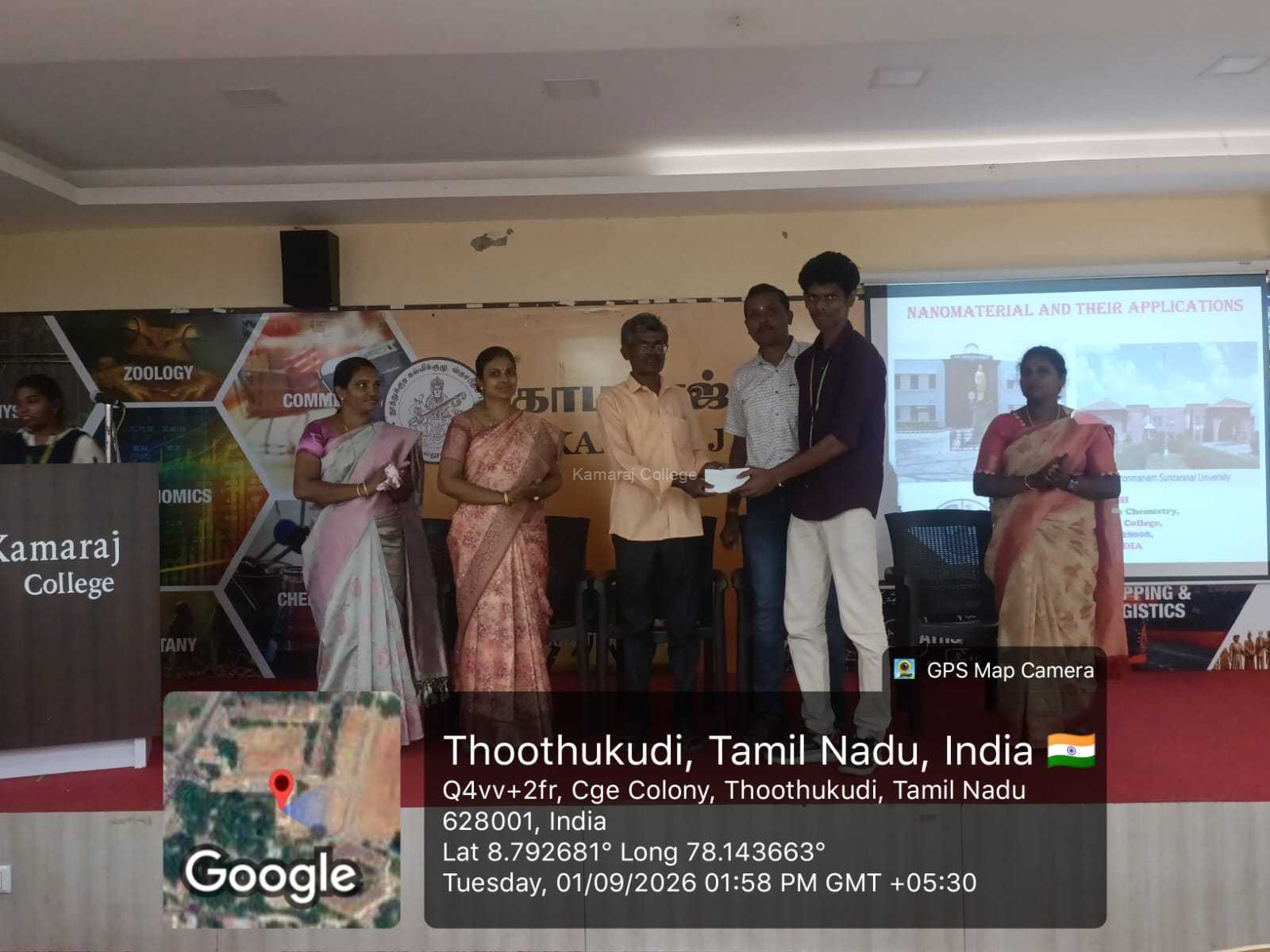
Furthermore, the programme recognised students who had actively participated in the Science Exhibition. Their enthusiasm and contribution were appreciated as part of the Domain Club inauguration.
Overall, the programme provided an enriching academic platform that encouraged scientific curiosity, creativity and interest in emerging areas of science.
Objectives of QUARKS HUB 2026
The inauguration of the Domain Club aimed to create an active academic platform where Physics students could explore scientific developments beyond their regular curriculum.
The major objectives were:
- Inaugurate the Physics Domain Club – QUARKS HUB 2026
- Promote scientific curiosity among students
- Introduce students to emerging areas of science and technology
- Create awareness about nanomaterials and their applications
- Connect classroom concepts with scientific developments
- Encourage creativity and scientific thinking
- Provide opportunities for student participation
- Recognise contributions to scientific activities
- Encourage interdisciplinary learning
- Strengthen students’ interest in research and innovation
Thus, QUARKS HUB 2026 created a platform for students to engage with contemporary scientific ideas while developing their academic interests.
Inauguration of QUARKS HUB 2026
The PG & Research Department of Physics inaugurated its Domain Club under the title “QUARKS HUB 2026.”
The Domain Club provides an opportunity for students to expand their scientific knowledge through lectures, exhibitions, discussions and other academic activities.
Such initiatives encourage learners to explore developments beyond textbooks and understand the wider applications of Physics.
Moreover, the club can provide students with opportunities to participate actively in scientific learning and develop their creativity.
Welcome Address
The programme commenced with the welcome speech delivered by Keerthika T, II B.Sc. Physics.
The welcome address marked the beginning of the programme and set the academic tone for the inauguration.
Student involvement in formal responsibilities also provided opportunities to develop confidence and communication abilities.
Furthermore, such participation encourages students to take greater responsibility in departmental academic activities.
Master of Ceremonies
Ashwini J, II B.Sc. Physics, served as the Master of Ceremonies and coordinated the proceedings of the programme.
Her role contributed to the smooth progression of the various components of the event.
Taking responsibility for programme coordination also provides students with practical opportunities to develop communication, planning and organisational skills.
Thus, student participation extended beyond academic learning to leadership and coordination.
Resource Person
The resource lecture was delivered by Dr. C. Vedhi, Associate Professor of Chemistry, V.O. Chidambaram College, Thoothukudi.
He addressed the students on the topic “Nanomaterial and Its Applications.”
The lecture provided valuable exposure to an emerging scientific area and encouraged students to understand how developments at the nanoscale can influence different areas of research and technology.
Moreover, the session promoted interdisciplinary learning by connecting concepts relevant to Physics, Chemistry and material science.
Understanding Nanomaterials
The resource lecture introduced students to the concept of Nanomaterials and their scientific significance.
Nanomaterials are associated with structures and materials at extremely small scales.
At such dimensions, materials can exhibit characteristics that differ from those observed at larger scales.
Understanding these properties has become important in several areas of modern science and technology.
The lecture therefore helped students appreciate why nanoscience has emerged as an important area of scientific study.
Unique Properties of Nanomaterials
A major focus of the lecture was the unique properties associated with nanomaterials.
The behaviour of materials at the nanoscale can provide scientists with new possibilities for studying and developing materials for specialised applications.
The session helped students understand that the properties of a material can be influenced by factors such as its structure and dimensions.
This concept encouraged students to look beyond conventional descriptions of materials and develop a deeper interest in modern material science.
Applications in Science and Technology
The resource person explained the applications of Nanomaterials in different areas of science and technology.
Nanoscience has become an important interdisciplinary field because its concepts can contribute to developments across multiple scientific and technological domains.
The lecture enabled students to understand how fundamental scientific concepts can eventually support practical applications.
Furthermore, it demonstrated the connection between scientific research, innovation and technological development.
Connecting Physics and Nanoscience
The topic was particularly relevant for students of Physics.
Physics provides important foundations for understanding the properties and behaviour of materials.
Nanoscience enables students to explore how these concepts operate at very small scales.
Therefore, the lecture helped connect classroom knowledge with an emerging area of scientific research.
This connection can encourage students to explore advanced topics and develop greater interest in higher studies and research.
Interdisciplinary Learning
The resource lecture also demonstrated the importance of interdisciplinary learning.
Modern scientific problems often require knowledge from more than one discipline.
Nanoscience, for example, connects areas of Physics, Chemistry, materials science and technology.
The participation of a Chemistry faculty member as the resource person for a Physics Domain Club programme itself reflected this interdisciplinary approach.
Students were therefore encouraged to develop a broader scientific perspective and remain open to knowledge from related disciplines.
Emerging Areas of Science
One of the important purposes of the programme was to expose students to emerging areas of science.
Scientific knowledge continues to expand through research and technological innovation.
Therefore, students need opportunities to learn about developments beyond their prescribed syllabus.
The QUARKS HUB 2026 programme provided such an opportunity by introducing students to nanoscience and its applications.
This exposure can encourage learners to explore new areas through further reading, projects and higher studies.
Encouraging Scientific Curiosity
Scientific curiosity is essential for meaningful learning.
Students who ask questions and explore concepts beyond textbooks can develop a deeper understanding of science.
The lecture on nanomaterials encouraged participants to think about how materials behave at very small scales and why these behaviours are scientifically important.
Furthermore, the programme demonstrated that science is a continuously developing field with new questions and possibilities.
Thus, the session helped strengthen students’ interest in scientific exploration.
Promoting Research Orientation
Exposure to emerging topics can encourage undergraduate students to develop an interest in research.
Research begins with curiosity, observation and the willingness to explore unanswered questions.
By learning about Nanomaterials, students gained awareness of an area with significant scope for scientific investigation.
Such exposure can motivate them to consider research projects, postgraduate studies and other opportunities for advanced scientific learning.
Role of the Domain Club
A Domain Club can complement classroom education by providing opportunities for students to explore subject-specific and interdisciplinary topics.
Through lectures, exhibitions and other scientific activities, students can expand their understanding of Physics and its applications.
QUARKS HUB 2026 can therefore serve as a platform for:
- Scientific Learning
- Academic Interaction
- Creative Thinking
- Research Awareness
- Student Participation
- Interdisciplinary Exposure
- Innovation
- Knowledge Sharing
The inauguration marked an important beginning for such student-oriented scientific activities.
Recognition of Science Exhibition Participants
As part of the programme, students who actively participated in the Science Exhibition were honoured for their enthusiasm and contribution.
Recognising student participation encourages learners to remain actively involved in scientific activities.
Science exhibitions also provide opportunities for students to transform theoretical ideas into models, demonstrations and creative presentations.
Therefore, honouring the participants reinforced the Department’s encouragement of practical learning and scientific creativity.
Students Honoured
The following students of II B.Sc. Physics were honoured for their active participation in the Science Exhibition:
- Michael Anarhas
- Messiyha Jeffrin
- Sarmitha B
- Ashwini J
Their recognition highlighted the importance of active participation in academic and scientific activities.
Furthermore, such appreciation can motivate other students to contribute enthusiastically to future departmental programmes.
Science Exhibition and Experiential Learning
Participation in a Science Exhibition provides students with an opportunity to learn through experience.
Students can apply concepts, develop ideas and communicate scientific information through practical presentations.
Such activities also encourage teamwork, problem-solving and creativity.
Therefore, recognising Science Exhibition participants during the QUARKS HUB inauguration strengthened the connection between theoretical learning and practical scientific exploration.
Developing Creativity
Creativity is an important component of scientific development.
Students need opportunities to think independently, explore ideas and find different ways to communicate scientific concepts.
The Domain Club and Science Exhibition activities encouraged this creative approach.
Moreover, learning about emerging fields such as nanoscience can inspire students to think about future possibilities in science and technology.
Student Leadership and Participation
Students played active roles in conducting the programme.
Keerthika T delivered the welcome address, while Ashwini J coordinated the proceedings as Master of Ceremonies.
Such responsibilities enable students to develop confidence and leadership qualities.
Furthermore, active involvement in departmental programmes can strengthen communication, teamwork and organisational abilities.
The programme therefore supported both scientific learning and personal development.
Vote of Thanks
The programme concluded with the vote of thanks proposed by Sarmitha B, II B.Sc. Physics.
She expressed appreciation for the contributions that supported the successful conduct of the programme.
The vote of thanks formally concluded an enriching academic event that combined a Domain Club inauguration, scientific learning and recognition of student participation.
Enhancing Scientific Knowledge
The programme helped students expand their scientific understanding beyond the regular curriculum.
The lecture introduced them to concepts related to nanomaterials and demonstrated their relevance to contemporary science.
Furthermore, the programme encouraged students to explore emerging scientific topics independently.
Such academic exposure can help learners develop a stronger foundation for higher education and research.
Preparing Students for Future Learning
Scientific education requires continuous learning because new discoveries and technologies emerge regularly.
Students were therefore encouraged to remain curious and update their knowledge.
Programmes such as QUARKS HUB can help learners become familiar with contemporary topics and identify areas that interest them.
This exposure can support future choices related to higher studies, research and scientific careers.
Key Areas Covered
The programme focused on several important academic and developmental areas:
- Nanomaterials
- Properties of Nanomaterials
- Applications of Nanomaterials
- Nanoscience
- Science and Technology
- Interdisciplinary Learning
- Scientific Curiosity
- Research Awareness
- Science Exhibition
- Student Creativity
Together, these areas provided students with a valuable academic and scientific learning experience.
Programme Highlights
- Programme: Domain Club Inauguration and Resource Lecture
- Domain Club: QUARKS HUB 2026
- Date: 1 September 2026
- Organised by: PG & Research Department of Physics
- Institution: Kamaraj College (Autonomous), Thoothukudi
- Resource Lecture: Nanomaterial and Its Applications
- Resource Person: Dr. C. Vedhi
- Designation: Associate Professor of Chemistry
- Institution: V.O. Chidambaram College, Thoothukudi
- Welcome Address: Keerthika T, II B.Sc. Physics
- Master of Ceremonies: Ashwini J, II B.Sc. Physics
- Vote of Thanks: Sarmitha B, II B.Sc. Physics
- Special Recognition: II B.Sc. Physics students who actively participated in the Science Exhibition
Programme Outcomes
The Nanomaterials resource lecture and QUARKS HUB 2026 inauguration resulted in several meaningful learning outcomes.
Through the programme, students:
- Gained awareness of nanomaterials
- Understood their unique properties
- Learned about applications in science and technology
- Developed greater interest in emerging areas of science
- Recognised the importance of interdisciplinary learning
- Connected Physics concepts with contemporary scientific developments
- Developed greater scientific curiosity
- Gained exposure to research-oriented topics
- Recognised the importance of creativity and practical learning
- Were encouraged to participate actively in scientific activities
Overall, the programme successfully strengthened scientific awareness while promoting creativity and active student participation.
Conclusion
The inauguration of “QUARKS HUB 2026”, the Domain Club of the PG & Research Department of Physics, Kamaraj College (Autonomous), Thoothukudi, on 1 September 2026 provided students with an enriching academic and scientific experience.
The resource lecture on “Nanomaterial and Its Applications” by Dr. C. Vedhi, Associate Professor of Chemistry, V.O. Chidambaram College, Thoothukudi, introduced students to Nanomaterials, their distinctive properties and their applications across different fields of science and technology.
The programme also demonstrated the value of interdisciplinary learning and encouraged students to explore emerging scientific areas beyond the regular curriculum.
Keerthika T, II B.Sc. Physics, welcomed the gathering, while Ashwini J, II B.Sc. Physics, served as the Master of Ceremonies and coordinated the proceedings. Sarmitha B, II B.Sc. Physics, proposed the vote of thanks.
Furthermore, Michael Anarhas, Messiyha Jeffrin, Sarmitha B and Ashwini J of II B.Sc. Physics were honoured for their active participation and contribution to the Science Exhibition.
Overall, the inauguration of QUARKS HUB 2026 successfully combined scientific knowledge, emerging technology, creativity, student participation and recognition. The programme encouraged students to develop greater curiosity and enthusiasm for scientific learning while exploring new areas of research and technology.
Internal Link
External Links
- Department of Science & Technology, Government of India – Explore scientific research, innovation and emerging technology initiatives in India.
- Science and Engineering Research Board – Explore information on scientific research and research opportunities in science and engineering.