
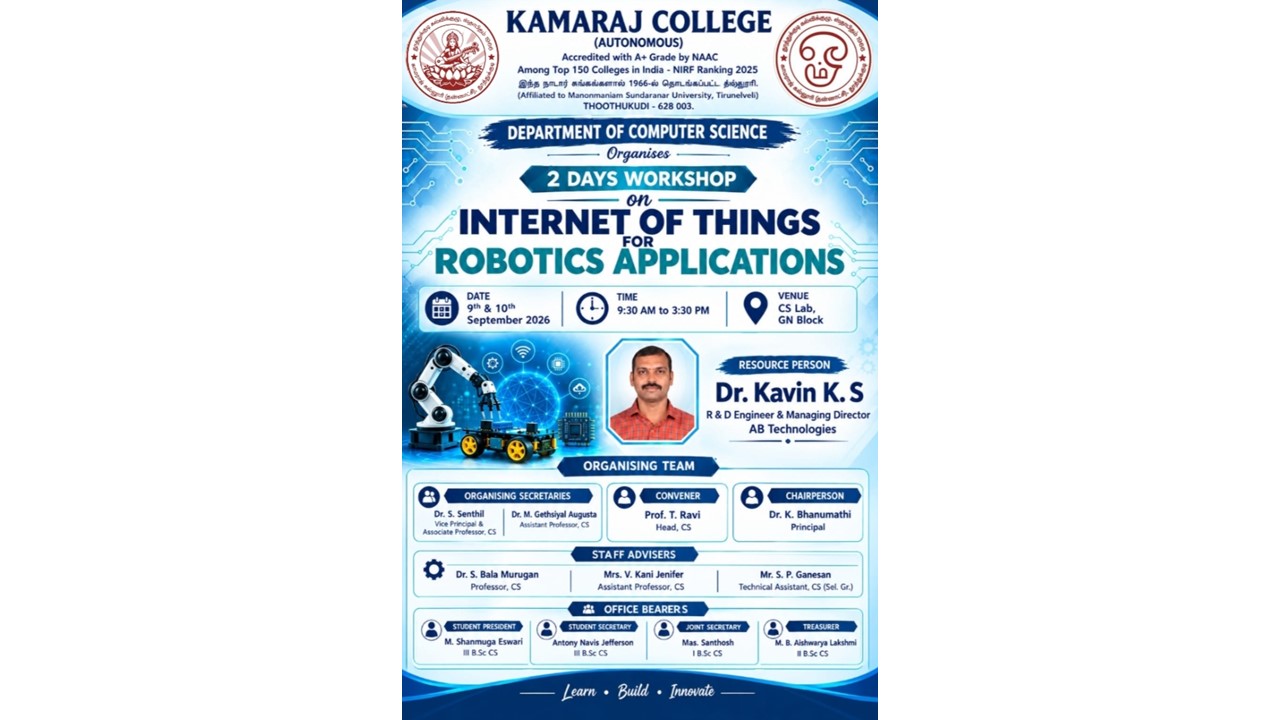
IoT Robotics Workshop: Powerful 2-Day Hands-On Training
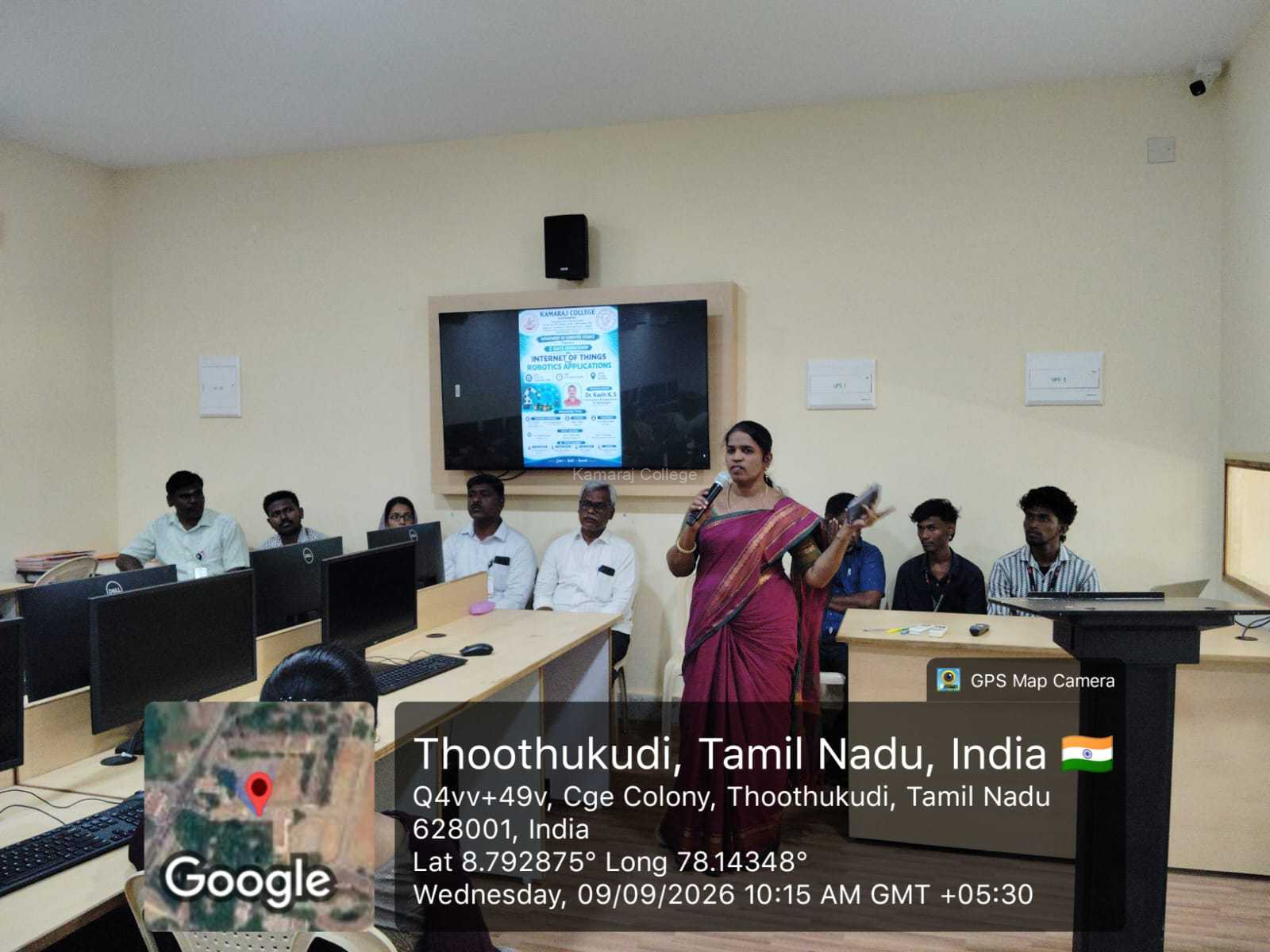
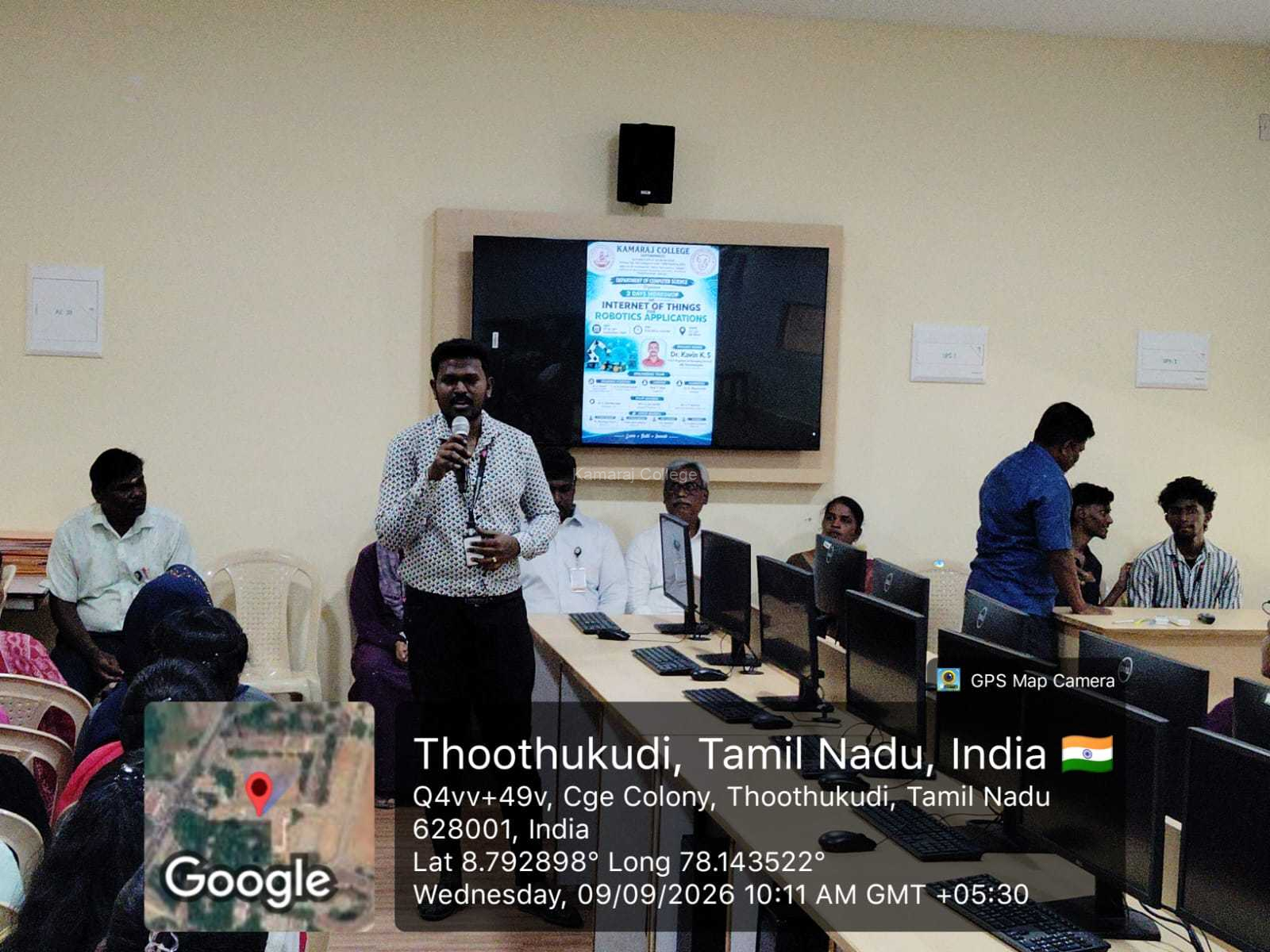
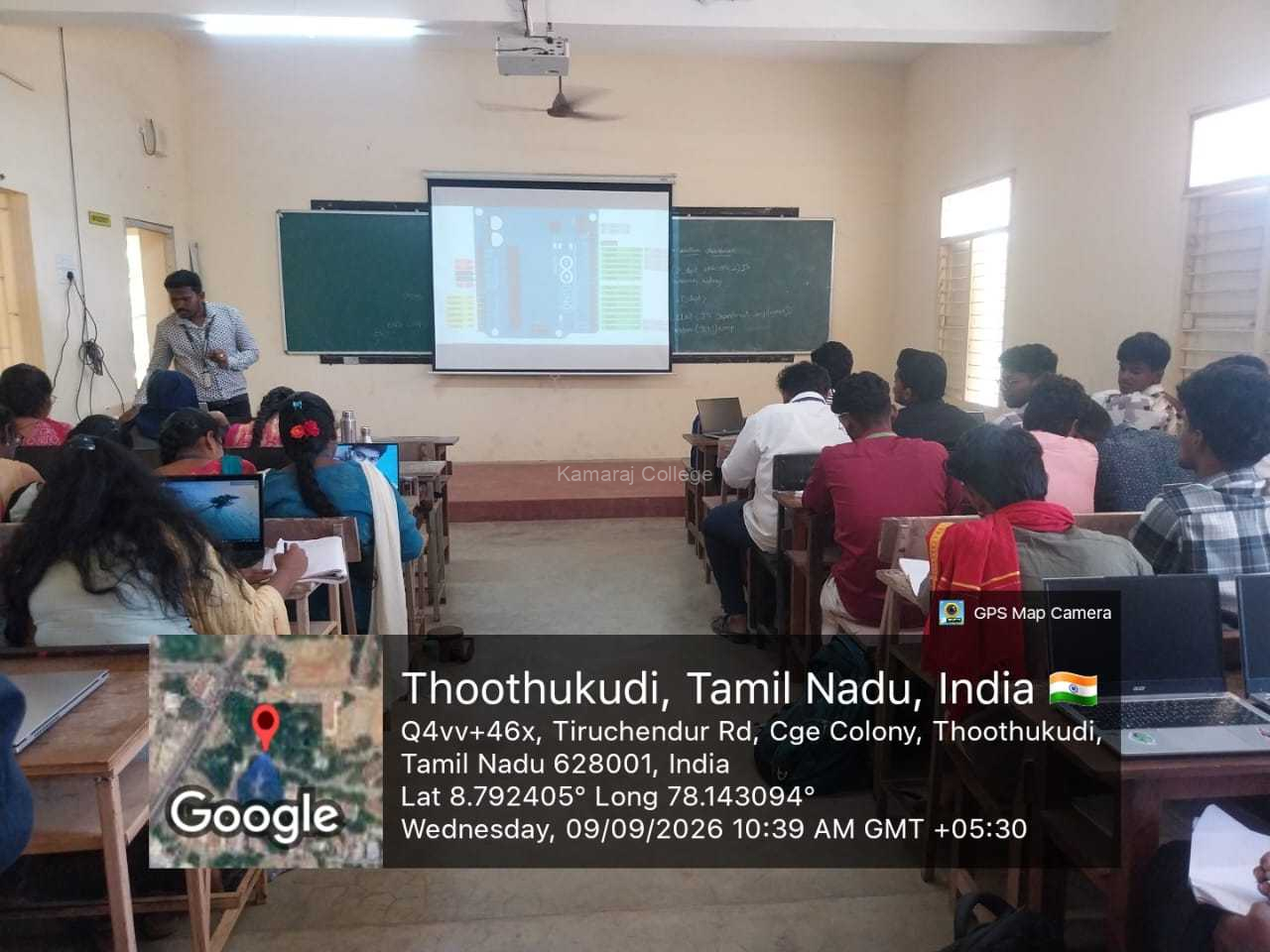
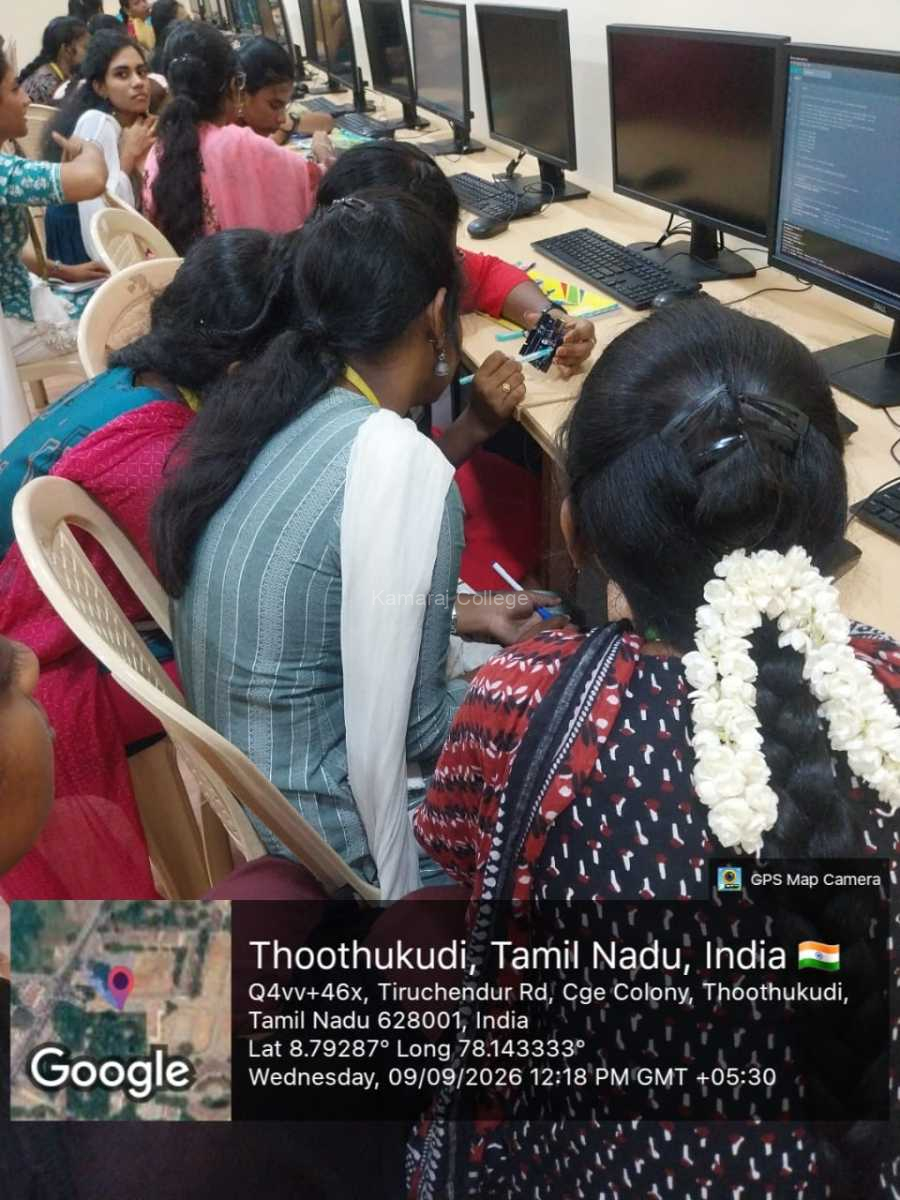
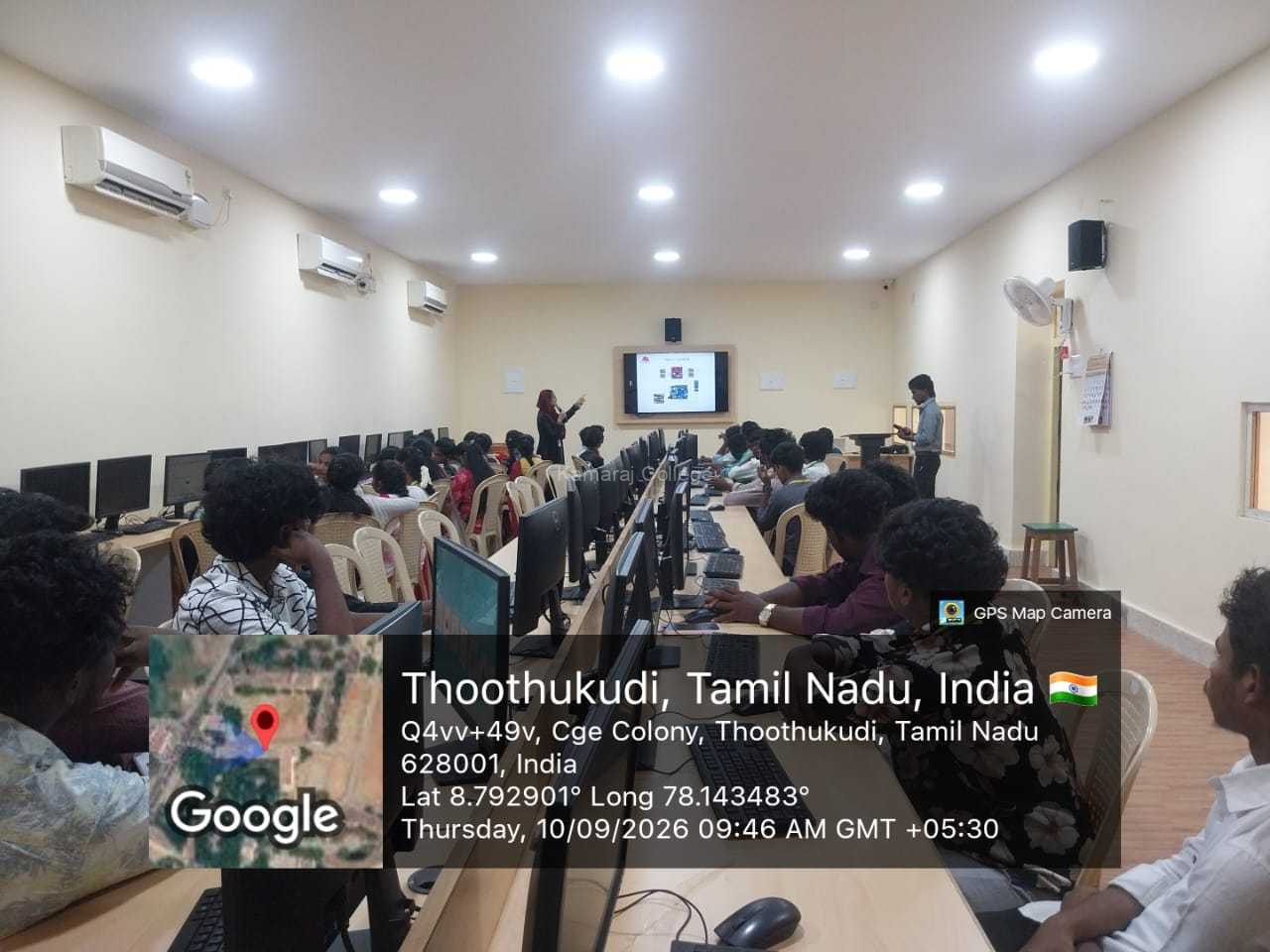
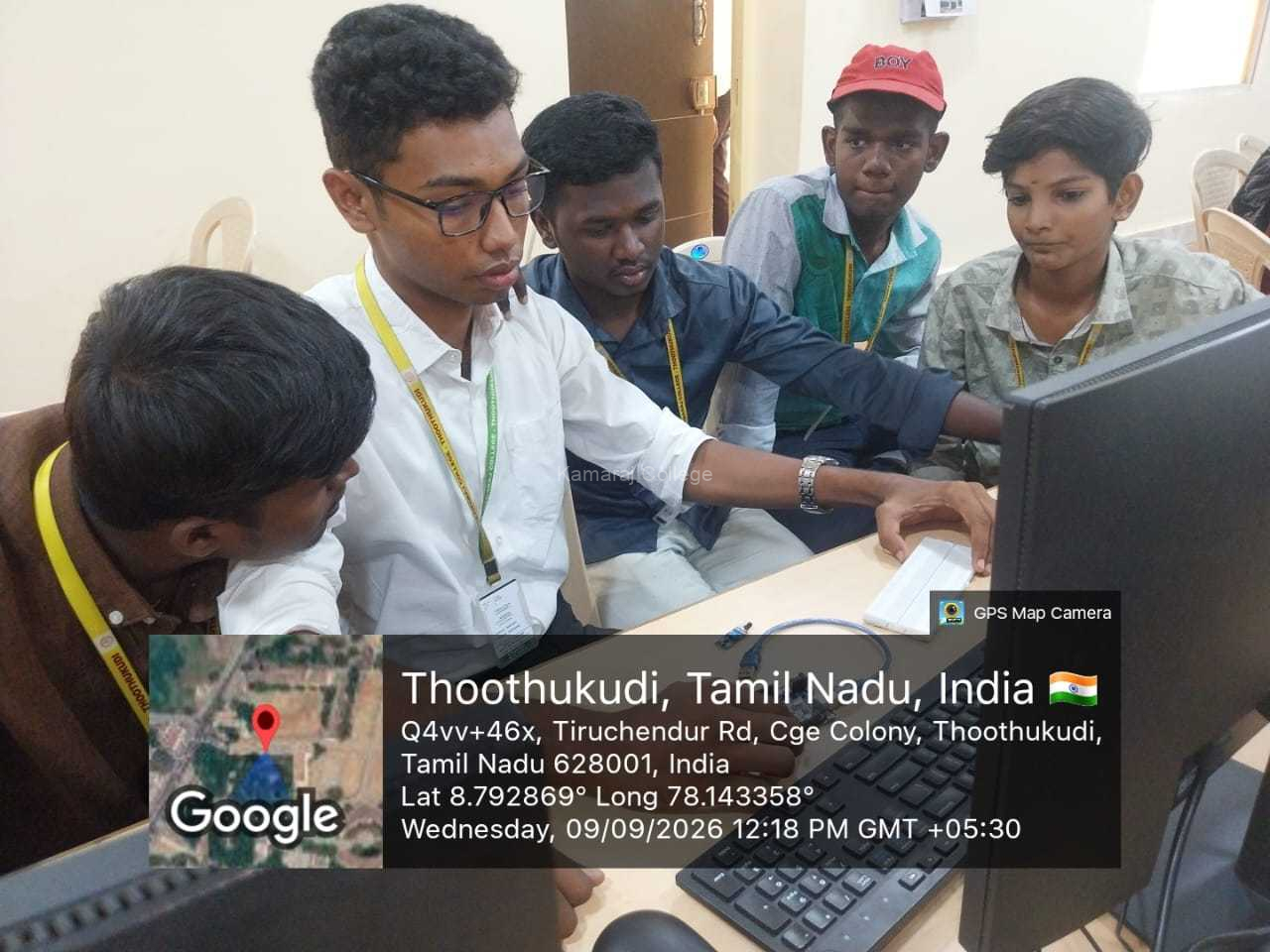
IoT Robotics Workshop on “Internet of Things for Robotics Applications” was organised by the Research Department of Computer Science, Kamaraj College (Autonomous), Thoothukudi, on 9 and 10 September 2026. The two-day workshop was conducted from 9.30 a.m. to 3.30 p.m. at the CS Lab, GN Block, and provided around 90 students of II and III B.Sc. Computer Science with theoretical knowledge and practical exposure to Internet of Things (IoT), sensors, Arduino, Bluetooth communication and robotics applications.
The technical and practical sessions were conducted by resource persons from AB Technologies. Through demonstrations and hands-on activities, students learned how IoT concepts, sensors, programming and electronic components can be integrated into practical applications. A major highlight of the workshop was the hands-on development of a Bluetooth-controlled robotic car using Arduino.
IoT Robotics Workshop at Kamaraj College
The IoT Robotics Workshop was organised to introduce students to emerging technologies and provide practical experience in IoT and robotics.
The programme combined theoretical explanations with hands-on activities, enabling students to understand how software and hardware technologies work together in real-world applications.
The two-day format provided students with progressive learning, beginning with IoT and sensor applications on the first day and moving towards Arduino and robotic car development on the second day.
Objectives of the IoT Robotics Workshop
The workshop aimed to strengthen students’ technical knowledge and practical skills in emerging technologies.
The major objectives were:
- Introduce the fundamentals of Internet of Things
- Provide practical exposure to IoT applications
- Develop an understanding of different sensors
- Provide hands-on experience with Water Level Sensors
- Introduce Ultrasonic Sensor applications
- Develop basic knowledge of Arduino
- Introduce students to robotics concepts
- Explain Bluetooth-based wireless communication
- Provide hands-on experience in robotic car development
- Integrate programming with hardware components
- Encourage practical problem-solving skills
- Prepare students for emerging technology applications
Guidance and Organisation
The workshop was organised under the guidance of Dr. K. Bhanumathi, Principal, and Prof. T. Ravi, Head of the Department of Computer Science.
The Organising Secretaries were:
- Dr. S. Senthil – Vice Principal and Associate Professor, Department of Computer Science
- Dr. M. Gethsiyal Augusta – Assistant Professor, Department of Computer Science
The workshop was conducted with the support and guidance of the faculty members and student office bearers of the Department of Computer Science.
Technical Support from AB Technologies
The resource persons from AB Technologies conducted the technical and practical sessions throughout the two-day workshop.
Their sessions helped students understand the practical implementation of IoT, sensors, Arduino, Bluetooth and robotics.
The industry-oriented technical interaction enabled participants to move beyond theoretical concepts and gain direct experience with hardware components and practical applications.
Day 1 – Introduction to Internet of Things
The first day of the IoT Robotics Workshop was conducted on 9 September 2026.
The programme began with the Master of Ceremonies by M. B. Aishwarya Lakshmi, II B.Sc. Computer Science.
This was followed by the Welcome Address delivered by M. Shanmuga Eswari, III B.Sc. Computer Science.
The inaugural session provided an introduction to the objectives and technical focus of the workshop.
Departmental Address
Following the welcome address, Prof. T. Ravi, Head of the Department of Computer Science, delivered the departmental address.
He highlighted the importance of learning emerging technologies such as Internet of Things and Robotics.
The address encouraged students to strengthen their technical competencies and gain practical exposure to technologies that are increasingly relevant in modern computing and automation.
Introduction of Resource Persons
Dr. S. Senthil, Vice Principal and Associate Professor, Department of Computer Science, introduced the resource persons from AB Technologies to the participants.
The introduction prepared students for the technical sessions and highlighted the practical orientation of the workshop.
The resource persons subsequently conducted the technical demonstrations and hands-on activities.
Fundamentals of Internet of Things
The first technical session focused on the fundamentals of the Internet of Things (IoT).
Students were introduced to the basic concept of connecting devices and using sensors to collect and monitor data.
The resource persons explained how IoT technologies can enable physical devices to generate and communicate useful information.
Practical examples helped students understand the relevance of IoT in real-world applications.
Understanding Sensors
Sensors formed an important component of the first-day training.
The resource persons explained how sensors can detect changes or conditions and provide data that can be used by connected systems.
Students learned how sensor-generated information can be collected and monitored in practical applications.
The demonstrations helped participants connect theoretical IoT concepts with actual hardware.
Hands-On Training with Water Level Sensor
Students received hands-on experience with a Water Level Sensor.
Through the activity, they learned how a sensor can be used to detect and monitor the level of water.
The exercise provided a simple and practical example of how sensors can be integrated into monitoring applications.
It also enabled students to understand how physical conditions can be converted into data for further processing.
Hands-On Training with Ultrasonic Sensor
The students also worked with an Ultrasonic Sensor.
They learned how the sensor can be used to measure the distance between objects.
The practical demonstration helped students understand the basic working principle and potential applications of distance sensing.
The activity strengthened their understanding of how sensors can provide input for automated and robotic systems.
Developing a Simple Sensor Application
As part of the first-day practical session, students worked with their laptops and created a simple application using the sensors.
They learned how sensor data could be collected and displayed.
This activity enabled participants to understand the connection between hardware devices, sensor data and software applications.
The hands-on exercise made the IoT concepts more accessible and practical.
Real-Time Data and IoT Applications
The workshop explained how sensor data can be used in real-time applications.
Students understood that IoT systems depend on the interaction between sensing devices, data collection and software-based processing.
This knowledge helped them recognise the practical significance of IoT in monitoring and automation.
The first-day activities therefore established a strong foundation for the robotics sessions conducted on the following day.
Day 2 – Robotics and Arduino Applications
The second day of the IoT Robotics Workshop was conducted on 10 September 2026.
The sessions focused mainly on Robotics, Arduino and Bluetooth-based applications.
The resource persons introduced students to the basic concepts of robotics and explained how different hardware components can be integrated to create a functioning robotic system.
The practical orientation enabled students to understand robotics through direct experimentation.
Introduction to Arduino
Students were introduced to Arduino and its basic functions.
The resource persons explained the role of Arduino in controlling electronic and robotic components.
Students learned how a programmable controller can receive instructions and control connected hardware.
This provided them with a fundamental understanding of embedded control in robotics applications.
Arduino-Based Applications
The workshop demonstrated how Arduino can serve as the control unit for practical electronic projects.
Students gained exposure to connecting components with the Arduino board and understanding how programming instructions influence hardware behaviour.
This activity strengthened their understanding of the relationship between coding and physical computing.
It also prepared them for the robotic car development activity.
Bluetooth Communication
Bluetooth communication formed another important part of the second-day session.
Students learned how Bluetooth technology can be used for wireless communication with a robotic system.
The resource persons explained how commands can be transmitted wirelessly and received by the control system.
This helped participants understand the practical role of wireless communication in robotics applications.
Building a Robotic Car
A major highlight of the IoT Robotics Workshop was the hands-on development of a robotic car.
Students were provided with the necessary components and worked with:
- Arduino
- Bluetooth
- Motors
- Electronic Components
- Hardware Connections
- Control Mechanisms
The activity provided students with direct exposure to assembling and developing a functional robotic system.
Hands-On Robotic Car Development
Students actively participated in connecting the required components and working with the Arduino board.
They understood how different parts of the robotic car needed to function together as an integrated system.
The practical exercise encouraged students to apply their technical knowledge rather than simply observe demonstrations.
This active involvement made the workshop highly interactive and skill-oriented.
Bluetooth-Controlled Movement
Students learned how commands could be transmitted through Bluetooth to control the movement of the robotic car.
They understood how the Arduino board could process these commands and control the connected motors.
This activity demonstrated the integration of wireless communication, programming, electronics and mechanical movement.
It provided participants with a clear example of how multiple technologies combine in a robotics application.
Integration of Hardware and Programming
The practical sessions demonstrated the importance of integrating hardware with programming.
Students observed that a robotic system requires both physical components and appropriate control instructions.
By working directly with Arduino, sensors, Bluetooth and motors, participants gained a better understanding of this integration.
The experience helped bridge the gap between software knowledge and hardware implementation.
Practical Problem-Solving
Hands-on activities naturally encouraged students to apply problem-solving skills.
Connecting components, working with sensor inputs and developing a robotic system required careful observation and logical thinking.
Students gained experience in approaching practical technical tasks systematically.
Such activities can strengthen confidence in handling future projects involving IoT and robotics.
Emerging Technology Exposure
IoT and robotics are important areas within emerging technologies.
Exposure to these fields enables Computer Science students to understand how computing can interact with physical devices and automated systems.
The workshop introduced students to this broader technological environment through practical applications.
It also encouraged them to explore advanced areas of IoT, embedded systems and robotics in the future.
Experiential Learning
The IoT Robotics Workshop followed an experiential-learning approach.
Students did not merely listen to technical explanations. They worked directly with sensors, laptops, Arduino boards, Bluetooth communication and robotic components.
This approach enabled them to learn through experimentation and practical implementation.
Such hands-on learning can improve conceptual understanding and strengthen technical confidence.
Benefits for Computer Science Students
The workshop was particularly relevant to students of Computer Science because it demonstrated how programming can interact with physical hardware.
Students gained exposure to concepts extending beyond conventional software development.
They understood how computing technologies can be applied in automation, sensing, embedded systems and robotics.
This broadened their understanding of potential technical and career pathways.
Participation of Around 90 Students
Around 90 students from II and III B.Sc. Computer Science benefited from the two-day programme.
Their active participation in the technical and practical sessions contributed significantly to the success of the workshop.
Students worked with laptops, sensors and robotic components and gained direct exposure to IoT and robotics applications.
The large participation also reflected students’ interest in learning emerging technologies.
Technical Skills Developed
Through the workshop, students gained exposure to several important technical areas:
- Internet of Things Fundamentals
- Sensor Applications
- Water Level Detection
- Ultrasonic Distance Measurement
- Real-Time Data Collection
- Arduino Fundamentals
- Hardware Integration
- Bluetooth Communication
- Robotics Fundamentals
- Robotic Car Development
- Hardware and Software Integration
- Practical Problem-Solving
Day-Wise Workshop Highlights
Day 1 – 9 September 2026
- Master of Ceremonies by M. B. Aishwarya Lakshmi, II B.Sc. Computer Science
- Welcome Address by M. Shanmuga Eswari, III B.Sc. Computer Science
- Departmental Address by Prof. T. Ravi
- Introduction of resource persons by Dr. S. Senthil
- Introduction to Internet of Things
- Understanding sensor applications
- Hands-on training with Water Level Sensor
- Hands-on training with Ultrasonic Sensor
- Development of a simple sensor-based application using laptops
- Understanding collection and display of sensor data
Day 2 – 10 September 2026
- Introduction to Robotics
- Fundamentals of Arduino
- Introduction to Bluetooth Communication
- Understanding robotic hardware components
- Connecting Arduino, Bluetooth and motors
- Hands-on development of a robotic car
- Understanding Bluetooth-based control
- Integration of programming and hardware
- Practical testing of robotic movement
Programme Highlights
- Programme: Two-Day Workshop
- Title: Internet of Things for Robotics Applications
- Dates: 9 and 10 September 2026
- Time: 9.30 a.m. to 3.30 p.m.
- Venue: CS Lab, GN Block
- Organised by: Research Department of Computer Science
- Institution: Kamaraj College (Autonomous), Thoothukudi
- Participants: Around 90 Students
- Beneficiaries: II and III B.Sc. Computer Science Students
- Principal: Dr. K. Bhanumathi
- Head of the Department: Prof. T. Ravi
- Organising Secretary: Dr. S. Senthil, Vice Principal and Associate Professor
- Organising Secretary: Dr. M. Gethsiyal Augusta, Assistant Professor
- Technical Resource Team: AB Technologies
- Major Areas: IoT, Sensors, Arduino, Bluetooth and Robotics
- Major Hands-On Activity: Development of a Bluetooth-Controlled Robotic Car
Workshop Outcomes
The IoT Robotics Workshop achieved several significant learning outcomes.
Through the two-day programme, students:
- Understood the fundamentals of Internet of Things
- Learned how sensors are used in IoT applications
- Gained hands-on experience with Water Level Sensors
- Learned to use Ultrasonic Sensors for distance measurement
- Understood how sensor data can be collected and displayed
- Gained basic knowledge of Arduino
- Understood fundamental robotics concepts
- Learned how Bluetooth communication can control robotic systems
- Gained experience in connecting electronic components
- Developed a robotic car through hands-on activity
- Understood the integration of hardware and programming
- Strengthened practical problem-solving skills
- Gained exposure to emerging technologies
- Developed greater confidence in practical technical applications
Overall, the programme strengthened students’ technical knowledge, practical skills, problem-solving ability and understanding of IoT and robotics applications.
Student Feedback and Conclusion
The workshop concluded successfully with enthusiastic feedback from the students and a Vote of Thanks.
The IoT Robotics Workshop on “Internet of Things for Robotics Applications”, organised by the Research Department of Computer Science on 9 and 10 September 2026, provided around 90 II and III B.Sc. Computer Science students with valuable theoretical and hands-on learning.
The first day introduced participants to IoT, Water Level Sensors, Ultrasonic Sensors and sensor-based applications. The second day progressed to Arduino, Bluetooth communication and robotics, culminating in the practical development of a robotic car.
The resource persons from AB Technologies provided technical guidance throughout the workshop, enabling students to understand the practical integration of software and hardware.
The programme was successfully conducted under the guidance of Dr. K. Bhanumathi, Principal, and Prof. T. Ravi, Head of the Department of Computer Science, with Dr. S. Senthil and Dr. M. Gethsiyal Augusta serving as Organising Secretaries.
Overall, the workshop successfully transformed theoretical concepts into practical learning and strengthened students’ understanding of IoT, sensors, Arduino, Bluetooth communication and robotics while encouraging them to explore emerging technologies further.
Internal Link
- Explore Kamaraj College – Learn more about workshops, technical training and student development activities at Kamaraj College.
External Links
- Arduino – Explore Arduino hardware, software and learning resources for electronics and robotics applications.
- University Grants Commission – Explore higher education initiatives supporting skill development and experiential learning.