
Industrial Training 2026: Powerful 2-Day Chemistry Programme



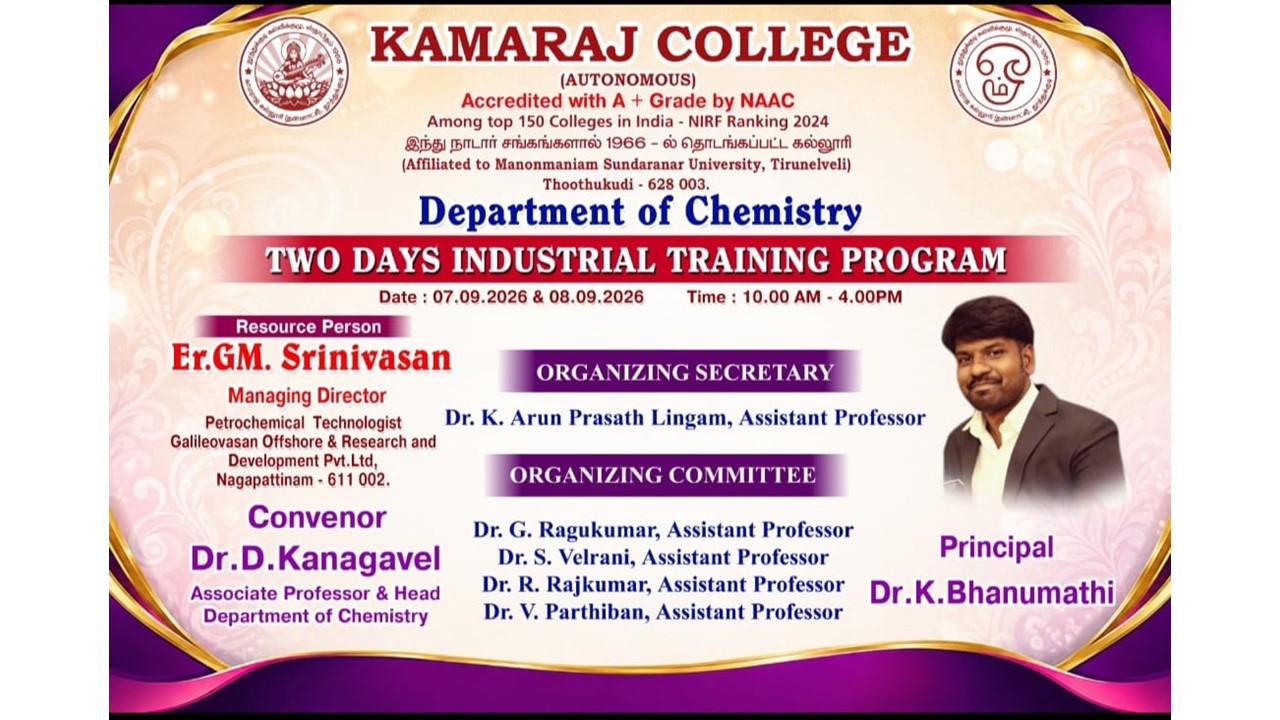
Industrial Training was organised by the Department of Chemistry, Kamaraj College, Thoothukudi, on 7 and 8 September 2026. The two-day programme provided students with practical exposure to industrial practices and helped them understand the application of chemistry in real-world industrial environments.
Two-Day Industrial Training Programme
The Industrial Training programme focused on bridging the gap between theoretical knowledge and practical industrial applications. It introduced students to industrial processes, laboratory practices, quality control, chemical safety, analytical techniques, professional skills and career opportunities.
The programme commenced with a welcome address by Siva Ranjani, I B.Sc. Chemistry.
The programme was inaugurated by the Chief Guest and Resource Person, Er. G. M. Srinivasan, Managing Director and Petrochemical Technologist, Galiliovasan Offshore and Research and Development Pvt. Limited, Nagapattinam.
His industry-oriented sessions provided students with valuable exposure to professional practices and the role of chemistry in industrial operations.
Objectives of the Industrial Training
The programme was organised to strengthen students’ practical understanding of chemistry and introduce them to industrial working environments.
The major objectives were:
- Provide practical exposure to industrial practices
- Connect theoretical chemistry with industrial applications
- Introduce students to industrial processes
- Develop awareness of laboratory practices
- Explain the importance of quality control
- Create awareness of chemical safety
- Introduce analytical techniques used in industry
- Develop professional skills among students
- Create awareness of career opportunities
- Improve students’ industry readiness
Thus, the training provided an effective combination of academic knowledge, practical exposure and career-oriented learning.
Inauguration of the Programme
The programme began with a welcome address by Siva Ranjani of I B.Sc. Chemistry.
The inaugural session introduced the objectives and significance of the two-day training programme.
Er. G. M. Srinivasan inaugurated the programme and interacted with the students as the Chief Guest and Resource Person.
His professional experience in the petrochemical sector added significant practical value to the training.
Resource Person
Er. G. M. Srinivasan, Managing Director and Petrochemical Technologist at Galiliovasan Offshore and Research and Development Pvt. Limited, Nagapattinam, served as the Resource Person.
He shared industry-oriented knowledge and helped students understand how chemistry is applied in professional and industrial environments.
The interaction also enabled students to gain insights into the skills, knowledge and professional approach required to work effectively in chemistry-related industries.
Understanding Industrial Processes
Industrial processes formed an important part of the Industrial Training.
Students were introduced to the practical application of chemical principles in industrial operations.
The sessions helped them understand that concepts studied in the classroom form the scientific foundation for many large-scale industrial processes.
This exposure enabled students to connect academic learning with real-world applications.
Laboratory Practices
The programme provided useful insights into laboratory practices followed in professional environments.
Students learned about the importance of accuracy, proper handling of materials, systematic procedures and responsible laboratory practices.
Professional laboratories require careful observation, precision and proper documentation.
Therefore, the training helped students understand how laboratory discipline contributes to reliable results and safe working conditions.
Importance of Quality Control
Quality control was another major area covered during the programme.
Students gained awareness of the importance of maintaining consistent standards in industrial production and laboratory operations.
Quality control helps ensure that products and processes meet required specifications.
The session enabled students to understand the role of chemistry professionals in testing, monitoring and maintaining product quality.
Chemical Safety
The programme emphasised the importance of chemical safety in industrial and laboratory environments.
Safe handling of chemicals is essential for protecting employees, equipment and the surrounding environment.
Students gained awareness of responsible laboratory behaviour and the importance of following established safety procedures.
The training therefore encouraged students to develop a safety-conscious approach while working with chemicals.
Analytical Techniques
The students were also introduced to the importance of analytical techniques in industrial chemistry.
Analytical methods play a major role in identifying substances, evaluating quality and monitoring industrial processes.
The sessions helped students understand how the analytical concepts learned during their academic programme are relevant to industrial operations.
This exposure strengthened their understanding of the practical importance of analytical chemistry.
Connecting Theory with Industrial Applications
One of the major benefits of the Industrial Training was the opportunity to connect theoretical learning with practical applications.
Students study several chemical concepts, reactions, analytical methods and laboratory procedures as part of their curriculum.
However, industrial exposure helps them understand how these principles are applied in professional settings.
The programme therefore helped bridge the gap between classroom learning and industrial practice.
Professional Skills Development
The training also focused on the professional skills required for employment.
Technical knowledge is important for chemistry graduates. At the same time, industries expect employees to demonstrate responsibility, communication abilities, adaptability, teamwork and professional discipline.
The sessions encouraged students to develop these competencies alongside their academic knowledge.
Such skills can improve their readiness for future employment and professional responsibilities.
Career Opportunities in Chemistry
Career awareness formed an important part of the programme.
The students gained insights into opportunities available in chemistry-related industries and professional environments.
Industrial chemistry offers career possibilities in areas such as production, laboratories, quality control, testing, analysis, research and development.
Therefore, the programme encouraged students to explore career paths that match their interests and academic strengths.
Interactive Learning
Students actively participated in the discussions conducted during the two-day programme.
The interactive approach allowed them to clarify their doubts and gain a better understanding of industrial practices.
Interaction with an experienced professional also provided perspectives that complement regular classroom instruction.
As a result, the programme created an engaging and practical learning environment.
Industry Readiness
The Industrial Training helped students understand the expectations of professional workplaces.
Industrial readiness requires a combination of subject knowledge, practical understanding, safety awareness and professional skills.
The sessions encouraged students to prepare themselves systematically for future career opportunities.
Furthermore, the programme highlighted the importance of continuous learning in adapting to developments in science and industry.
Guidance and Coordination
The programme was conducted under the guidance of Dr. D. Kanagavel, Convener.
Dr. K. Arun Prasad Lingam served as the Organizing Secretary and contributed to the successful coordination of the programme.
The coordinated efforts of the Department ensured that students received meaningful practical and career-oriented exposure during the two days.
Key Areas Covered
The programme focused on:
- Industrial Processes
- Laboratory Practices
- Quality Control
- Chemical Safety
- Analytical Techniques
- Industrial Applications of Chemistry
- Professional Skills
- Industry Readiness
- Career Opportunities
- Practical Application of Academic Knowledge
These areas helped students gain a broader understanding of the relationship between chemistry education and industrial practice.
Programme Highlights
- Programme: Two-Day Industrial Training Programme
- Dates: 7 and 8 September 2026
- Organised by: Department of Chemistry
- Institution: Kamaraj College, Thoothukudi
- Chief Guest & Resource Person: Er. G. M. Srinivasan
- Designation: Managing Director and Petrochemical Technologist
- Organisation: Galiliovasan Offshore and Research and Development Pvt. Limited, Nagapattinam
- Welcome Address: Siva Ranjani, I B.Sc. Chemistry
- Convener: Dr. D. Kanagavel
- Organizing Secretary: Dr. K. Arun Prasad Lingam
- Vote of Thanks: Muthushankar, II B.Sc. Chemistry
Learning Outcomes
The Industrial Training provided several valuable learning outcomes.
Through the programme, students:
- Gained practical exposure to industrial practices
- Understood the application of chemistry in industry
- Developed awareness of industrial processes
- Learned about professional laboratory practices
- Understood the importance of quality control
- Developed greater awareness of chemical safety
- Gained insights into analytical techniques
- Understood the importance of professional skills
- Explored chemistry-related career opportunities
- Connected theoretical learning with real-world applications
Overall, the training strengthened students’ practical knowledge, professional awareness and readiness for future career opportunities.
Conclusion
The Industrial Training organised by the Department of Chemistry, Kamaraj College, Thoothukudi, on 7 and 8 September 2026 provided students with meaningful practical and industry-oriented learning.
The sessions on industrial processes, laboratory practices, quality control, chemical safety, analytical techniques, professional skills and career opportunities enabled students to understand the practical relevance of their academic knowledge.
The active participation of the students made the programme interactive and effective. The training also helped them understand the professional expectations and opportunities available in chemistry-related industries.
The two-day programme was successfully conducted under the guidance of Dr. D. Kanagavel, Convener, and Dr. K. Arun Prasad Lingam, Organizing Secretary.
The programme concluded with a vote of thanks by Muthushankar, II B.Sc. Chemistry.
Overall, the training successfully bridged the gap between theoretical chemistry and industrial applications while enhancing students’ practical knowledge, safety awareness, professional skills and career readiness.
Internal Link
External Links
- University Grants Commission – Explore initiatives related to higher education, skill development and academic quality.
- Ministry of Education, Government of India – Explore national initiatives supporting higher education and skill development.