
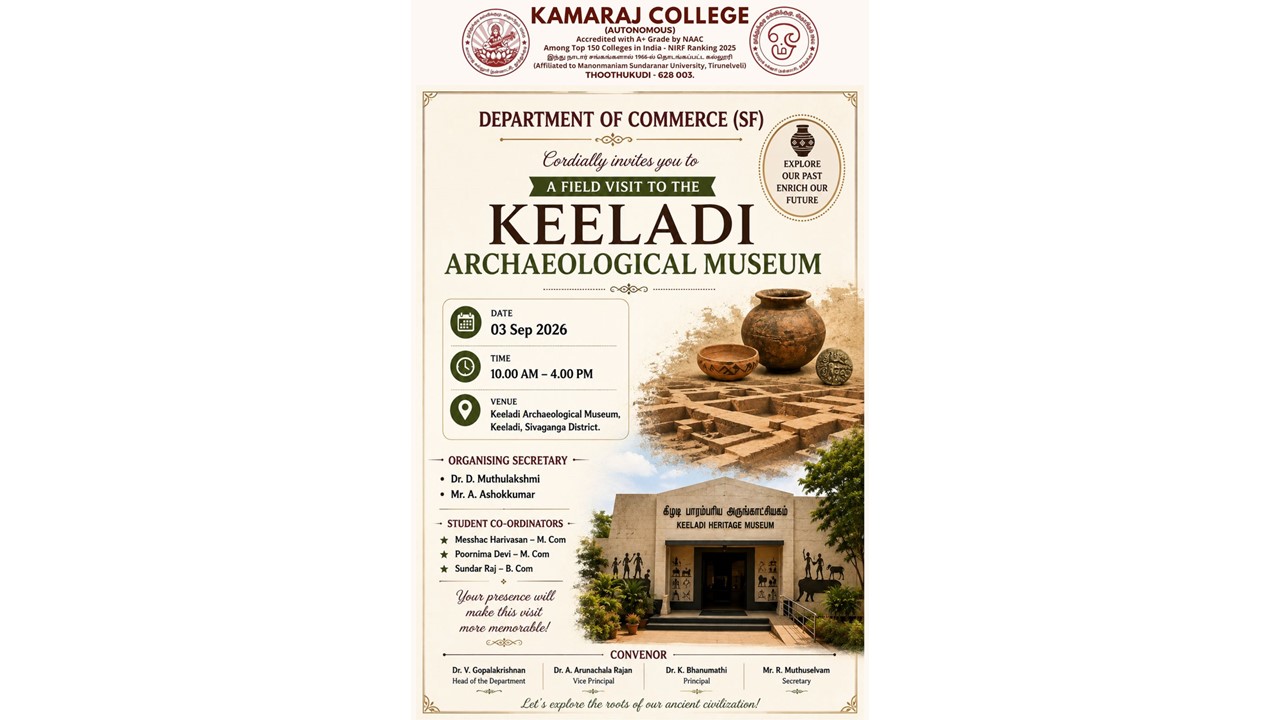
Keeladi Field Visit 2026: Inspiring Heritage Learning for 47 Commerce Students
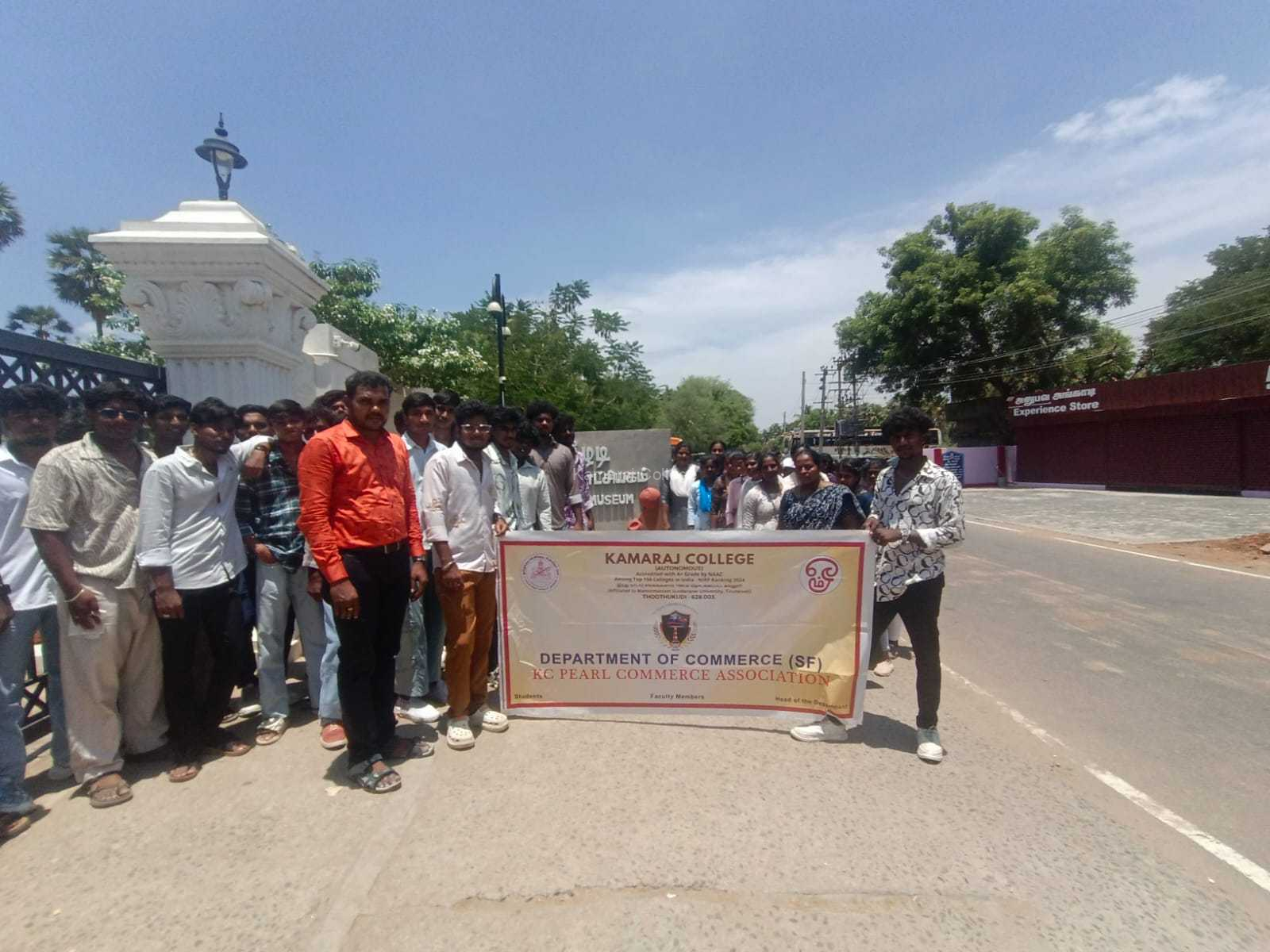
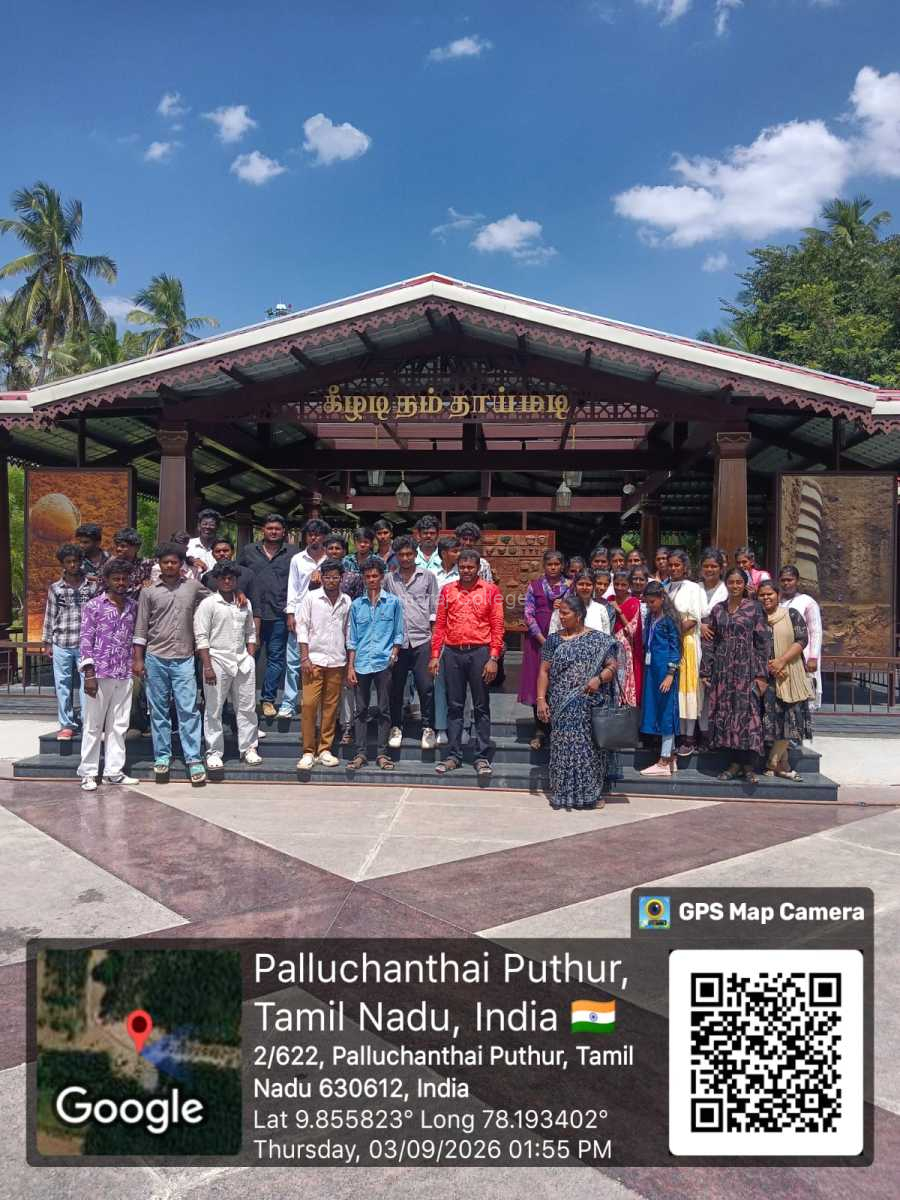
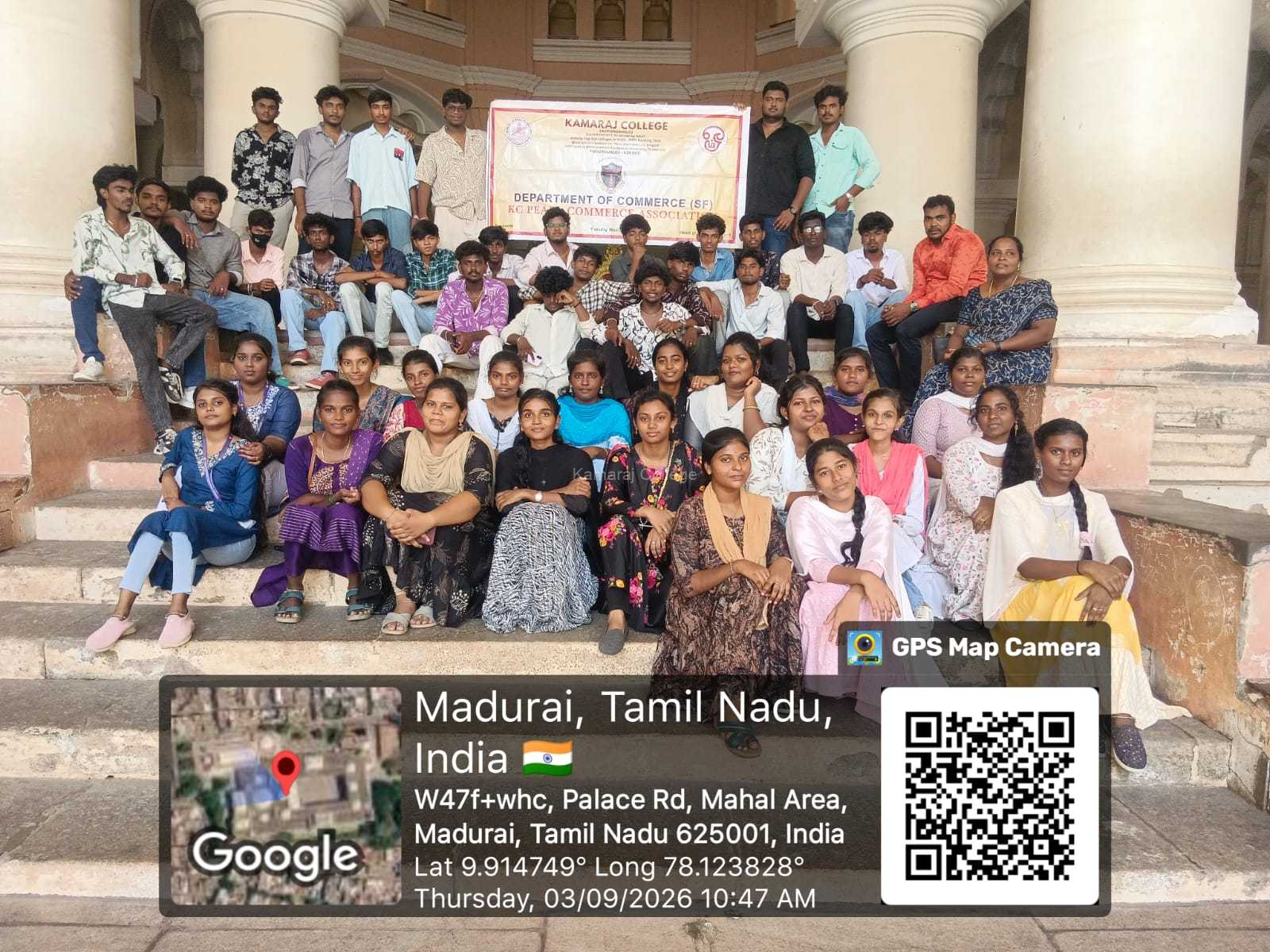
Report on Educational Field Visit to Keeladi
Keeladi Field Visit was organised by the Department of Commerce (SF), Kamaraj College (Autonomous), Thoothukudi, on 3 September 2026 for the students of II B.Com A and I B.Com B.
A total of 47 students, comprising 21 girls and 26 boys, accompanied by two faculty members, participated in the educational tour.
The students departed from the Kamaraj College campus at 6.00 a.m. The itinerary included three important historical and cultural destinations: Thirumalai Nayak Mahal, Madurai, Keeladi Archaeological Museum and Alagar Koyil.
The educational visit provided students with valuable experiential learning and helped them understand the historical, archaeological and cultural richness of Tamil Nadu.
Furthermore, the programme encouraged teamwork, discipline, social interaction and appreciation of cultural heritage. After completing all the scheduled visits, the students and faculty members safely returned to the college campus at 9.20 p.m.
Objectives of the Educational Field Visit
The field visit aimed to provide students with learning experiences beyond the classroom and expose them directly to important historical and cultural sites.
The major objectives were:
- Provide experiential learning beyond the classroom
- Create awareness of Tamil Nadu’s historical heritage
- Introduce students to archaeological evidence of ancient Tamil civilisation
- Develop appreciation for architecture and cultural heritage
- Encourage observation and inquiry-based learning
- Connect academic learning with real-world experiences
- Promote teamwork and cooperation
- Develop discipline and responsibility
- Encourage positive social interaction among students
- Strengthen awareness of the importance of heritage preservation
Thus, the visit combined educational exposure with cultural learning and student development.
Participation in the Field Visit
The Keeladi Field Visit involved 47 students from II B.Com A and I B.Com B.
The group consisted of:
- 21 Girls
- 26 Boys
- 47 Students in Total
- Two Accompanying Faculty Members
The participation of students from two classes created opportunities for interaction and collective learning.
Furthermore, travelling and learning together encouraged cooperation, responsibility and teamwork among the participants.
Departure from Kamaraj College
The students and accompanying faculty members departed from the Kamaraj College campus at 6.00 a.m.
The early departure enabled the group to follow the planned itinerary and visit all the scheduled destinations.
Educational tours require punctuality and coordination from every participant. Therefore, the journey itself provided students with practical experience in discipline, time management and collective responsibility.
Visit to Thirumalai Nayak Mahal
The first destination was Thirumalai Nayak Mahal, Madurai.
The visit provided students with an opportunity to observe the historical significance and architectural excellence of the monument.
Seeing an important heritage structure directly offers a different learning experience from reading about history through textbooks or other sources.
Students were able to observe architectural features and understand the importance of preserving historical monuments.
The visit therefore provided a meaningful introduction to the day’s heritage learning activities.
Understanding Architectural Heritage
The visit to Thirumalai Nayak Mahal encouraged students to appreciate architecture as an important part of cultural history.
Historical buildings can reveal information about the artistic traditions, construction practices and cultural environment of earlier periods.
By observing the monument directly, students gained a better understanding of how architectural heritage contributes to our knowledge of the past.
Moreover, such visits encourage young people to recognise the need to protect historical structures for future generations.
Visit to Keeladi Archaeological Museum
The students then proceeded to the Keeladi Archaeological Museum, an important destination of the educational tour.
The museum provided students with valuable exposure to archaeological artefacts and exhibits connected with ancient Tamil civilisation.
Students explored the displays and gained insights into the culture, material life and way of life of people in the past.
The museum experience helped transform archaeological history from an abstract subject into a visible and engaging learning experience.
Exploring Ancient Tamil Civilisation
A major learning outcome of the Keeladi Field Visit was greater awareness of ancient Tamil civilisation.
Archaeological discoveries provide material evidence that helps researchers understand earlier societies.
Museum exhibits enable students to see how archaeology contributes to the reconstruction and interpretation of the past.
Therefore, the visit helped participants appreciate the importance of archaeological research in understanding Tamil history and cultural development.
Learning Through Archaeological Artefacts
The artefacts and exhibits at the museum offered students an opportunity to understand history through physical evidence.
Objects recovered through archaeological research can provide valuable information about daily life, occupations, craftsmanship, social practices and cultural development.
Observing such exhibits directly encouraged students to think about how historians and archaeologists use material evidence to understand earlier communities.
Thus, the museum visit promoted curiosity and observation-based learning.
Understanding Culture and Way of Life
The museum exhibits helped students gain a broader understanding of the culture and way of life associated with ancient Tamil society.
Cultural heritage includes more than monuments. It also includes material objects, practices, artistic expressions and evidence of everyday life.
The visit therefore enabled students to appreciate history from a wider perspective.
Furthermore, it encouraged them to recognise the depth and continuity of Tamil cultural heritage.
Importance of Archaeology
The educational visit also introduced students to the importance of archaeology in understanding human history.
Archaeological research uses physical evidence to examine how people lived in earlier periods.
Museums then help preserve and present such evidence for education and public understanding.
The Keeladi Archaeological Museum therefore provided students with an opportunity to understand the connection between excavation, research, preservation and public education.
Experiential Learning at Keeladi
The Keeladi Field Visit demonstrated the value of experiential learning.
Classroom education provides students with concepts and information. However, field visits allow them to observe places, artefacts and cultural environments directly.
This combination can make learning more meaningful and memorable.
The students were able to connect what they observed with their broader understanding of society, culture and history.
Visit to Alagar Koyil
After lunch, the students visited Alagar Koyil, another important historical and cultural landmark.
The visit provided an opportunity to observe its architectural and heritage significance.
The students experienced another dimension of Tamil Nadu’s cultural landscape and gained greater appreciation for the diversity of heritage sites in the region.
The visit complemented their earlier experiences at Thirumalai Nayak Mahal and Keeladi Archaeological Museum.
Appreciating Cultural Heritage
The three destinations offered different perspectives on heritage.
Thirumalai Nayak Mahal introduced students to monumental architecture and history. The Keeladi Archaeological Museum provided archaeological insights into ancient Tamil civilisation. Meanwhile, Alagar Koyil offered exposure to historical, architectural and cultural heritage.
Together, these experiences enabled students to understand heritage as a combination of history, archaeology, architecture and living cultural traditions.
Connecting Classroom Learning with Real-World Experience
One of the major benefits of the programme was its ability to connect academic learning with real-world experiences.
Students often encounter history, society and culture through books, lectures and digital resources.
A field visit provides a different form of learning because students can observe places and objects directly.
Therefore, the educational tour helped participants develop a broader perspective and encouraged them to learn through observation and experience.
Relevance for Commerce Students
Although the participants were Commerce students, exposure to history and cultural heritage contributes to holistic education.
Commerce education prepares students to understand organisations, society and economic activity. However, broader awareness of history and culture helps them develop a deeper understanding of the social environment in which institutions and economic activities operate.
Moreover, heritage sites are also connected with areas such as tourism, local economies, public administration, cultural industries and heritage management.
Therefore, the visit broadened the students’ learning beyond their core discipline.
Promoting Teamwork
The educational tour encouraged students to work together throughout the journey.
Travelling as a group requires cooperation, punctuality and mutual responsibility.
Students learned to coordinate with their classmates and accompanying faculty members while following the planned schedule.
Such experiences can strengthen teamwork and interpersonal relationships.
Furthermore, these qualities are important for students’ future academic and professional development.
Developing Discipline and Responsibility
Discipline played an important role in the successful completion of the field visit.
Students needed to follow instructions, maintain time schedules and behave responsibly at the heritage locations.
These experiences encouraged them to understand the importance of discipline outside the classroom.
Educational tours therefore provide opportunities to develop responsibility through practical experience.
Encouraging Social Interaction
The field visit also promoted healthy social interaction among students.
Travelling, observing and learning together created opportunities for participants to communicate and share their experiences.
Such interaction can strengthen relationships among students and create a more cooperative learning environment.
Moreover, collective educational experiences can contribute to confidence and interpersonal development.
Learning the Importance of Heritage Preservation
Visiting historical and archaeological sites can encourage students to recognise the importance of heritage preservation.
Historical monuments, archaeological artefacts and cultural landmarks provide valuable evidence about society and civilisation.
Protecting them ensures that future generations can also learn from and appreciate them.
Therefore, the field visit contributed to greater awareness of the collective responsibility to respect and preserve cultural heritage.
A Memorable Learning Experience
The combination of travel, observation and cultural exposure made the programme memorable for the participants.
Students visited three significant destinations in a single educational tour and experienced different dimensions of Tamil Nadu’s heritage.
The programme therefore offered more than recreation. It provided structured learning through direct exposure.
Such experiences can remain with students for a long time and encourage continued interest in history and culture.
Safe Return to the College Campus
After completing all the scheduled visits, the students and accompanying faculty members began their return journey.
The group safely returned to the Kamaraj College campus at 9.20 p.m.
The successful completion of the journey reflected effective coordination, cooperation and adherence to the planned schedule.
Thus, the educational field visit concluded safely after a full day of learning and exploration.
Places Visited
The educational tour covered three important destinations:
- Thirumalai Nayak Mahal, Madurai – Historical significance and architectural excellence
- Keeladi Archaeological Museum – Archaeological artefacts, ancient Tamil civilisation, culture and way of life
- Alagar Koyil – Historical, architectural and cultural significance
Each destination contributed a different dimension to the students’ understanding of Tamil Nadu’s rich heritage.
Key Learning Areas
The educational field visit focused on:
- Ancient Tamil Civilisation
- Archaeological Heritage
- Historical Architecture
- Tamil Culture and Heritage
- Experiential Learning
- Heritage Preservation
- Observation-Based Learning
- Teamwork
- Discipline
- Social Interaction
These learning areas contributed to the overall educational value of the programme.
Programme Highlights
- Programme: Educational Field Visit to Keeladi
- Date: 3 September 2026
- Organised by: Department of Commerce (SF)
- Institution: Kamaraj College (Autonomous), Thoothukudi
- Participating Classes: II B.Com A and I B.Com B
- Total Students: 47
- Girls: 21
- Boys: 26
- Accompanying Faculty Members: 2
- Departure: 6.00 a.m. from Kamaraj College campus
- Places Visited: Thirumalai Nayak Mahal, Keeladi Archaeological Museum and Alagar Koyil
- Return: 9.20 p.m. at Kamaraj College campus
- Major Focus: History, archaeology, architecture, Tamil culture and experiential learning
Programme Outcomes
The Keeladi Field Visit resulted in several valuable learning outcomes.
Through the educational tour, students:
- Gained direct exposure to important historical and cultural sites
- Developed greater awareness of ancient Tamil civilisation
- Explored archaeological artefacts and museum exhibits
- Understood the historical significance of Thirumalai Nayak Mahal
- Appreciated architectural and cultural heritage at Alagar Koyil
- Connected academic learning with real-world experiences
- Developed greater appreciation for Tamil Nadu’s cultural heritage
- Recognised the importance of heritage preservation
- Strengthened teamwork, discipline and responsibility
- Improved social interaction through collective learning
Overall, the programme successfully combined educational exposure, experiential learning and cultural awareness.
Conclusion
The Keeladi Field Visit organised by the Department of Commerce (SF), Kamaraj College (Autonomous), Thoothukudi, on 3 September 2026 was an informative, enriching and memorable educational experience.
A total of 47 students from II B.Com A and I B.Com B, comprising 21 girls and 26 boys, accompanied by two faculty members, participated in the programme.
The group departed from the college campus at 6.00 a.m. and first visited Thirumalai Nayak Mahal, Madurai, where students gained insights into its historical significance and architectural excellence.
They then visited the Keeladi Archaeological Museum and explored archaeological artefacts and exhibits that offered valuable insights into ancient Tamil civilisation, culture and way of life.
After lunch, the students visited Alagar Koyil and observed its historical, architectural and cultural significance.
Furthermore, the tour encouraged teamwork, discipline, responsibility and social interaction while helping students connect academic learning with direct real-world experiences.
After completing all the scheduled visits, the students and faculty members safely returned to the Kamaraj College campus at 9.20 p.m.
Overall, the educational field visit successfully fulfilled its objective of providing students with meaningful exposure to the historical, archaeological and cultural heritage of Tamil Nadu. It also strengthened their appreciation for the richness of Tamil civilisation and the importance of preserving heritage for future generations.
Internal Link
External Links
- Tamil Nadu Department of Archaeology – Explore information about archaeological excavations, museums and the heritage of Tamil Nadu.
- Archaeological Survey of India – Explore India’s archaeological heritage, monuments and heritage conservation initiatives.