
Silk Road of Ideas 2026: Fascinating Journey Across Ancient Civilizations


Report on Domain Club Programme – Historical Silk Road of Ideas
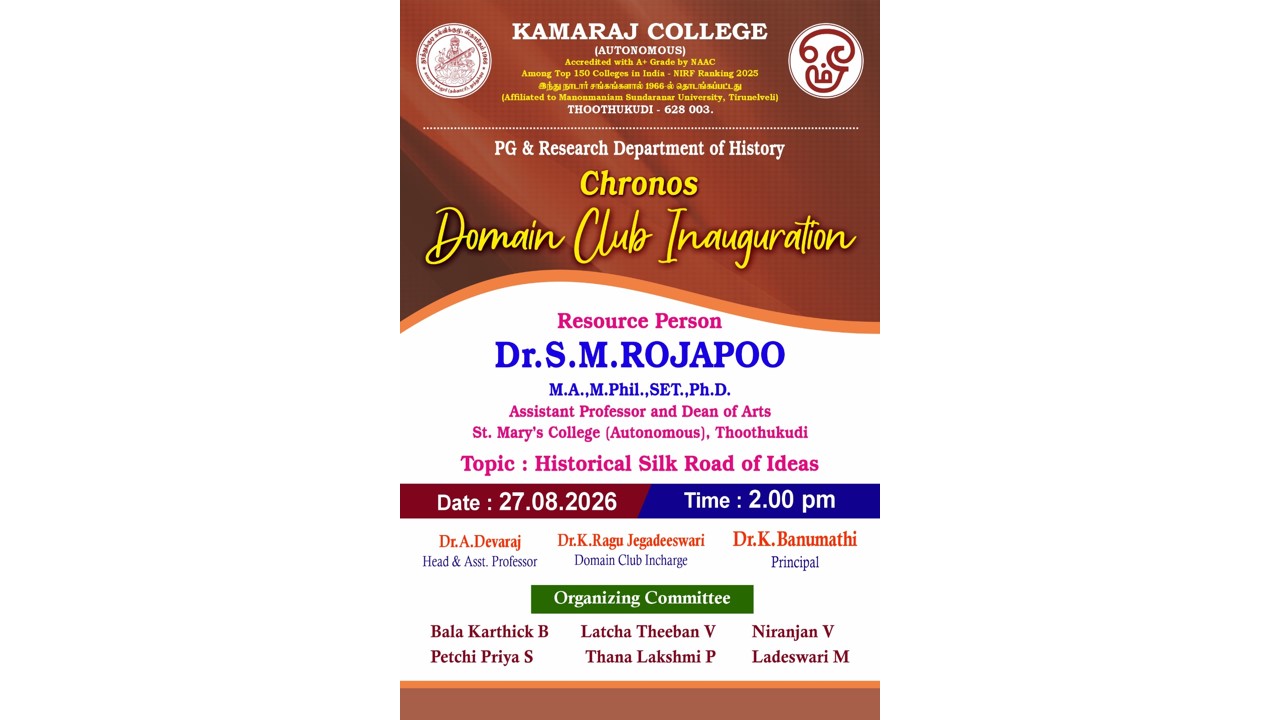
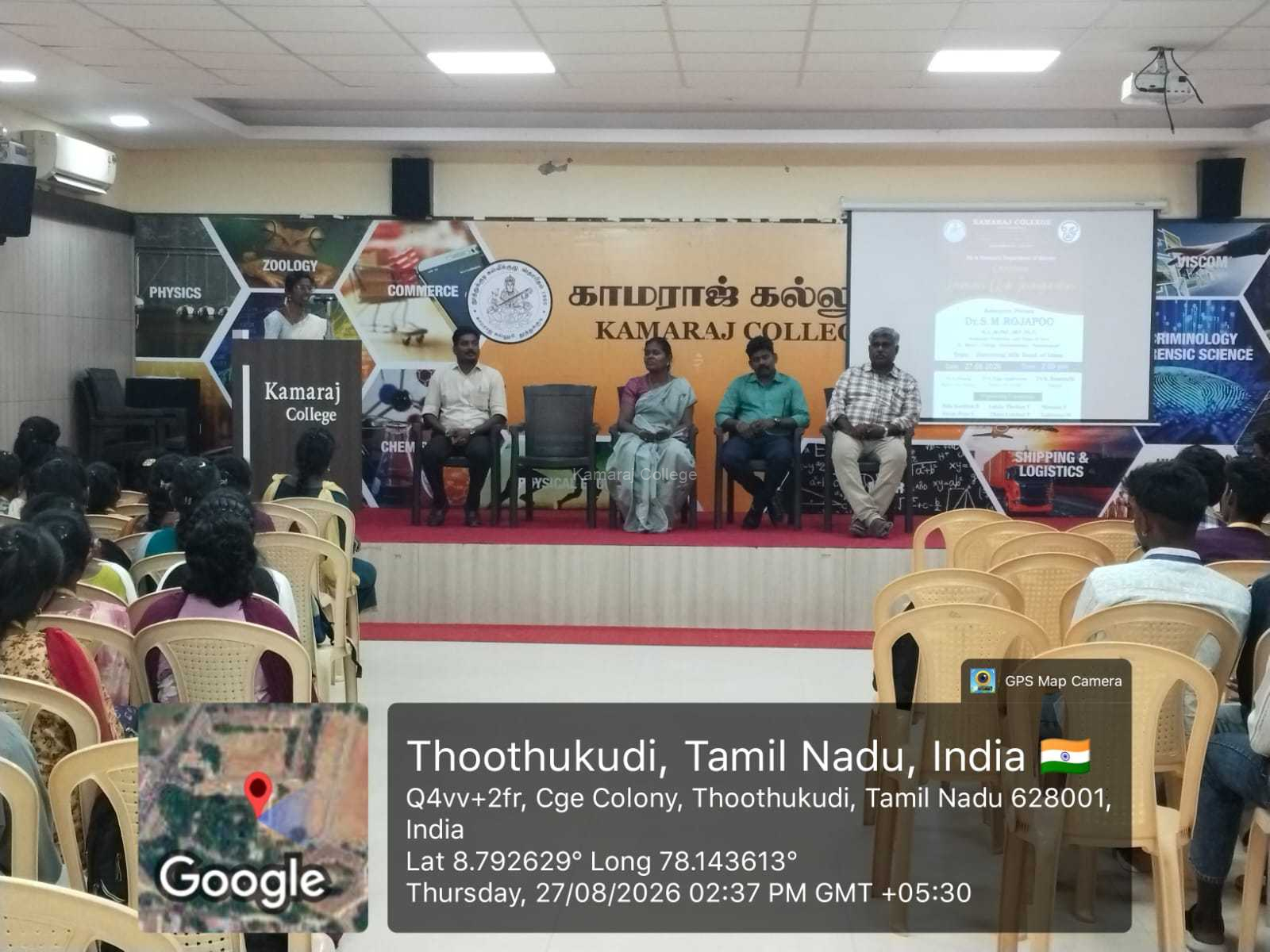
Silk Road of Ideas was the theme of an insightful programme organized by the Domain Club of the Department of History, Kamaraj College (Autonomous), Thoothukudi. The programme introduced students to the historical exchange of knowledge, culture, art, science and ideas among different civilizations.
The session explored how the ancient Silk Road connected societies across Asia, the Middle East and Europe. Moreover, it helped students understand that these routes played an important role not only in trade but also in the movement of knowledge, beliefs, technologies and cultural traditions.
Objectives of the Domain Club Programme
The Silk Road of Ideas programme aimed to broaden students’ understanding of historical connections among civilizations.
The major objectives included:
- Introduce students to the historical significance of the Silk Road
- Explain cultural exchanges among ancient civilizations
- Explore the movement of knowledge and ideas across regions
- Understand the role of trade in cultural interaction
- Examine the spread of religions and philosophies
- Understand the exchange of scientific and technological knowledge
- Highlight the importance of cultural interaction
- Encourage students to view history from a global perspective
Thus, the programme encouraged students to look beyond geographical boundaries and understand the interconnected nature of human history.
Welcome Address
The programme commenced with the welcome address delivered by Dr. A. Devaraj, Head of the Department.
He welcomed the Chief Guest, faculty members and students to the Domain Club programme. His address introduced the significance of the topic and set the stage for an engaging academic discussion.
Furthermore, the welcome address encouraged students to actively participate in the session and gain a deeper understanding of the historical connections created by the Silk Road.
Chief Guest – Dr. S. Rojappoo
Dr. S. Rojappoo, Assistant Professor of History and Dean of Arts, St. Mary’s College, Thoothukudi, graced the programme as the Chief Guest.
Dr. Rojappoo delivered an informative and engaging lecture on the importance of the Silk Road in connecting people and civilizations across vast geographical regions.
The session provided students with valuable historical perspectives and helped them understand how trade routes became powerful channels for interaction among diverse societies.
Understanding the Historical Silk Road
During the Silk Road of Ideas session, the Chief Guest explained the historical importance of the Silk Road as an extensive network of routes connecting different parts of the ancient world.
Merchants, travellers, scholars and explorers travelled along these routes and interacted with people from different cultural backgrounds.
Consequently, the Silk Road became much more than a commercial network. It developed into an important platform for the exchange of ideas, knowledge, beliefs and cultural practices.
Trade Across Ancient Civilizations
The session explained that trade remained an important driving force behind the development of the Silk Road.
Various commodities travelled through these routes, including:
- Silk
- Spices
- Precious stones
- Other valuable goods and commodities
However, commercial exchange also created opportunities for people from different civilizations to meet and interact.
As a result, merchants and travellers carried not only goods but also their languages, beliefs, customs, knowledge and ideas from one region to another.
A Route for the Exchange of Ideas
A central theme of the programme was that the Silk Road served as a significant route for intellectual and cultural exchange.
The Chief Guest explained how interaction among travellers, scholars and communities enabled knowledge to move across geographical boundaries.
The Silk Road of Ideas therefore represented the movement of human thought and creativity alongside physical trade.
Moreover, such exchanges contributed to the development and transformation of societies across different regions.
Spread of Religions and Philosophies
The Silk Road also played an important role in the spread of religious beliefs and philosophical ideas.
As people travelled between regions, they carried their religious traditions and worldviews with them. Interaction with different communities allowed these ideas to reach new societies.
The session helped students understand how historical contact between civilizations contributed to the movement and development of religious and philosophical traditions.
Exchange of Science and Technology
Another important aspect discussed during the programme was the exchange of scientific knowledge and technologies.
The ancient trade routes enabled communities to encounter new methods, inventions and ideas developed in distant regions. Therefore, knowledge could travel from one civilization to another and contribute to further development.
The discussion helped students recognise that scientific progress has often been shaped by the sharing and adaptation of knowledge across cultures.
Languages and Literature Across Borders
The Chief Guest also highlighted the role of the Silk Road in facilitating the movement of languages and literary traditions.
Continuous interaction among merchants, travellers and scholars encouraged communication across linguistic boundaries. Furthermore, stories, ideas and literary traditions travelled along with people.
This cultural interaction contributed to a richer intellectual environment and helped societies learn from one another.
Art and Cultural Traditions
Artistic traditions also travelled across the ancient routes.
Interactions among civilizations influenced art, cultural practices and creative expression. People encountered different artistic forms and adapted them according to their own social and cultural contexts.
Consequently, the Silk Road demonstrates how cultural interaction can influence creativity and produce new forms of expression.
Role of Merchants, Travellers and Scholars
The programme highlighted the important role played by people who travelled along the Silk Road.
They included:
- Merchants
- Travellers
- Scholars
- Explorers
These individuals acted as important links between different regions and civilizations.
Their journeys enabled them to carry information, knowledge and cultural practices from one place to another. Thus, human interaction played a central role in transforming trade routes into routes of intellectual exchange.
Connecting Asia, the Middle East and Europe
The Silk Road of Ideas session provided students with a broader understanding of the historical connections between Asia, the Middle East and Europe.
Rather than viewing ancient civilizations as isolated societies, students learned to understand them as interconnected communities that exchanged goods, knowledge and ideas.
This perspective encouraged participants to appreciate the global dimensions of history and recognise how developments in one region could influence societies elsewhere.
Importance of Cultural Exchange
The programme placed special emphasis on the value of cultural exchange.
When people from different societies interact, they gain opportunities to understand new perspectives and ways of life. Furthermore, such interactions can contribute to intellectual growth and greater mutual understanding.
The historical Silk Road provided a powerful example of how contact between cultures can influence social, intellectual and cultural development over long periods.
Key Learning Areas
The Domain Club programme covered several important historical themes:
- Origins and significance of the Silk Road
- Trade among ancient civilizations
- Exchange of knowledge and ideas
- Movement of religions and philosophies
- Spread of languages and literature
- Scientific and technological exchange
- Development of artistic traditions
- Role of merchants and travellers
- Connections between Asia, the Middle East and Europe
- Importance of intercultural understanding
Therefore, the programme enabled students to explore the Silk Road from economic, social, cultural and intellectual perspectives.
Programme Outcomes
The Silk Road of Ideas programme provided several valuable learning outcomes.
Through the session, students were able to:
- Understand the historical significance of the Silk Road
- Recognise the interconnected nature of ancient civilizations
- Understand how ideas travelled alongside goods
- Learn about cultural and intellectual exchanges
- Explore the historical movement of science and technology
- Understand the spread of religions and philosophies
- Develop a broader perspective on global history
- Appreciate the value of cultural exchange and mutual understanding
Overall, the session encouraged students to approach history as a study of connections, interactions and shared human experiences.
Vote of Thanks
The programme concluded with a vote of thanks proposed by Dr. K. Ragu Jegadeeswari, Department of History.
She expressed gratitude to Dr. S. Rojappoo for sharing valuable historical insights with the students. She also thanked the faculty members, organizers and participants for their contribution to the successful conduct of the programme.
Conclusion
Overall, the Silk Road of Ideas Domain Club programme was an informative, thought-provoking and enriching academic experience.
The insightful lecture by Dr. S. Rojappoo, Assistant Professor of History and Dean of Arts, St. Mary’s College, Thoothukudi, helped students understand that the historical Silk Road was much more than a network for commercial trade.
It served as an important channel through which religions, languages, philosophies, scientific knowledge, technologies, literature, art and cultural traditions travelled across civilizations.
Most importantly, the programme helped students understand the lasting influence of cultural and intellectual exchange in shaping human history. The session successfully broadened their historical perspective and reinforced the importance of knowledge sharing, cultural interaction and mutual understanding among societies.
Internal Link
External Links
- UNESCO Silk Roads Programme – Explore the history, cultures and exchange of knowledge associated with the Silk Roads.
- Ministry of Culture, Government of India – Explore India’s history, heritage and cultural traditions.