
6 Powerful Insights from Intellectual Property Rights Programme


Intellectual Property Rights Programme
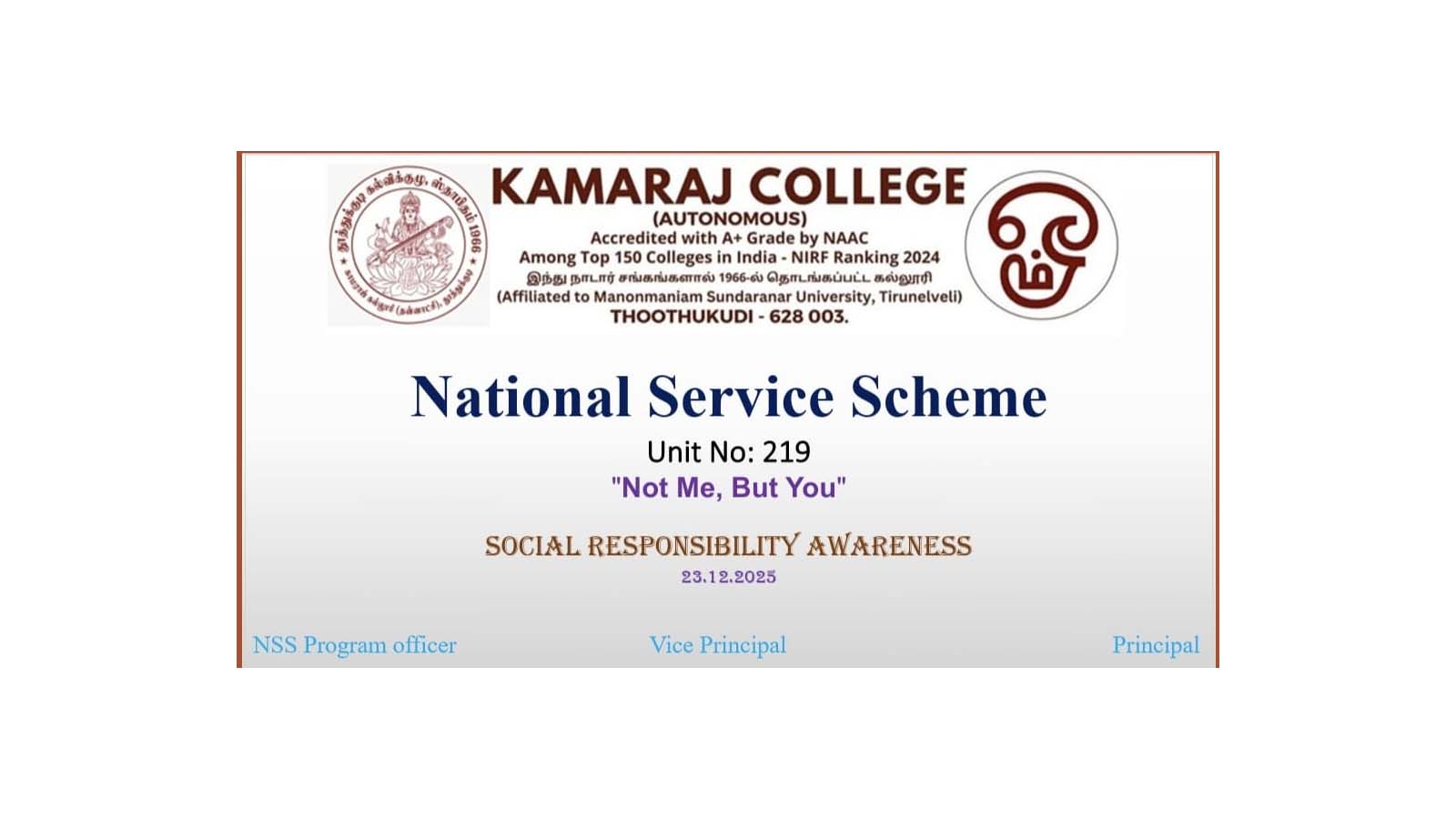
On 23 December 2025, National Service Scheme (NSS) Unit No. 219 of Kamaraj College (Autonomous), Thoothukudi successfully organized a Social Responsibility Programme on the topic of Intellectual Property Rights. The Intellectual Property Rights Programme was conducted from 04.00 p.m. to 05.30 p.m. at the Golden Jubilee Block on the college campus.
The Intellectual Property Rights Programme aimed to educate students about the protection of creative works and innovations while promoting ethical and responsible academic and professional practices.
Objectives of the Intellectual Property Rights Programme
The Intellectual Property Rights Programme was organized with the objective of creating awareness among students about the legal frameworks that protect intellectual creations. The programme focused on helping participants understand how intellectual property plays a vital role in innovation, research, and creative industries.
The key objectives included:
- Introducing the concept of Intellectual Property Rights
- Creating awareness about legal protection for creative works
- Encouraging ethical use of intellectual property
- Promoting respect for originality in academics and professions
Resource Person and Session Leadership
The Intellectual Property Rights Programme was handled by Mr. S. Dwarak, B.A. LL.B. student from Woxsen University, Hyderabad. With his academic background in law, he delivered a clear and engaging session tailored to students from diverse academic disciplines.
His ability to explain legal concepts in a simple and relatable manner made the Intellectual Property Rights Programme highly accessible and informative.
Introduction to Intellectual Property Rights
During the Intellectual Property Rights Programme, the resource person introduced the fundamental concept of intellectual property and its significance in today’s knowledge-driven society. He explained that Intellectual Property Rights safeguard creations of the mind, including inventions, literary works, artistic expressions, and brand identities.
He emphasized that understanding Intellectual Property Rights is essential for students who aspire to become researchers, entrepreneurs, writers, designers, and professionals.
Explanation of Patents, Copyrights, and Trademarks
A major highlight of the Intellectual Property Rights Programme was the detailed explanation of different types of intellectual property protections.
- Patents were explained as legal protections for inventions and innovations that offer technical solutions to problems.
- Copyrights were discussed in the context of protecting literary, artistic, musical, and academic works from unauthorized use.
- Trademarks were explained as symbols, logos, or brand names that distinguish products and services in the marketplace.
These explanations helped participants gain a clear understanding of how Intellectual Property Rights apply to real-world situations.
Ethical Use of Intellectual Property
The Intellectual Property Rights Programme strongly emphasized ethical practices in using intellectual creations. The resource person highlighted the importance of acknowledging original authors, avoiding plagiarism, and respecting copyright laws in academic writing and professional work.
Students were encouraged to adopt responsible behavior while using books, articles, software, and digital content, thereby fostering academic integrity.
Importance of Intellectual Property Rights in Academics
The Intellectual Property Rights Programme helped students understand how Intellectual Property Rights support academic growth and innovation. The session highlighted that respecting intellectual property encourages creativity, originality, and research excellence.
The programme also emphasized that knowledge of Intellectual Property Rights is increasingly important for higher studies, competitive examinations, startups, and research-based careers.
Student Participation and Learning Outcomes
Students actively participated in the Intellectual Property Rights Programme and showed keen interest in learning about legal protections for creative works. The session enhanced their basic knowledge and clarified misconceptions related to copyright and plagiarism.
The interactive nature of the programme encouraged students to ask questions and relate Intellectual Property Rights concepts to their academic disciplines.
Institutional Commitment to Social Responsibility
Kamaraj College (Autonomous) consistently promotes awareness programmes that extend beyond academic curricula. The Intellectual Property Rights Programme organized by NSS Unit No. 219 reflects the institution’s commitment to social responsibility and legal literacy.
More information about institutional initiatives can be accessed at:
Kamaraj College Official Website
External Learning Resources
To further enhance understanding of Intellectual Property Rights, students were encouraged to explore authoritative resources such as:
Intellectual Property India – Official Website
These resources provide updated information on patents, copyrights, and trademarks in India.
Conclusion
The Intellectual Property Rights Programme organized by NSS Unit No. 219 was informative, relevant, and impactful. It successfully created awareness about the importance of safeguarding intellectual creations and practicing ethical use of intellectual property.
The session enhanced students’ legal awareness and encouraged responsible academic and professional conduct. Overall, the Intellectual Property Rights Programme significantly contributed to student knowledge and social responsibility.